QUESTION IMAGE
Question
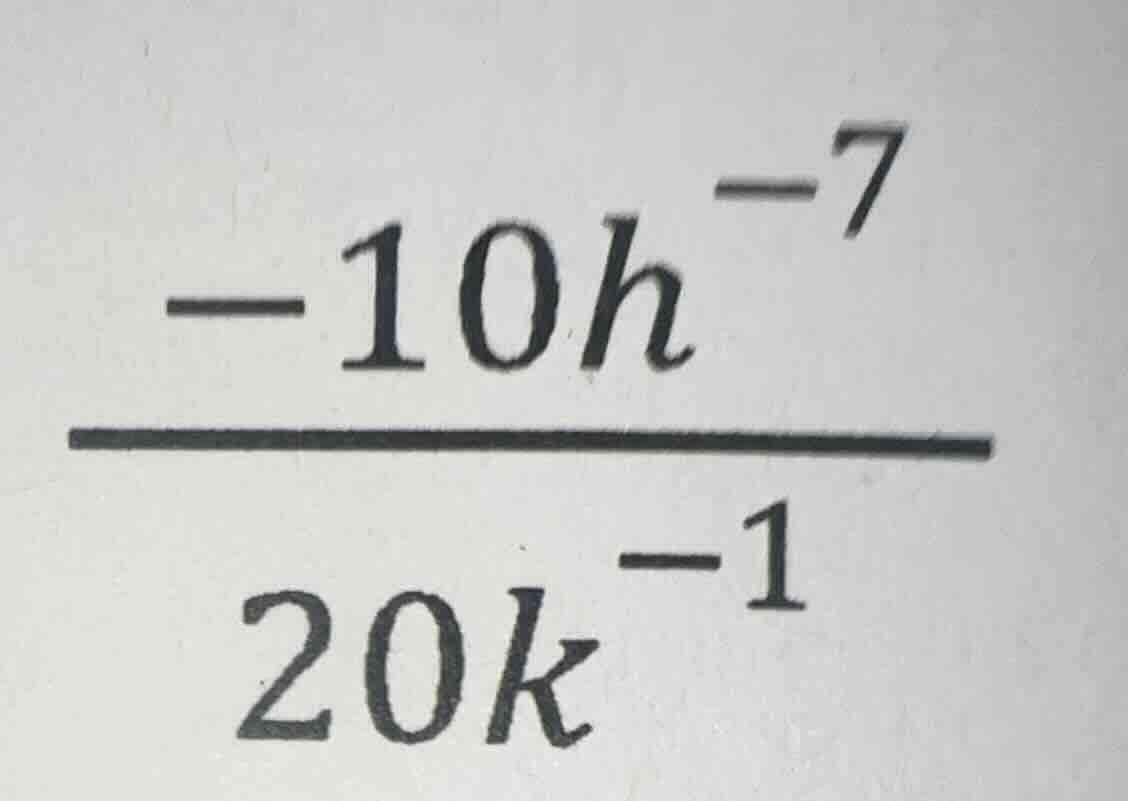
(\frac{-10h^{-7}}{20k^{-1}})
Step1: Simplify the coefficient
Simplify the fraction of the coefficients \(\frac{-10}{20}\), which equals \(-\frac{1}{2}\).
Step2: Apply the negative exponent rule to \(h\)
Using the rule \(a^{-n}=\frac{1}{a^{n}}\) (or \(\frac{a^{-m}}{a^{-n}} = a^{n - m}\)), for \(h^{-7}\) in the numerator and no \(h\) in the denominator (treat denominator's \(h\) exponent as 0), we have \(h^{-7-0}=h^{-7}\), and using the negative exponent rule again, \(h^{-7}=\frac{1}{h^{7}}\), but we can also handle it as \(\frac{h^{-7}}{1}=h^{-7}\) and then when simplifying with the denominator's non - \(h\) terms, we can rewrite the expression for the \(h\) part as \(h^{-7}\) (since the denominator has no \(h\) factor). Wait, actually, the denominator has \(k^{-1}\), not \(h\). So for the \(h\) term: the numerator has \(h^{-7}\), denominator has no \(h\) term, so the \(h\) part remains \(h^{-7}\). For the \(k\) term: the numerator has no \(k\) term, denominator has \(k^{-1}\), so \(\frac{1}{k^{-1}}=k^{1}\) (by the rule \(a^{-n}=\frac{1}{a^{n}}\), so \(\frac{1}{a^{-n}}=a^{n}\)).
Now, putting it all together:
\(\frac{-10h^{-7}}{20k^{-1}}=\frac{-10}{20}\times h^{-7}\times\frac{1}{k^{-1}}\)
\(=-\frac{1}{2}\times h^{-7}\times k^{1}\)
Using the negative exponent rule \(a^{-n}=\frac{1}{a^{n}}\) on \(h^{-7}\), we get \(h^{-7}=\frac{1}{h^{7}}\), so the expression becomes:
\(=-\frac{k}{2h^{7}}\)

Snap & solve any problem in the app
Get step-by-step solutions on Sovi AI
Photo-based solutions with guided steps
Explore more problems and detailed explanations
\(-\frac{k}{2h^{7}}\)