QUESTION IMAGE
Question
21 ) in humans, which cell is produced most directly by mitotic cell division?
a.) a sperm cell
b.) an egg cell
c.) a skin cell
d.) a zygote
22 ) which event normally occurs in meiosis but not in mitosis?
a.) chromosome replication
b.) nuclear membrane disintegration
c.) synapsis of homologous chromosomes
d.) movement of chromosomes to opposite poles
23 ) which situation is a result of crossing - over during meiosis?
a.) genes are duplicated exactly, ensuring that offspring will be identical to the parents
b.) genes are rearranged, increasing the variability of offspring.
c.) chromatids thicken and align themselves, helping to ensure genetic continuity
d.) chromatids fail to sort independently, creating abnormal chromosome numbers.
24 ) in sexually reproducing species, doubling of the chromosome number from generation to generation is prevented by events that take place during the process of
a.) gametogenesis
b.) nondisjunction
c.) cleavage
d.) fertilization
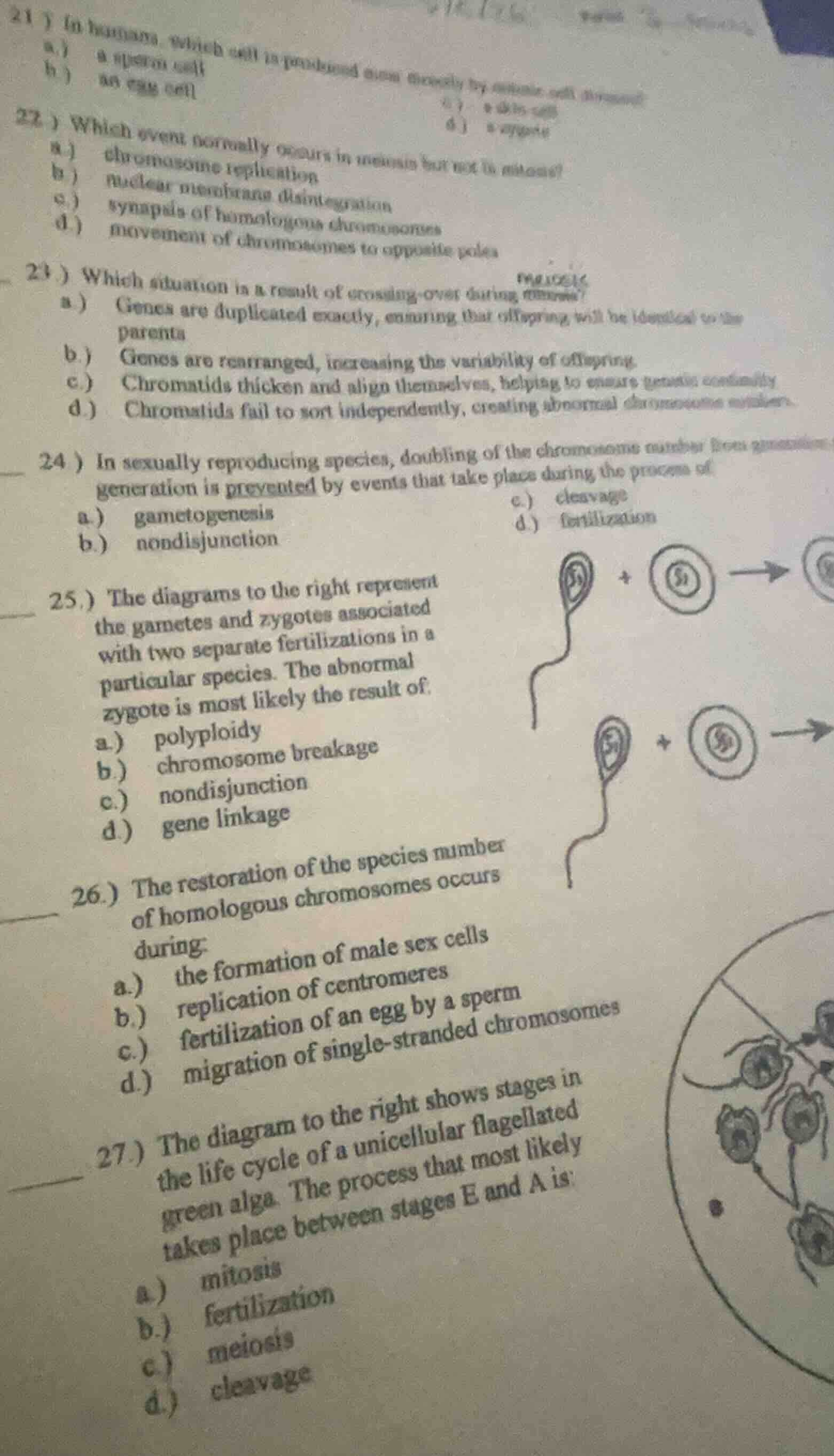
25.) the diagrams to the right represent the gametes and zygotes associated with two separate fertilizations in a particular species. the abnormal zygote is most likely the result of:
a.) polyploidy
b.) chromosome breakage
c.) nondisjunction
d.) gene linkage
26.) the restoration of the species number of homologous chromosomes occurs during:
a.) the formation of male sex cells
b.) replication of centromeres
c.) fertilization of an egg by a sperm
d.) migration of single - stranded chromosomes
27.) the diagram to the right shows stages in the life cycle of a unicellular flagellated green alga. the process that most likely takes place between stages e and a is:
a.) mitosis
b.) fertilization
c.) meiosis
d.) cleavage
Question 22
To solve this, we analyze each option:
- Option a: Chromosome replication occurs in both mitosis (interphase) and meiosis (interphase I), so this is incorrect.
- Option b: Nuclear membrane disintegration happens in both mitosis (prometaphase) and meiosis (prometaphase I and II), so incorrect.
- Option c: Synapsis (pairing of homologous chromosomes) occurs only in meiosis (prophase I) and not in mitosis, as mitosis doesn't involve homologous chromosome pairing.
- Option d: Movement of chromosomes to opposite poles occurs in both mitosis (anaphase) and meiosis (anaphase I and II), so incorrect.
Crossing - over in meiosis (prophase I) involves the exchange of genetic material between homologous chromosomes:
- Option a: Crossing - over does not result in exact gene duplication for identical offspring; that's more related to asexual reproduction or mitosis, so incorrect.
- Option b: When crossing - over occurs, genes on homologous chromosomes are rearranged, which increases the genetic variability of the offspring. This is correct.
- Option c: Chromatids thickening and aligning is about chromosome condensation and metaphase alignment, not crossing - over, so incorrect.
- Option d: Chromatids failing to sort independently is nondisjunction, not crossing - over, so incorrect.
In sexually reproducing species:
- Option a: Gametogenesis (meiosis) reduces the chromosome number by half (from diploid to haploid) in gametes. When fertilization occurs, the diploid number is restored. So gametogenesis prevents the doubling of chromosome number from generation to generation.
- Option b: Nondisjunction is a failure of chromosome separation, which can lead to aneuploidy, not prevention of chromosome number doubling, so incorrect.
- Option c: Cleavage is cell division in the early embryo, it doesn't affect chromosome number for generation - to - generation control, so incorrect.
- Option d: Fertilization restores the diploid number, it doesn't prevent the doubling; rather, gametogenesis (meiosis) before fertilization is what prevents the doubling, so incorrect.

Snap & solve any problem in the app
Get step-by-step solutions on Sovi AI
Photo-based solutions with guided steps
Explore more problems and detailed explanations
c. synapsis of homologous chromosomes