QUESTION IMAGE
Question
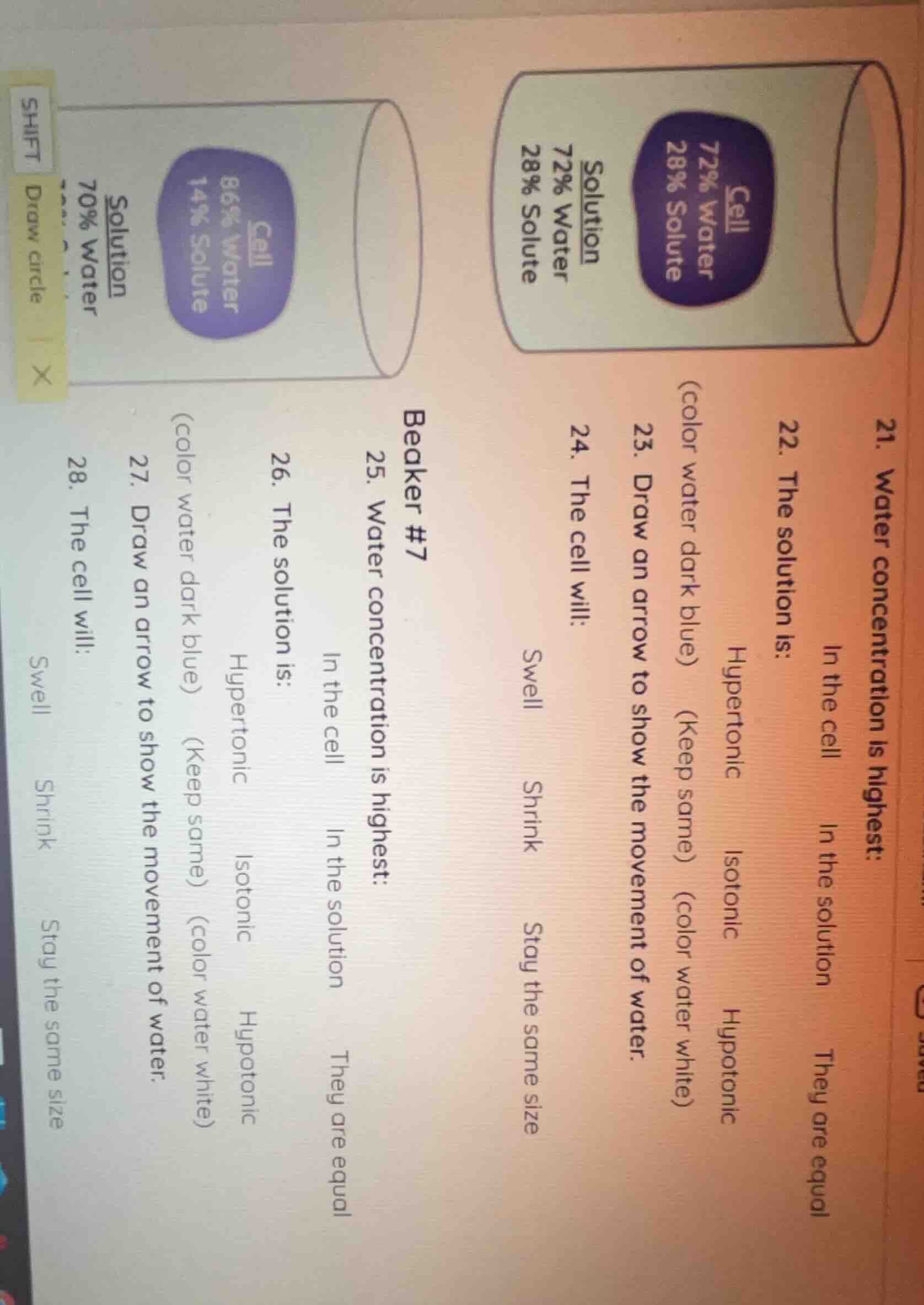
- water concentration is highest: in the cell in the solution they are equal 22. the solution is: hypertonic isotonic hypotonic 23. draw an arrow to show the movement of water. (color water dark blue) (keep same) (color water white) 24. the cell will: swell shrink stay the same size beaker #7 25. water concentration is highest: in the cell in the solution they are equal 26. the solution is: hypertonic isotonic hypotonic (color water dark blue) (keep same) (color water white) 27. draw an arrow to show the movement of water. 28. the cell will: swell shrink stay the same size
Question 21 (Water concentration is highest: )
To determine where water concentration is highest, we compare the water percentages. In the cell, water is 86% (first diagram) or 72% (second diagram). In the solution, water is 70% (first) or 72% (second). For the first diagram (Beaker #7? Maybe a typo, but focusing on the first cell: cell has 86% water, solution has 70% water. So water concentration is highest in the cell. For the second cell and solution, both have 72% water, so they are equal? Wait, the first cell (left) has 86% water, solution has 70% water. So for the first set (left), water concentration is highest in the cell. For the second (right), cell and solution have 72% water, so equal. But the question is "Water concentration is highest: In the cell, In the solution, They are equal". So we analyze the diagrams. Left cell: 86% water, solution: 70% water. So water concentration is higher in the cell. Right cell: 72% water, solution: 72% water, so equal. But the options are "In the cell", "In the solution", "They are equal". So we check the diagrams. The left diagram: cell has 86% water, solution has 70% water. So water concentration is highest in the cell. The right diagram: cell and solution both 72% water, so equal. But the question is probably about the first diagram (Beaker #7's cell). So the answer is "In the cell" (for the first cell) or "They are equal" (for the second). But looking at the options, the first part (question 21) has options: In the cell, In the solution, They are equal. So we compare water percentages. Water percentage = 100% - solute percentage. Left cell: 86% water (14% solute), solution: 70% water (30% solute? Wait, the left solution says "70% Water" (so 30% solute), cell has 86% water (14% solute). So water concentration (water percentage) is higher in the cell (86% > 70%). So water concentration is highest in the cell.
Tonicity: Hypertonic solution has higher solute concentration than cell, Hypotonic has lower, Isotonic equal. Left solution: solute is 30% (100 - 70), cell solute is 14%. So solution has higher solute (30% > 14%), so solution is hypertonic? Wait no: hypertonic solution has more solute, so water moves out of cell. Wait, solute concentration: solution (left) has 30% solute, cell has 14% solute. So solution is hypertonic (higher solute), cell is hypotonic relative to solution. Wait, tonicity is based on solute concentration relative to cell. So if solution has more solute (hypertonic), cell has less solute (hypotonic to solution). So the solution is hypertonic (since solute in solution (30%) > solute in cell (14%)). For the right diagram: solution has 28% solute, cell has 28% solute. So isotonic. But question 22 is about which solution? The left diagram (Beaker #7's solution). So solution solute is 30% (70% water), cell solute 14% (86% water). So solution has higher solute, so it's hypertonic.
Osmosis: water moves from high water concentration (low solute) to low water concentration (high solute). Left cell: 86% water (low solute), solution: 70% water (high solute). So water moves from cell (high water) to solution (low water)? Wait no: wait, water moves to area of higher solute concentration (since solute attracts water). Wait, solute concentration in solution (30%) is higher than cell (14%), so water moves out of cell (from cell to solution). So arrow points from cell to solution. For the right diagram: cell and solution have same solute (28%), so water moves equally, arrow can be bidirectional or no net movement. But for the left diagram (Beaker #7), water moves out of cell (from cell to solution). So draw an arrow from the cell (inside the purple cell) to the solution (outside the cell, in the beaker).

Snap & solve any problem in the app
Get step-by-step solutions on Sovi AI
Photo-based solutions with guided steps
Explore more problems and detailed explanations
In the cell