QUESTION IMAGE
Question
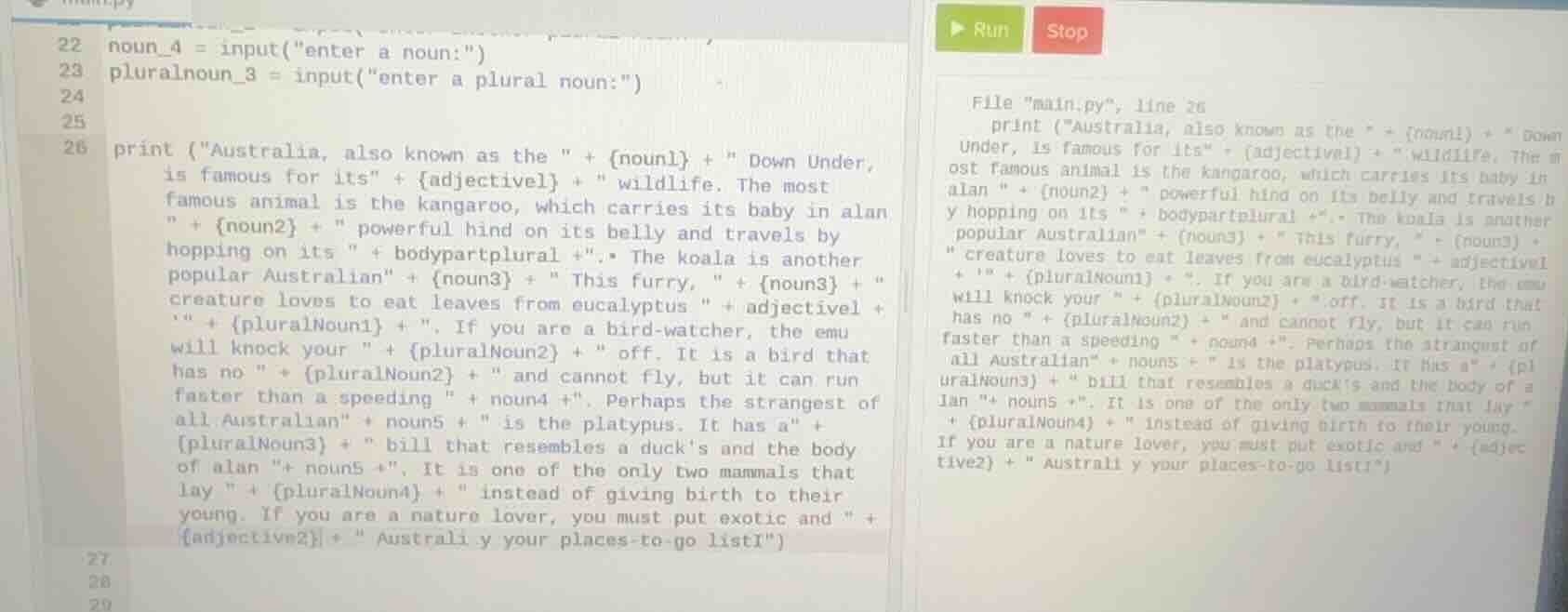
22 noun_4 = input(\enter a noun:\)
23 pluralnoun_3 = input(\enter a plural noun:\)
24
25 print (\australia, also known as the \ + {noun1} + \ down under,
26 is famous for its\ + {adjective1} + \ wildlife. the most
27 famous animal is the kangaroo, which carries its baby in alan
28 \ + {noun2} + \ powerful hind on its belly and travels by
29 hopping on its \ + bodypartplural +\.\ + \ the koala is another
30 popular australian \ + {noun3} + \ this furry, \ + {noun3} + \
31 creature loves to eat leaves from eucalyptus \ + adjective1 +
32 \ \ + {pluralnoun1} + \. if you are a bird-watcher, the emu
33 will knock your \ + {pluralnoun2} + \ off. it is a bird that
34 has no \ + {pluralnoun2} + \ and cannot fly, but it can run
35 faster than a speeding \ + noun4 +\. perhaps the strangest of
36 all australian\ + noun5 + \ is the platypus. it has a\ +
37 {pluralnoun3} + \ bill that resembles a ducks and the body
38 of alan \+ noun5 +\, it is one of the only two mammals that
39 lay \ + {pluralnoun4} + \ instead of giving birth to their
40 young. if you are a nature lover, you must put exotic and \ +
41 {adjective2} + \ australia your places-to-go list!\)
file \main.py\, line 26
print (\australia, also known as the \ + {noun1} + \ down under,
^
syntaxerror: invalid syntax
To fix the syntax errors in the Python code (assuming the goal is to correct the code for proper string formatting and variable usage):
Step 1: Correct Variable Syntax
In Python, we use variables directly (e.g., noun1), not {noun1}. So we need to replace all occurrences of {variable} with variable (without the curly braces). Also, ensure all input variables are defined (like noun1, adjective1, etc. should be input or defined before use). Let's assume the input variables are defined as:
noun1 = input("enter a noun:")
adjective1 = input("enter an adjective:")
noun2 = input("enter a noun:")
bodypartplural = input("enter a plural noun (body part):")
noun3 = input("enter a noun:")
pluralNoun1 = input("enter a plural noun:")
pluralNoun2 = input("enter a plural noun:")
noun4 = input("enter a noun:")
noun5 = input("enter a noun:")
pluralNoun3 = input("enter a plural noun:")
pluralNoun4 = input("enter a plural noun:")
adjective2 = input("enter an adjective:")
Step 2: Correct Print Statement Formatting
The print statement should use string concatenation with the corrected variable references. The corrected print statement would be:
print("Australia, also known as the " + noun1 + " Down Under, is famous for its " + adjective1 + " wildlife. The most famous animal is the kangaroo, which carries its baby in a/an " + noun2 + " powerful hind on its belly and travels by hopping on its " + bodypartplural + ". The koala is another popular Australian " + noun3 + ". This furry, " + noun3 + " creature loves to eat leaves from eucalyptus " + adjective1 + " " + pluralNoun1 + ". If you are a bird - watcher, the emu will knock your " + pluralNoun2 + " off. It is a bird that has no " + pluralNoun2 + " and cannot fly, but it can run faster than a speeding " + noun4 + ". Perhaps the strangest of all Australian " + noun5 + " is the platypus. It has a " + pluralNoun3 + " bill that resembles a duck's and the body of a/an " + noun5 + ". It is one of the only two mammals that lay " + pluralNoun4 + " instead of giving birth to their young. If you are a nature lover, you must put exotic and " + adjective2 + " Australia on your places - to - go list!")If you run this code after defining all the input variables, it will generate the intended mad - lib style output about Australia.
(Note: The original code had syntax errors in variable referencing (using curly braces instead of just the variable name) and likely some missing input variable definitions. The above steps correct those issues.)

Snap & solve any problem in the app
Get step-by-step solutions on Sovi AI
Photo-based solutions with guided steps
Explore more problems and detailed explanations
To fix the syntax errors in the Python code (assuming the goal is to correct the code for proper string formatting and variable usage):
Step 1: Correct Variable Syntax
In Python, we use variables directly (e.g., noun1), not {noun1}. So we need to replace all occurrences of {variable} with variable (without the curly braces). Also, ensure all input variables are defined (like noun1, adjective1, etc. should be input or defined before use). Let's assume the input variables are defined as:
noun1 = input("enter a noun:")
adjective1 = input("enter an adjective:")
noun2 = input("enter a noun:")
bodypartplural = input("enter a plural noun (body part):")
noun3 = input("enter a noun:")
pluralNoun1 = input("enter a plural noun:")
pluralNoun2 = input("enter a plural noun:")
noun4 = input("enter a noun:")
noun5 = input("enter a noun:")
pluralNoun3 = input("enter a plural noun:")
pluralNoun4 = input("enter a plural noun:")
adjective2 = input("enter an adjective:")
Step 2: Correct Print Statement Formatting
The print statement should use string concatenation with the corrected variable references. The corrected print statement would be:
print("Australia, also known as the " + noun1 + " Down Under, is famous for its " + adjective1 + " wildlife. The most famous animal is the kangaroo, which carries its baby in a/an " + noun2 + " powerful hind on its belly and travels by hopping on its " + bodypartplural + ". The koala is another popular Australian " + noun3 + ". This furry, " + noun3 + " creature loves to eat leaves from eucalyptus " + adjective1 + " " + pluralNoun1 + ". If you are a bird - watcher, the emu will knock your " + pluralNoun2 + " off. It is a bird that has no " + pluralNoun2 + " and cannot fly, but it can run faster than a speeding " + noun4 + ". Perhaps the strangest of all Australian " + noun5 + " is the platypus. It has a " + pluralNoun3 + " bill that resembles a duck's and the body of a/an " + noun5 + ". It is one of the only two mammals that lay " + pluralNoun4 + " instead of giving birth to their young. If you are a nature lover, you must put exotic and " + adjective2 + " Australia on your places - to - go list!")If you run this code after defining all the input variables, it will generate the intended mad - lib style output about Australia.
(Note: The original code had syntax errors in variable referencing (using curly braces instead of just the variable name) and likely some missing input variable definitions. The above steps correct those issues.)