QUESTION IMAGE
Question
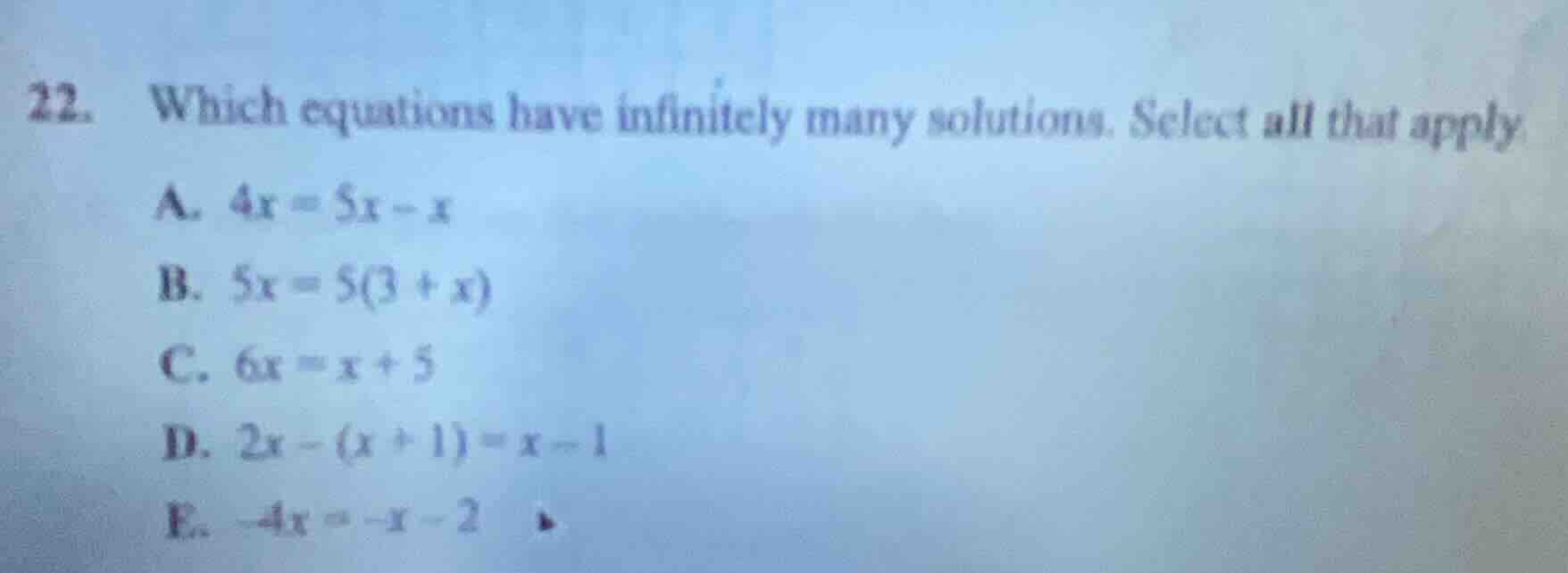
- which equations have infinitely many solutions. select all that apply
a. $4x = 5x - x$
b. $5x = 5(3 + x)$
c. $6x = x + 5$
d. $2x - (x + 1) = x - 1$
e. $-4x = -x - 2$
Step1: Analyze Option A
Simplify the right - hand side of the equation \(4x = 5x - x\). Combine like terms: \(5x - x=4x\). So the equation becomes \(4x = 4x\). Subtract \(4x\) from both sides: \(4x-4x = 4x - 4x\), which gives \(0 = 0\). This is a true statement for all values of \(x\), so the equation has infinitely many solutions.
Step2: Analyze Option B
Simplify the right - hand side of the equation \(5x = 5(3 + x)\). Use the distributive property \(a(b + c)=ab+ac\), so \(5(3 + x)=15 + 5x\). The equation is \(5x=15 + 5x\). Subtract \(5x\) from both sides: \(5x-5x=15 + 5x-5x\), which gives \(0 = 15\). This is a false statement, so the equation has no solution.
Step3: Analyze Option C
Solve the equation \(6x=x + 5\). Subtract \(x\) from both sides: \(6x-x=x + 5-x\), which gives \(5x=5\). Divide both sides by 5: \(x = 1\). The equation has a single solution, not infinitely many.
Step4: Analyze Option D
Simplify the left - hand side of the equation \(2x-(x + 1)=x - 1\). Use the distributive property \(a-(b + c)=a - b - c\), so \(2x-(x + 1)=2x-x - 1=x - 1\). The equation becomes \(x - 1=x - 1\). Subtract \(x\) from both sides: \(x - 1-x=x - 1-x\), which gives \(-1=-1\). This is a true statement for all values of \(x\), so the equation has infinitely many solutions.
Step5: Analyze Option E
Solve the equation \(-4x=-x - 2\). Add \(x\) to both sides: \(-4x+x=-x - 2+x\), which gives \(-3x=-2\). Divide both sides by \(-3\): \(x=\frac{2}{3}\). The equation has a single solution, not infinitely many.

Snap & solve any problem in the app
Get step-by-step solutions on Sovi AI
Photo-based solutions with guided steps
Explore more problems and detailed explanations
A. \(4x = 5x - x\)
D. \(2x-(x + 1)=x - 1\)