QUESTION IMAGE
Question
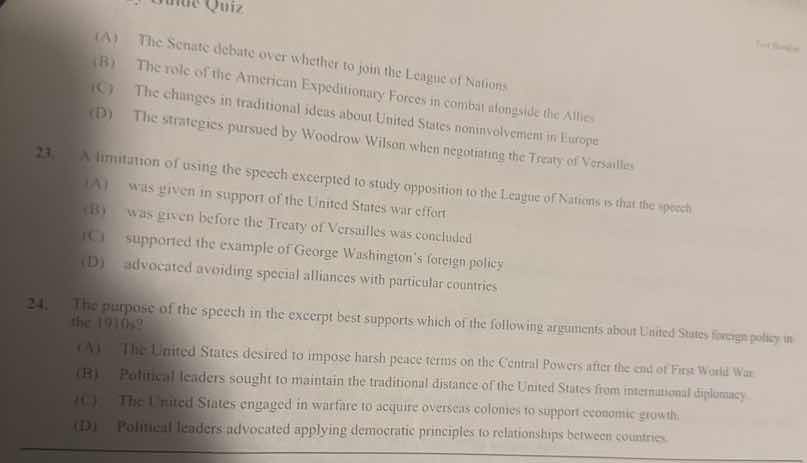
- a limitation of using the speech excerpted to study opposition to the league of nations is that the speech
(a) was given in support of the united states war effort
(b) was given before the treaty of versailles was concluded
(c) supported the example of george washington’s foreign policy
(d) advocated avoiding special alliances with particular countries
- the purpose of the speech in the excerpt best supports which of the following arguments about united states foreign policy in the 1910s?
(a) the united states desired to impose harsh peace terms on the central powers after the end of first world war.
(b) political leaders sought to maintain the traditional distance of the united states from international diplomacy.
(c) the united states engaged in warfare to acquire overseas colonies to support economic growth.
(d) political leaders advocated applying democratic principles to relationships between countries.
To solve these multiple - choice questions, we analyze each one based on historical knowledge about U.S. foreign policy, especially around the time of World War I and the Treaty of Versailles.
Question 23
- Option A: If the speech was in support of the U.S. war effort, it doesn't directly limit its use to study opposition to the League of Nations. So, A is incorrect.
- Option B: The timing of the speech relative to the conclusion of the Treaty of Versailles doesn't limit its use to study opposition to the League of Nations. So, B is incorrect.
- Option C: Supporting George Washington's foreign policy example (likely isolationist) doesn't directly limit the study of opposition to the League of Nations. So, C is incorrect.
- Option D: If the speech advocated avoiding special alliances with particular countries, it shows the speaker's stance, and this stance can limit the study of opposition to the League of Nations (since the League involved international cooperation and alliances). So, D is correct.
Question 24
- Option A: The excerpt's speech purpose is not about imposing harsh peace terms on the Central Powers. So, A is incorrect.
- Option B: If the speech's purpose relates to maintaining the traditional distance of the U.S. from international diplomacy (isolationism), this aligns with the idea of political leaders wanting to keep the U.S. out of international diplomatic entanglements like the League of Nations. So, B is correct.
- Option C: The speech's purpose is not about acquiring overseas colonies for economic growth through warfare. So, C is incorrect.
- Option D: The speech's purpose is not about applying democratic principles to international relationships. So, D is incorrect.

Snap & solve any problem in the app
Get step-by-step solutions on Sovi AI
Photo-based solutions with guided steps
Explore more problems and detailed explanations
s
- D. advocated avoiding special alliances with particular countries
- B. Political leaders sought to maintain the traditional distance of the United States from international diplomacy.