QUESTION IMAGE
Question
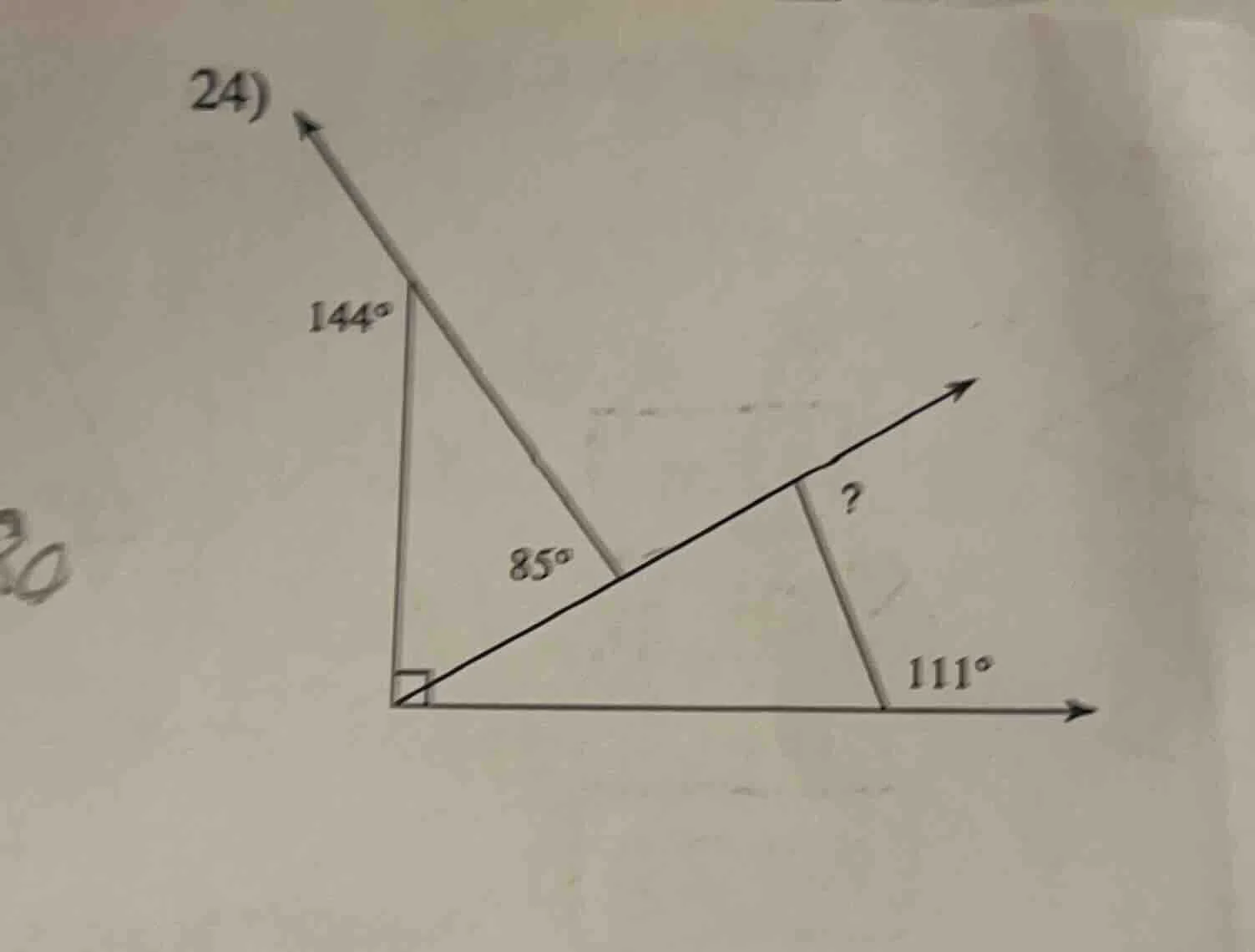
- 144° 85°? 111° (with a right - angled triangle and some angle - marked lines in the diagram)
Step1: Find adjacent angle to 144°
Adjacent angles on a straight line sum to 180°. So, \(180^\circ - 144^\circ = 36^\circ\).
Step2: Find angle in right triangle
In the right triangle (with 90°), the sum of angles is 180°. Let the angle be \(x\), then \(x = 90^\circ - 36^\circ = 54^\circ\).
Step3: Find another angle in the triangle
In the triangle with 85°, the third angle (let's call it \(y\)): \(180^\circ - 85^\circ - 54^\circ = 41^\circ\).
Step4: Find adjacent angle to 111°
Adjacent angles on a straight line sum to 180°, so \(180^\circ - 111^\circ = 69^\circ\).
Step5: Find the unknown angle (?)
In the triangle with 69° and 41°, the unknown angle (let's call it \(z\)): \(180^\circ - 69^\circ - 41^\circ = 70^\circ\)? Wait, no, wait. Wait, the straight line for the unknown angle: Wait, maybe better to use the sum of exterior angles or check again. Wait, let's re - evaluate.
Wait, first, the angle adjacent to 144°: \(180 - 144 = 36^\circ\). Then in the right - angled triangle (the one with the right angle), the angle at the vertex with 36°: since it's a right triangle, the other acute angle is \(90 - 36 = 54^\circ\). Then in the triangle with 85°, the three angles of a triangle sum to 180°, so the angle adjacent to the 85° triangle and the other triangle: \(180 - 85 - 54 = 41^\circ\). Then the angle adjacent to 111° is \(180 - 111 = 69^\circ\). Now, in the triangle where we need to find the unknown angle (let's say the triangle with angles 41°, 69°, and the angle related to the unknown angle), wait, no. Wait, the unknown angle is on a straight line with the angle we are going to find. Wait, maybe the sum of angles around the transversal or using the fact that the sum of all exterior angles of a triangle is 360°? Wait, no, let's use the sum of angles in a polygon or re - check the diagram.
Wait, maybe a better approach:
The sum of the angles in a triangle is 180°, and the sum of adjacent angles on a straight line is 180°.
First, angle 1: \(180 - 144 = 36^\circ\) (adjacent to 144°).
In the right - angled triangle (with 90°), the angle opposite to the 36° - related angle: \(90 - 36 = 54^\circ\).
In the triangle with 85°, the third angle: \(180 - 85 - 54 = 41^\circ\).
Angle 2: \(180 - 111 = 69^\circ\) (adjacent to 111°).
Now, in the triangle that has angles 41°, 69°, and the angle adjacent to the unknown angle (let's call it \(a\)): \(180 - 41 - 69 = 70^\circ\). Then the unknown angle (?) is adjacent to \(a\) on a straight line? Wait, no, the unknown angle is on a straight line with \(a\)? Wait, no, maybe I made a mistake. Wait, the unknown angle is an exterior angle? Wait, no, let's look at the diagram again.
Wait, the correct way:
The angle adjacent to 144° is \(180 - 144 = 36^\circ\).
In the right - angled triangle (with 90°), the angle at the vertex is \(90 - 36 = 54^\circ\).
In the triangle with 85°, the angle is \(180 - 85 - 54 = 41^\circ\).
The angle adjacent to 111° is \(180 - 111 = 69^\circ\).
Now, in the triangle that contains the unknown angle, the two non - unknown angles are 41° and 69°, so the angle adjacent to the unknown angle (let's call it \(b\)) is \(180 - 41 - 69 = 70^\circ\). Then the unknown angle (?) is \(180 - 70 = 110^\circ\)? No, that can't be. Wait, I think I messed up the triangles.
Wait, let's start over.
- Find the angle inside the triangle next to 144°:
Since it's a straight line, the angle is \(180^{\circ}-144^{\circ} = 36^{\circ}\).
- In the right - angled triangle (with the 90° angle), the other acute angle:
The sum of angles in a triangle is \(180^{\circ}\), so the angle…

Snap & solve any problem in the app
Get step-by-step solutions on Sovi AI
Photo-based solutions with guided steps
Explore more problems and detailed explanations
\(110^{\circ}\)