QUESTION IMAGE
Question
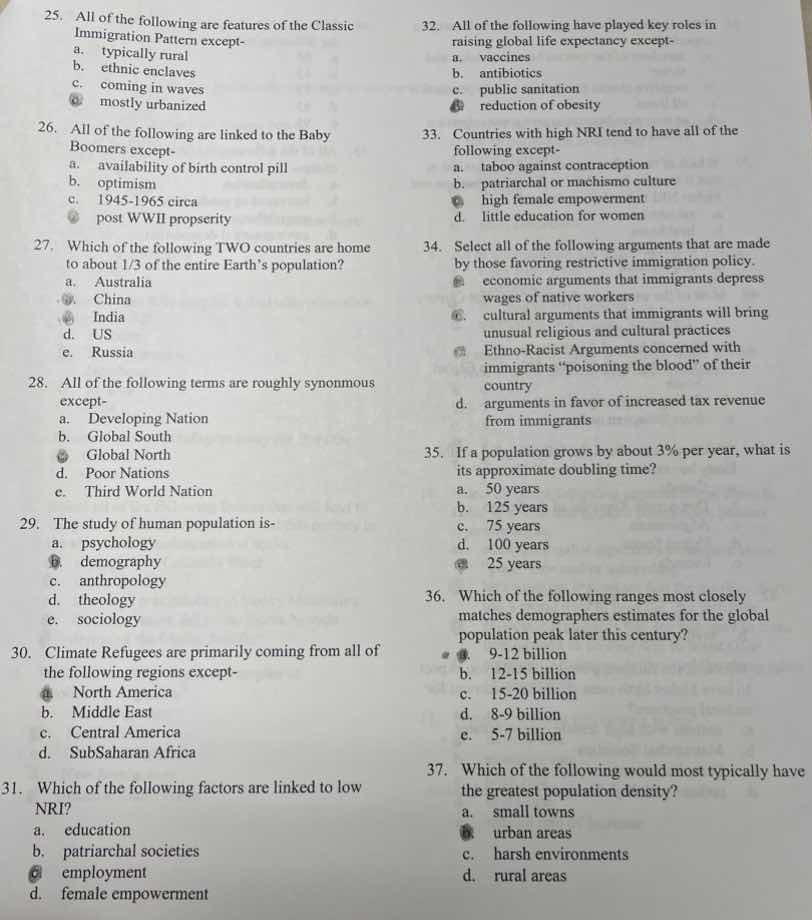
- all of the following are features of the classic immigration pattern except-a. typically ruralb. ethnic enclavesc. coming in wavesd. mostly urbanized26. all of the following are linked to the baby boomers except-a. availability of birth control pillb. optimismc. 1945-1965 circad. post wwii prosperity27. which of the following two countries are home to about 1/3 of the entire earths population?a. australiab. chinac. indiad. use. russia28. all of the following terms are roughly synonymous except-a. developing nationb. global southc. global northd. poor nationse. third world nation29. the study of human population is-a. psychologyb. demographyc. anthropologyd. theologye. sociology30. climate refugees are primarily coming from all of the following regions except-a. north americab. middle eastc. central americad. subsaharan africa31. which of the following factors are linked to low nri?a. educationb. patriarchal societiesc. employmentd. female empowerment32. all of the following have played key roles in raising global life expectancy except-a. vaccinesb. antibioticsc. public sanitationd. reduction of obesity33. countries with high nri tend to have all of the following except-a. taboo against contraceptionb. patriarchal or machismo culturec. high female empowermentd. little education for women34. select all of the following arguments that are made by those favoring restrictive immigration policy.a. economic arguments that immigrants depress wages of native workersb. cultural arguments that immigrants will bring unusual religious and cultural practicesc. ethno-racist arguments concerned with immigrants \poisoning the blood\ of their countryd. arguments in favor of increased tax revenue from immigrants35. if a population grows by about 3% per year, what is its approximate doubling time?a. 50 yearsb. 125 yearsc. 75 yearsd. 100 yearse. 25 years36. which of the following ranges most closely matches demographers estimates for the global population peak later this century?a. 9-12 billionb. 12-15 billionc. 15-20 billiond. 8-9 billione. 5-7 billion37. which of the following would most typically have the greatest population density?a. small townsb. urban areasc. harsh environmentsd. rural areas
Brief Explanations
- Classic immigration patterns were rural, had ethnic enclaves, came in waves, not urbanized.
- Baby Boomers were born 1945-1965, linked to post-WWII prosperity/optimism; birth control was later.
- China and India together hold ~1/3 of the global population.
- Global North refers to wealthy nations, unlike the other terms for low-income nations.
- Demography is the formal study of human population.
- Climate refugees primarily come from climate-vulnerable regions, not North America.
- Low NRI (Net Reproductive Index) links to lower fertility; employment reduces birth rates, while the other factors raise or do not lower NRI.
- Vaccines, antibiotics, sanitation raised life expectancy; obesity reduction is not a historic key factor.
- High NRI nations have low female empowerment, not high; the other options align with high fertility.
- Restrictive immigration arguments focus on harms; tax revenue is a pro-immigration argument.
- Using the Rule of 70: $\frac{70}{3} \approx 23$, closest to 25 years.
- Demographers project global population will peak at 9-12 billion this century.
- Urban areas have the highest concentration of people, so greatest population density.

Snap & solve any problem in the app
Get step-by-step solutions on Sovi AI
Photo-based solutions with guided steps
Explore more problems and detailed explanations
- d. mostly urbanized
- a. availability of birth control pill
- b. China, c. India
- c. Global North
- b. demography
- a. North America
- c. employment
- d. reduction of obesity
- c. high female empowerment
- d. arguments in favor of increased tax revenue from immigrants
- e. 25 years
- a. 9-12 billion
- b. urban areas