QUESTION IMAGE
Question
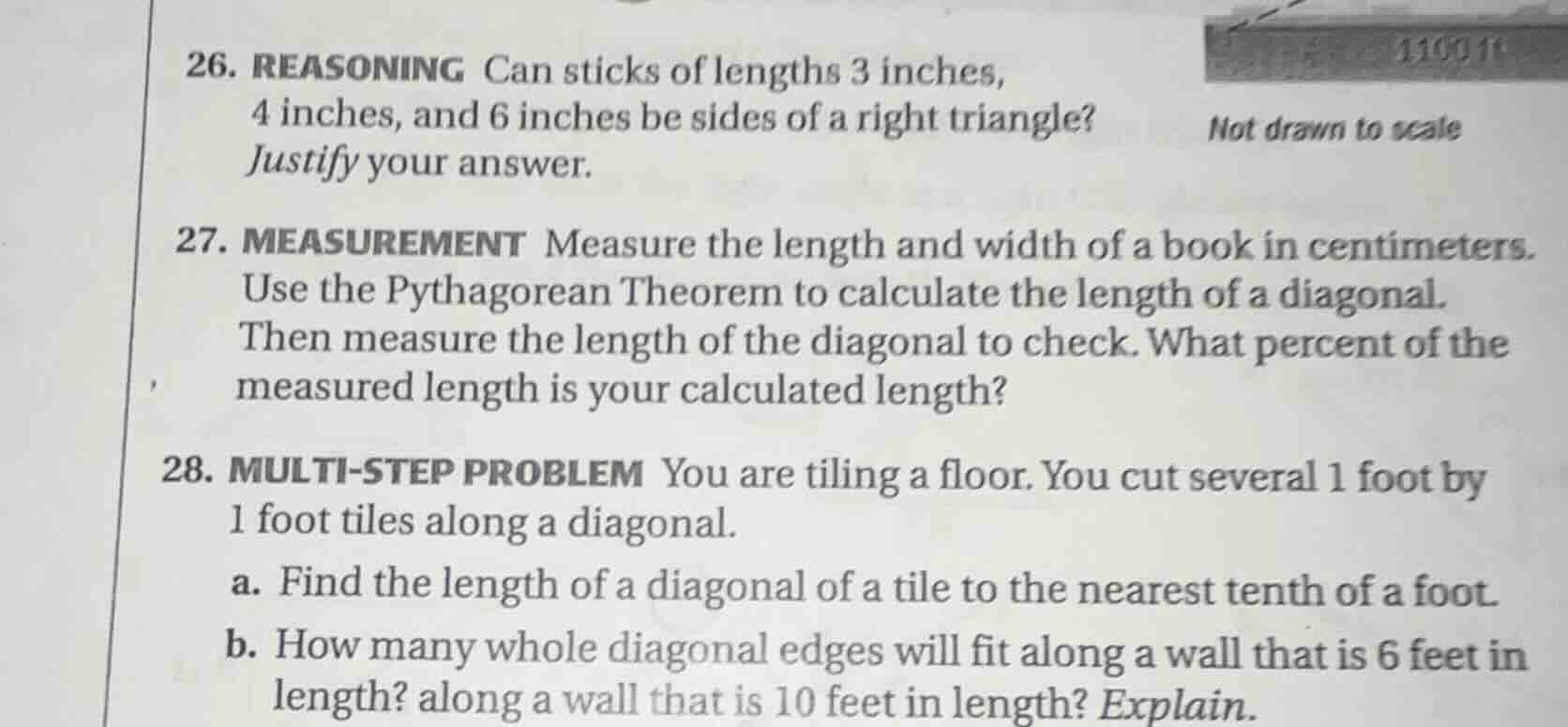
- reasoning can sticks of lengths 3 inches, 4 inches, and 6 inches be sides of a right triangle? justify your answer. 27. measurement measure the length and width of a book in centimeters. use the pythagorean theorem to calculate the length of a diagonal. then measure the length of the diagonal to check. what percent of the measured length is your calculated length? 28. multi-step problem you are tiling a floor. you cut several 1 foot by 1 foot tiles along a diagonal. a. find the length of a diagonal of a tile to the nearest tenth of a foot. b. how many whole diagonal edges will fit along a wall that is 6 feet in length? along a wall that is 10 feet in length? explain.
Question 26
Step1: Recall Pythagorean theorem
For a right triangle, the Pythagorean theorem states that \(a^2 + b^2 = c^2\), where \(c\) is the hypotenuse (the longest side), and \(a\) and \(b\) are the other two sides.
Step2: Identify the sides
Here, the sides are 3 inches, 4 inches, and 6 inches. The longest side is 6 inches, so we check if \(3^2 + 4^2 = 6^2\).
Step3: Calculate each square
\(3^2 = 9\), \(4^2 = 16\), and \(6^2 = 36\).
Step4: Check the equation
Now, add the squares of the two shorter sides: \(9 + 16 = 25\).
Since \(25
eq36\), the Pythagorean theorem is not satisfied.
Step1: Apply Pythagorean theorem
The length of the diagonal \(d\) of a rectangle (book) is given by \(d=\sqrt{l^2 + w^2}\). Substituting \(l = 20\) and \(w = 15\), we get \(d=\sqrt{20^2 + 15^2}=\sqrt{400 + 225}=\sqrt{625}=25\) cm (in this example).
Step2: Measure the diagonal
Suppose we measure the diagonal and get 25 cm (matching the calculation in this example).
Step3: Calculate the percentage
The formula for percentage is \(\frac{\text{Calculated length}}{\text{Measured length}}\times100\%\). Substituting the values, \(\frac{25}{25}\times100\% = 100\%\) (in this example).
Step1: Recall Pythagorean theorem for square tile
A 1 foot by 1 foot tile is a square, so the diagonal \(d\) satisfies \(d^2 = 1^2 + 1^2\).
Step2: Calculate the diagonal
\(d^2 = 1 + 1 = 2\), so \(d=\sqrt{2}\approx1.4\) feet (to the nearest tenth).

Snap & solve any problem in the app
Get step-by-step solutions on Sovi AI
Photo-based solutions with guided steps
Explore more problems and detailed explanations
No, because \(3^2 + 4^2 = 9 + 16 = 25\) and \(6^2 = 36\), and \(25
eq36\), so they do not satisfy the Pythagorean theorem for a right triangle.
Question 27
(Note: This requires actual measurement of a book. Let's assume we measure a book with length \(l = 20\) cm and width \(w = 15\) cm as an example. )