QUESTION IMAGE
Question
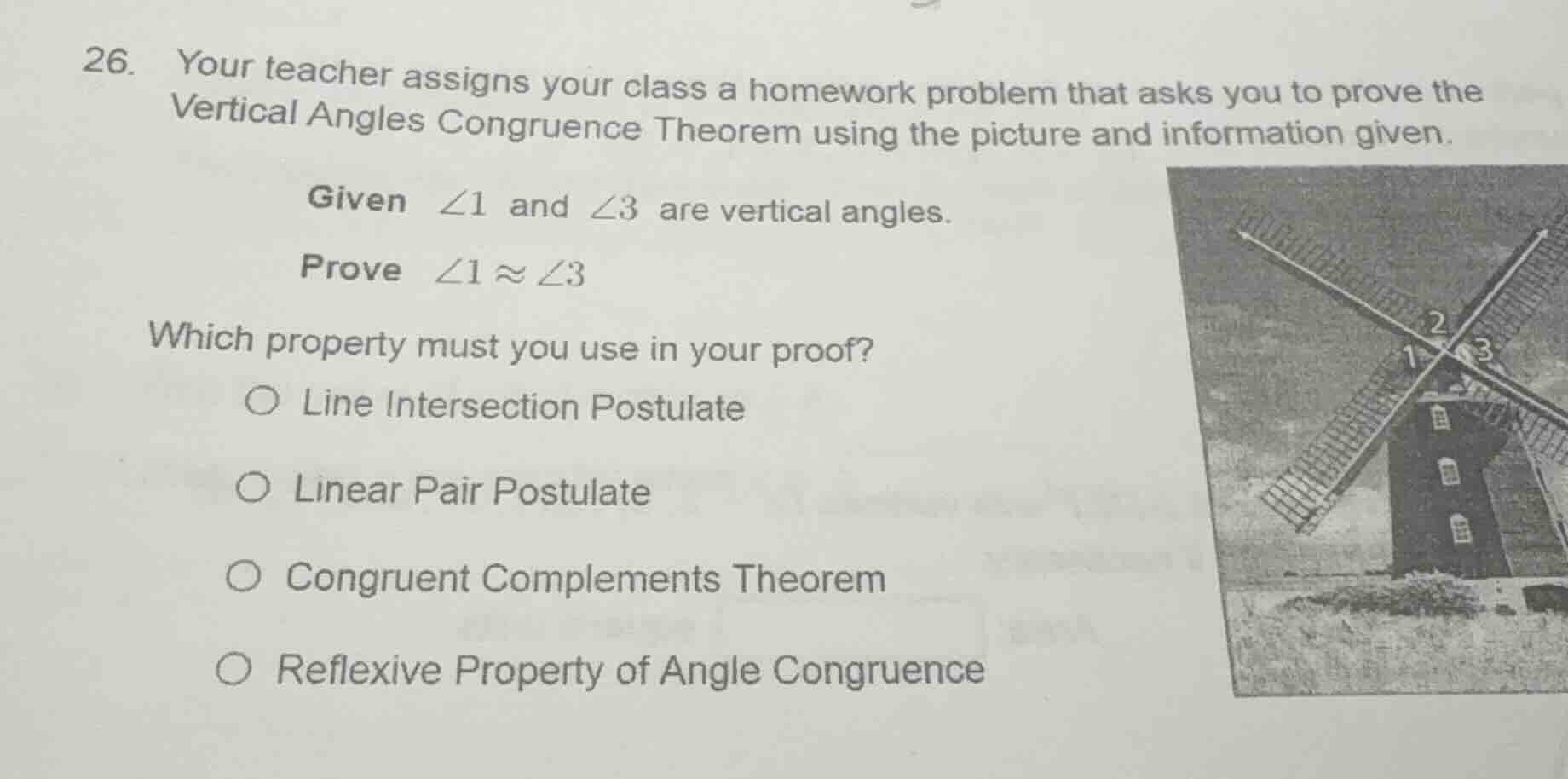
- your teacher assigns your class a homework problem that asks you to prove the vertical angles congruence theorem using the picture and information given. given ∠1 and ∠3 are vertical angles. prove ∠1 ≈ ∠3 which property must you use in your proof? ○ line intersection postulate ○ linear pair postulate ○ congruent complements theorem ○ reflexive property of angle congruence
Brief Explanations
To prove the Vertical Angles Congruence Theorem (that vertical angles like $\angle1$ and $\angle3$ are congruent), we analyze the properties:
- The Linear Pair Postulate states that a linear pair of angles (adjacent angles forming a straight line) are supplementary (sum to $180^\circ$). For $\angle1$ and $\angle2$, they form a linear pair, so $\angle1 + \angle2 = 180^\circ$. Similarly, $\angle2$ and $\angle3$ form a linear pair, so $\angle2 + \angle3 = 180^\circ$. By the Substitution Property (or solving for $\angle1$ and $\angle3$), we find $\angle1 = \angle3$ (hence $\angle1 \cong \angle3$).
- The other options are irrelevant:
- Line Intersection Postulate deals with lines intersecting at a point (not angle congruence).
- Congruent Complements Theorem applies to complementary angles (sum to $90^\circ$), not supplementary.
- Reflexive Property states an angle is congruent to itself (not useful for vertical angles).

Snap & solve any problem in the app
Get step-by-step solutions on Sovi AI
Photo-based solutions with guided steps
Explore more problems and detailed explanations
B. Linear Pair Postulate