QUESTION IMAGE
Question
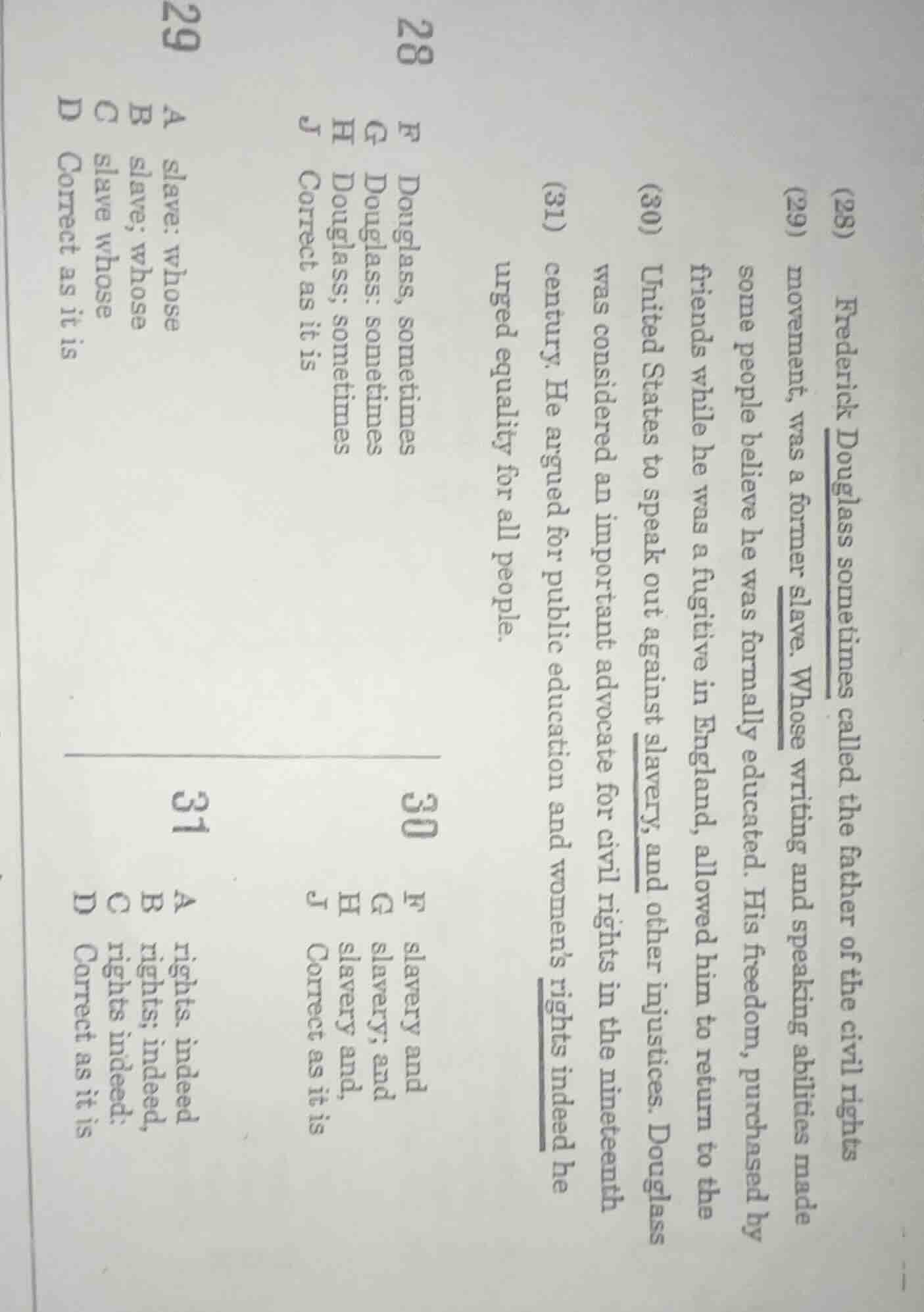
(28) frederick douglass sometimes called the father of the civil rights movement, was a former slave. whose writing and speaking abilities made some people believe he was formally educated. his freedom, purchased by friends while he was a fugitive in england, allowed him to return to the united states to speak out against slavery, and other injustices. douglass was considered an important advocate for civil rights in the nineteenth century. he argued for public education and womens rights indeed he urged equality for all people.(29)(30)(31)28f douglass, sometimesg douglass: sometimesh douglass; sometimesj correct as it is29a slave: whoseb slave; whosec slave whosed correct as it is30f slavery andg slavery; andh slavery and,j correct as it is31a rights. indeedb rights; indeed,c rights indeed:d correct as it is
(28)
The phrase "Frederick Douglass sometimes called" creates a fragment. We need a colon to introduce the descriptive label, and "sometimes" correctly modifies the naming.
(29)
"Whose" is a possessive pronoun that incorrectly refers to Frederick Douglass here; we need a main clause subject. "He was a former slave" is the correct structure, and the semicolon properly connects two related independent clauses, with "whose" replaced by the correct framing.
(30)
The list includes "slavery" and "other injustices," so a comma before "and" is not needed for a two-item list in this context.
(31)
"Indeed" is an adverb that should follow the phrase it emphasizes. Placing it after "rights" and using a comma sets it off correctly as a parenthetical emphasis.

Snap & solve any problem in the app
Get step-by-step solutions on Sovi AI
Photo-based solutions with guided steps
Explore more problems and detailed explanations
- G. Douglass: sometimes
- B. slave; whose
- F. slavery and
- B. rights; indeed,