QUESTION IMAGE
Question
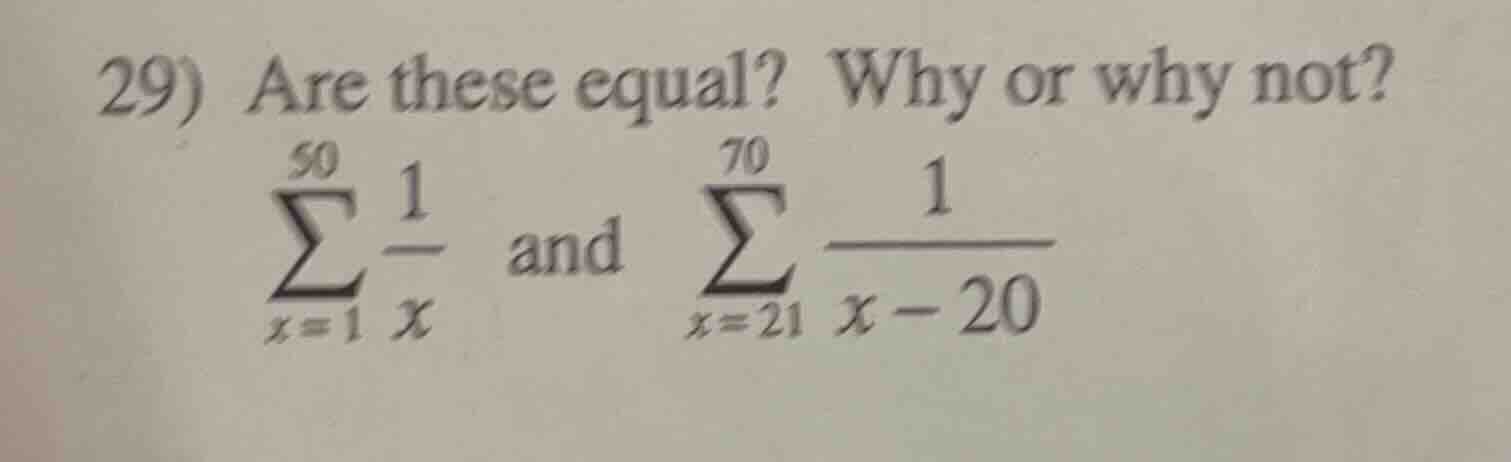
- are these equal? why or why not?
\\(\displaystyle \sum_{x=1}^{50} \frac{1}{x}\\) and \\(\displaystyle \sum_{x=21}^{70} \frac{1}{x - 20}\\)
Step1: Analyze the second sum with substitution
Let \( y = x - 20 \) in the second sum \( \sum_{x = 21}^{70}\frac{1}{x - 20} \). When \( x = 21 \), \( y=21 - 20 = 1 \); when \( x = 70 \), \( y=70 - 20 = 50 \). So the second sum becomes \( \sum_{y = 1}^{50}\frac{1}{y} \).
Step2: Compare the two sums
The first sum is \( \sum_{x = 1}^{50}\frac{1}{x} \), and after substitution, the second sum is \( \sum_{y = 1}^{50}\frac{1}{y} \). Since the variable of summation is a dummy variable (it can be renamed without changing the sum), these two sums are equal.

Snap & solve any problem in the app
Get step-by-step solutions on Sovi AI
Photo-based solutions with guided steps
Explore more problems and detailed explanations
Yes, they are equal. Because we can use the substitution \( y=x - 20 \) in the second sum, which transforms \( \sum_{x = 21}^{70}\frac{1}{x - 20} \) into \( \sum_{y = 1}^{50}\frac{1}{y} \), and the dummy variable \( y \) (or \( x \)) does not affect the value of the sum, so it is equal to \( \sum_{x = 1}^{50}\frac{1}{x} \).