QUESTION IMAGE
Question
6.2b (l)
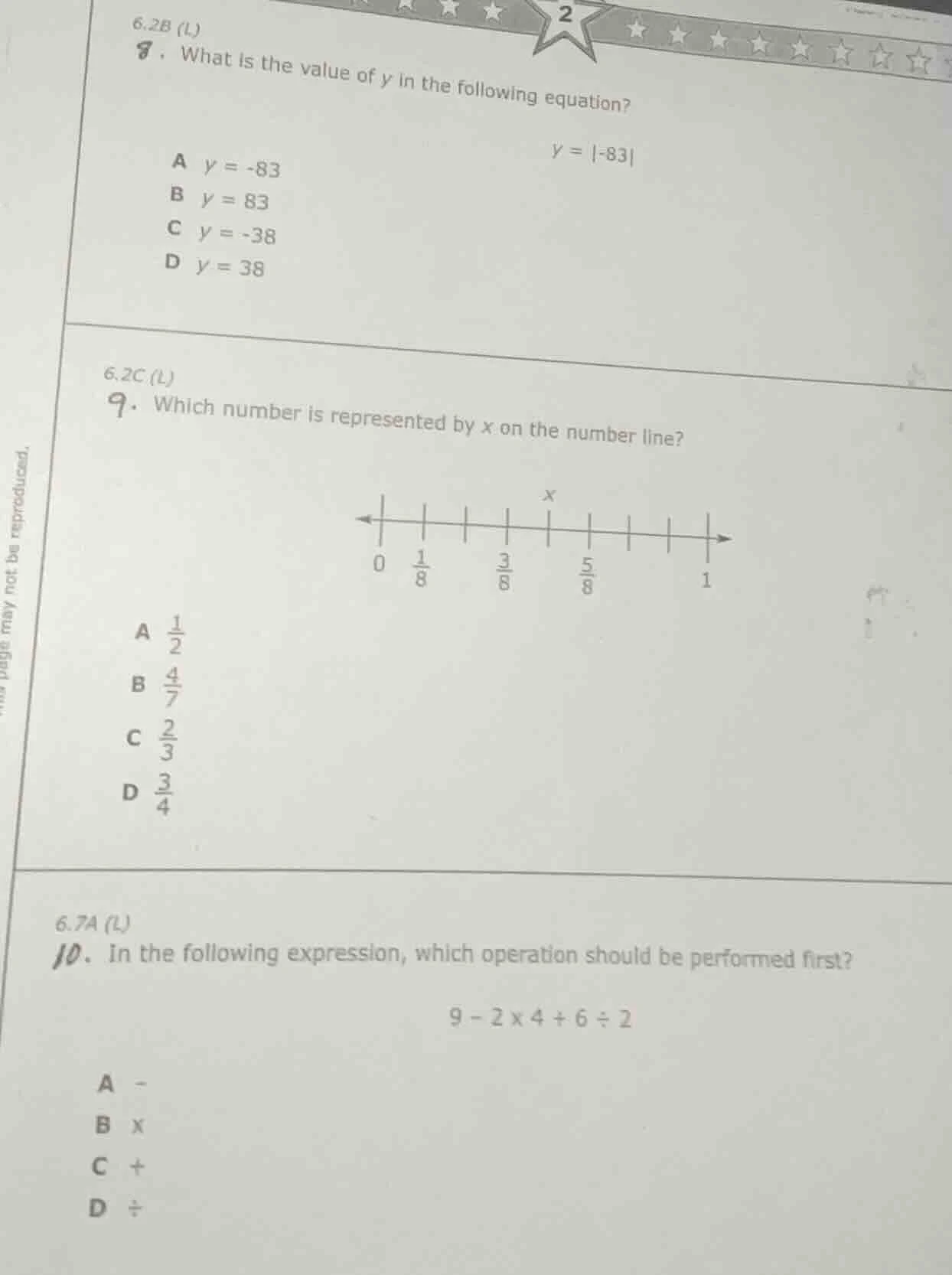
- what is the value of y in the following equation?
$y = |-83|$
a $y = -83$
b $y = 83$
c $y = -38$
d $y = 38$
6.2c (l)
- which number is represented by x on the number line?
number line with 0, 1/8, 3/8, x, 5/8, 1
a $\frac{1}{2}$
b $\frac{4}{7}$
c $\frac{2}{3}$
d $\frac{3}{4}$
6.7a (l)
- in the following expression, which operation should be performed first?
$9 - 2 \times 4 + 6 \div 2$
a $-$
b $\times$
c $+$
d $\div$
Question 8
Step1: Recall absolute value definition
The absolute value of a number \( a \), denoted \( |a| \), is the distance of \( a \) from 0 on the number line, so it's always non - negative. For \( a=-83 \), \( | - 83| \) is the distance of - 83 from 0, which is 83.
Step1: Analyze the number line intervals
The number line has marks at \( 0,\frac{1}{8},\frac{3}{8},\frac{5}{8},1 \). The distance between \( \frac{3}{8} \) and \( \frac{5}{8} \) is \( \frac{5}{8}-\frac{3}{8}=\frac{2}{8}=\frac{1}{4} \). The point \( x \) is halfway between \( \frac{3}{8} \) and \( \frac{5}{8} \)? Wait, no, let's count the intervals. From 0 to 1, the intervals between the marks: from 0 to \( \frac{1}{8} \) is 1 interval, \( \frac{1}{8} \) to next (let's say \( \frac{2}{8}=\frac{1}{4} \)) is the second, \( \frac{2}{8} \) to \( \frac{3}{8} \) third, \( \frac{3}{8} \) to \( x \) fourth, \( x \) to \( \frac{5}{8} \) fifth? Wait, no, looking at the number line, the marks are at \( 0,\frac{1}{8},\frac{3}{8},\frac{5}{8},1 \). Wait, actually, the difference between \( \frac{1}{8} \) and \( \frac{3}{8} \) is \( \frac{2}{8}=\frac{1}{4} \), so the step between each mark is \( \frac{1}{8} \)? Wait, no, \( 0,\frac{1}{8} \) (1st interval), then next should be \( \frac{2}{8}=\frac{1}{4} \), then \( \frac{3}{8} \), then \( \frac{4}{8}=\frac{1}{2} \), then \( \frac{5}{8} \), etc. So \( x \) is at \( \frac{4}{8}=\frac{1}{2} \)? Wait, no, let's check the options. Option A is \( \frac{1}{2} \), which is \( \frac{4}{8} \). Let's see the positions: \( 0,\frac{1}{8},\frac{2}{8},\frac{3}{8},\frac{4}{8},\frac{5}{8},...1 \). So \( x \) is at \( \frac{4}{8}=\frac{1}{2} \).
Step1: Recall order of operations (PEMDAS/BODMAS)
The order of operations is Parentheses, Exponents, Multiplication and Division (from left to right), Addition and Subtraction (from left to right). In the expression \( 9 - 2\times4+6\div2 \), we first perform multiplication and division from left to right. The multiplication \( 2\times4 \) and division \( 6\div2 \) are at the same level, but we start from the left. The first operation among multiplication and division is \( 2\times4 \) (the \( \times \) operation) and \( 6\div2 \) (the \( \div \) operation). But when considering which comes first in the expression, \( 2\times4 \) is to the left of \( 6\div2 \). But the question is which operation should be performed first. Multiplication and division have the same precedence, but we do them from left to right. So the first operation to perform is either \( 2\times4 \) (multiplication) or \( 6\div2 \) (division). But in the expression, \( 2\times4 \) is before \( 6\div2 \) from left to right. Wait, but let's check the options. The options are -, \( \times \), +, \( \div \). According to PEMDAS, multiplication and division are done before addition and subtraction. So among the operations in the expression, multiplication (\( \times \)) and division (\( \div \)) are to be done before subtraction (-) and addition (+). Now, between \( \times \) (2×4) and \( \div \) (6÷2), we do them from left to right. So the first operation to perform is \( 2\times4 \) (the \( \times \) operation) or \( 6\div2 \) (the \( \div \) operation)? Wait, the expression is \( 9 - 2\times4+6\div2 \). So we scan from left to right for multiplication and division. The first multiplication or division is \( 2\times4 \) (the \( \times \) operation) at position 2 - 4 (2×4). So the operation to perform first is multiplication (\( \times \)).

Snap & solve any problem in the app
Get step-by-step solutions on Sovi AI
Photo-based solutions with guided steps
Explore more problems and detailed explanations
B. \( y = 83 \)