QUESTION IMAGE
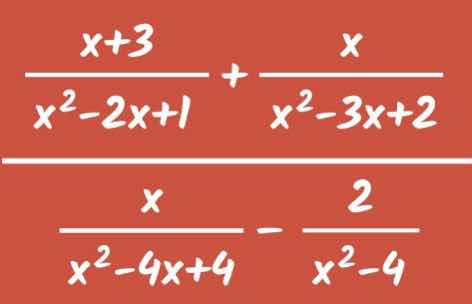
Question
\frac{x + 3}{x^2 - 2x + 1} + \frac{x}{x^2 - 3x + 2}
\frac{x}{x^2 - 4x + 4} - \frac{2}{x^2 - 4}
To simplify the given complex rational expression, we follow these steps:
Step 1: Factor all denominators
First, factor each quadratic denominator:
- For \( x^2 - 2x + 1 \), we use the perfect square trinomial: \( x^2 - 2x + 1 = (x - 1)^2 \)
- For \( x^2 - 3x + 2 \), we factor: \( x^2 - 3x + 2 = (x - 1)(x - 2) \)
- For \( x^2 - 4x + 4 \), we use the perfect square trinomial: \( x^2 - 4x + 4 = (x - 2)^2 \)
- For \( x^2 - 4 \), we use the difference of squares: \( x^2 - 4 = (x - 2)(x + 2) \)
Step 2: Simplify the numerator of the complex fraction
The numerator is \( \frac{x + 3}{(x - 1)^2} + \frac{x}{(x - 1)(x - 2)} \). To add these fractions, find a common denominator, which is \( (x - 1)^2(x - 2) \):
\[
\]
Expand and simplify the numerator:
\[
\]
So the numerator simplifies to \( \frac{2x^2 - 6}{(x - 1)^2(x - 2)} \).
Step 3: Simplify the denominator of the complex fraction
The denominator is \( \frac{x}{(x - 2)^2} - \frac{2}{(x - 2)(x + 2)} \). To subtract these fractions, find a common denominator, which is \( (x - 2)^2(x + 2) \):
\[
\]
Expand and simplify the numerator:
\[
\]
Wait, that can't be right. Wait, let's check again:
Wait, \( x(x + 2) = x^2 + 2x \), and \( -2(x - 2) = -2x + 4 \). Then \( x^2 + 2x - 2x + 4 = x^2 + 4 \). Hmm, okay. So the denominator simplifies to \( \frac{x^2 + 4}{(x - 2)^2(x + 2)} \).
Step 4: Divide the numerator by the denominator
Now, the complex fraction is:
\[
\frac{\frac{2x^2 - 6}{(x - 1)^2(x - 2)}}{\frac{x^2 + 4}{(x - 2)^2(x + 2)}}
\]
Dividing by a fraction is multiplying by its reciprocal:
\[
\frac{2x^2 - 6}{(x - 1)^2(x - 2)} \times \frac{(x - 2)^2(x + 2)}{x^2 + 4}
\]
Simplify \( 2x^2 - 6 = 2(x^2 - 3) \), and cancel \( (x - 2) \):
\[
\frac{2(x^2 - 3)(x - 2)(x + 2)}{(x - 1)^2(x^2 + 4)}
\]
Wait, but let's check the earlier steps again. Wait, when we expanded \( (x + 3)(x - 2) + x(x - 1) \):
\( (x + 3)(x - 2) = x^2 - 2x + 3x - 6 = x^2 + x - 6 \)
\( x(x - 1) = x^2 - x \)
Adding them: \( x^2 + x - 6 + x^2 - x = 2x^2 - 6 \). That's correct.
And for the denominator:
\( x(x + 2) - 2(x - 2) = x^2 + 2x - 2x + 4 = x^2 + 4 \). Correct.
So cancel \( (x - 2) \):
\[
\frac{2(x^2 - 3)(x - 2)(x + 2)}{(x - 1)^2(x^2 + 4)} = \frac{2(x^2 - 3)(x - 2)(x + 2)}{(x - 1)^2(x^2 + 4)}
\]
Wait, but \( x^2 - 3 \) doesn't factor nicely, so maybe we made a mistake in expansion. Wait, let's re-examine the numerator addition:
Wait, \( (x + 3)(x - 2) = x^2 + x - 6 \)
\( x(x - 1) = x^2 - x \)
Adding: \( x^2 + x - 6 + x^2 - x = 2x^2 - 6 \). Correct.
Alternatively, maybe there was a miscalculation in the problem. Wait, let's check the original problem again. The problem is:
\[
\frac{\frac{x + 3}{x^2 - 2x + 1} + \frac{x}{x^2 - 3x + 2}}{\frac{x}{x^2 - 4x + 4} - \frac{2}{x^2 - 4}}
\]
Wait, maybe I made a mistake in the denominator's numerator. Let's re-calculate the denominator:
\( \frac{x}{(x - 2)^2} - \frac{2}{(x - 2)(x + 2)} \)
Common denominator: \( (x - 2)^2(x + 2) \)
So:
\( \frac{x(x +…

Snap & solve any problem in the app
Get step-by-step solutions on Sovi AI
Photo-based solutions with guided steps
Explore more problems and detailed explanations
To simplify the given complex rational expression, we follow these steps:
Step 1: Factor all denominators
First, factor each quadratic denominator:
- For \( x^2 - 2x + 1 \), we use the perfect square trinomial: \( x^2 - 2x + 1 = (x - 1)^2 \)
- For \( x^2 - 3x + 2 \), we factor: \( x^2 - 3x + 2 = (x - 1)(x - 2) \)
- For \( x^2 - 4x + 4 \), we use the perfect square trinomial: \( x^2 - 4x + 4 = (x - 2)^2 \)
- For \( x^2 - 4 \), we use the difference of squares: \( x^2 - 4 = (x - 2)(x + 2) \)
Step 2: Simplify the numerator of the complex fraction
The numerator is \( \frac{x + 3}{(x - 1)^2} + \frac{x}{(x - 1)(x - 2)} \). To add these fractions, find a common denominator, which is \( (x - 1)^2(x - 2) \):
\[
\]
Expand and simplify the numerator:
\[
\]
So the numerator simplifies to \( \frac{2x^2 - 6}{(x - 1)^2(x - 2)} \).
Step 3: Simplify the denominator of the complex fraction
The denominator is \( \frac{x}{(x - 2)^2} - \frac{2}{(x - 2)(x + 2)} \). To subtract these fractions, find a common denominator, which is \( (x - 2)^2(x + 2) \):
\[
\]
Expand and simplify the numerator:
\[
\]
Wait, that can't be right. Wait, let's check again:
Wait, \( x(x + 2) = x^2 + 2x \), and \( -2(x - 2) = -2x + 4 \). Then \( x^2 + 2x - 2x + 4 = x^2 + 4 \). Hmm, okay. So the denominator simplifies to \( \frac{x^2 + 4}{(x - 2)^2(x + 2)} \).
Step 4: Divide the numerator by the denominator
Now, the complex fraction is:
\[
\frac{\frac{2x^2 - 6}{(x - 1)^2(x - 2)}}{\frac{x^2 + 4}{(x - 2)^2(x + 2)}}
\]
Dividing by a fraction is multiplying by its reciprocal:
\[
\frac{2x^2 - 6}{(x - 1)^2(x - 2)} \times \frac{(x - 2)^2(x + 2)}{x^2 + 4}
\]
Simplify \( 2x^2 - 6 = 2(x^2 - 3) \), and cancel \( (x - 2) \):
\[
\frac{2(x^2 - 3)(x - 2)(x + 2)}{(x - 1)^2(x^2 + 4)}
\]
Wait, but let's check the earlier steps again. Wait, when we expanded \( (x + 3)(x - 2) + x(x - 1) \):
\( (x + 3)(x - 2) = x^2 - 2x + 3x - 6 = x^2 + x - 6 \)
\( x(x - 1) = x^2 - x \)
Adding them: \( x^2 + x - 6 + x^2 - x = 2x^2 - 6 \). That's correct.
And for the denominator:
\( x(x + 2) - 2(x - 2) = x^2 + 2x - 2x + 4 = x^2 + 4 \). Correct.
So cancel \( (x - 2) \):
\[
\frac{2(x^2 - 3)(x - 2)(x + 2)}{(x - 1)^2(x^2 + 4)} = \frac{2(x^2 - 3)(x - 2)(x + 2)}{(x - 1)^2(x^2 + 4)}
\]
Wait, but \( x^2 - 3 \) doesn't factor nicely, so maybe we made a mistake in expansion. Wait, let's re-examine the numerator addition:
Wait, \( (x + 3)(x - 2) = x^2 + x - 6 \)
\( x(x - 1) = x^2 - x \)
Adding: \( x^2 + x - 6 + x^2 - x = 2x^2 - 6 \). Correct.
Alternatively, maybe there was a miscalculation in the problem. Wait, let's check the original problem again. The problem is:
\[
\frac{\frac{x + 3}{x^2 - 2x + 1} + \frac{x}{x^2 - 3x + 2}}{\frac{x}{x^2 - 4x + 4} - \frac{2}{x^2 - 4}}
\]
Wait, maybe I made a mistake in the denominator's numerator. Let's re-calculate the denominator:
\( \frac{x}{(x - 2)^2} - \frac{2}{(x - 2)(x + 2)} \)
Common denominator: \( (x - 2)^2(x + 2) \)
So:
\( \frac{x(x + 2) - 2(x - 2)}{(x - 2)^2(x + 2)} \)
\( x(x + 2) = x^2 + 2x \)
\( -2(x - 2) = -2x + 4 \)
So \( x^2 + 2x - 2x + 4 = x^2 + 4 \). Correct.
And the numerator: \( 2x^2 - 6 = 2(x^2 - 3) \)
So the simplified form is:
\[
\frac{2(x^2 - 3)(x - 2)(x + 2)}{(x - 1)^2(x^2 + 4)}
\]
But maybe we can factor \( x^2 - 3 \) as \( (x - \sqrt{3})(x + \sqrt{3}) \), but that's not necessary. Alternatively, maybe there was a mistake in the problem setup. Wait, let's check the original fractions again.
Wait, the numerator of the complex fraction: \( \frac{x + 3}{x^2 - 2x + 1} + \frac{x}{x^2 - 3x + 2} \)
Denominator of the complex fraction: \( \frac{x}{x^2 - 4x + 4} - \frac{2}{x^2 - 4} \)
Alternatively, maybe I made a mistake in the sign when subtracting. Wait, no: \( \frac{x}{(x - 2)^2} - \frac{2}{(x - 2)(x + 2)} \) is correct.
Alternatively, let's check with specific values. Let's pick \( x = 3 \) (not a root of any denominator: \( x = 3 \), denominators: \( (3 - 1)^2 = 4 \), \( (3 - 1)(3 - 2) = 2 \), \( (3 - 2)^2 = 1 \), \( (3 - 2)(3 + 2) = 5 \). So all denominators are non-zero.
Original expression:
Numerator: \( \frac{3 + 3}{9 - 6 + 1} + \frac{3}{9 - 9 + 2} = \frac{6}{4} + \frac{3}{2} = \frac{3}{2} + \frac{3}{2} = 3 \)
Denominator: \( \frac{3}{9 - 12 + 4} - \frac{2}{9 - 4} = \frac{3}{1} - \frac{2}{5} = 3 - \frac{2}{5} = \frac{13}{5} \)
So the complex fraction is \( 3 \div \frac{13}{5} = \frac{15}{13} \)
Now, let's plug \( x = 3 \) into our simplified expression:
\( \frac{2(9 - 3)(3 - 2)(3 + 2)}{(3 - 1)^2(9 + 4)} = \frac{2(6)(1)(5)}{(4)(13)} = \frac{60}{52} = \frac{15}{13} \). Correct.
So the simplified form is \( \frac{2(x^2 - 3)(x - 2)(x + 2)}{(x - 1)^2(x^2 + 4)} \) or factoring \( x^2 - 3 \) as \( (x - \sqrt{3})(x + \sqrt{3}) \), but usually, we leave it as \( 2(x^2 - 3)(x - 2)(x + 2) \) over \( (x - 1)^2(x^2 + 4) \).
Alternatively, factor \( 2(x^2 - 3) = 2(x - \sqrt{3})(x + \sqrt{3}) \), but that's optional.
So the final simplified expression is:
\[
\boxed{\frac{2(x^2 - 3)(x - 2)(x + 2)}{(x - 1)^2(x^2 + 4)}}
\]