QUESTION IMAGE
Question
- circle the appropriate letter to identify the primary pattern of organization.
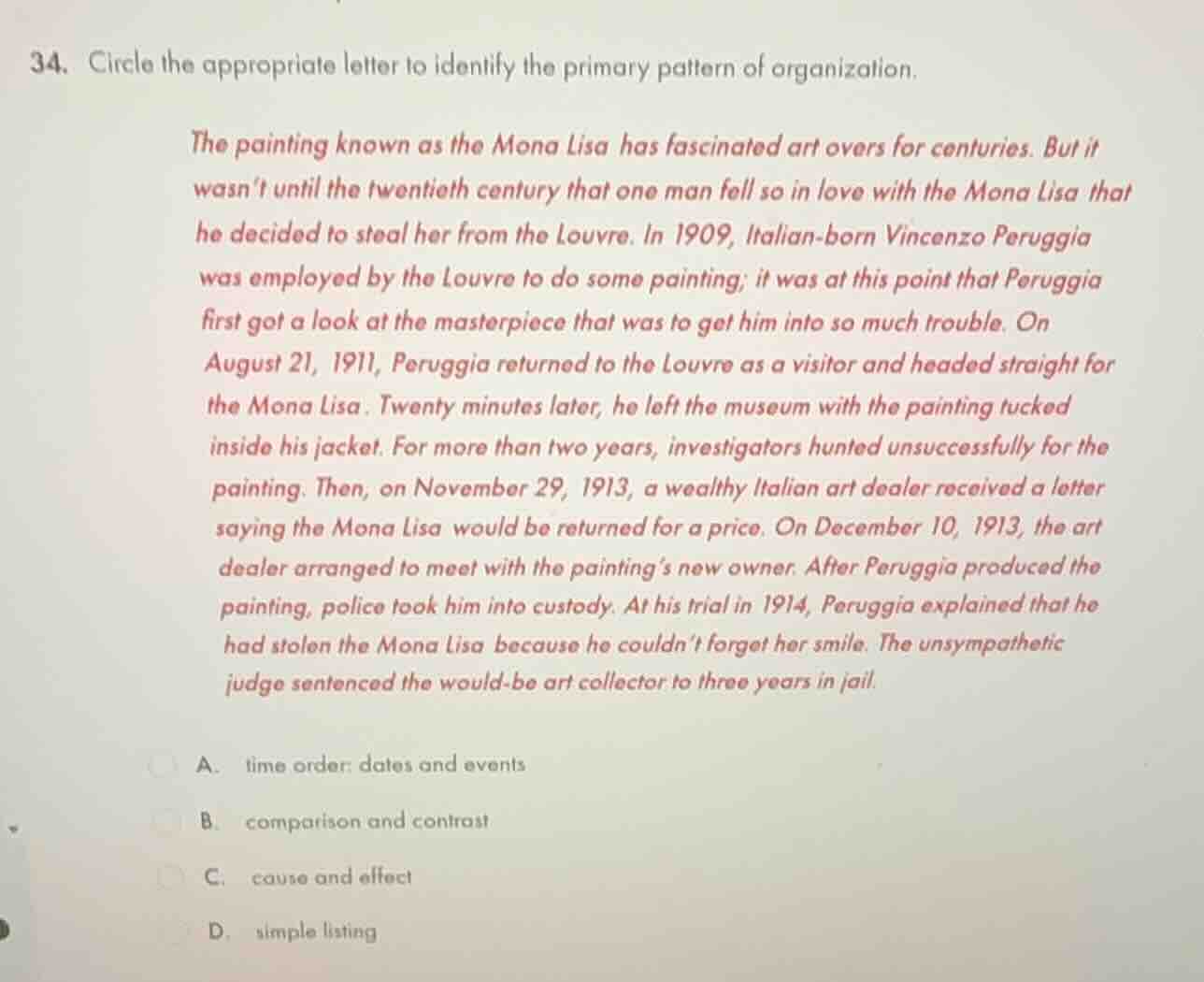
the painting known as the mona lisa has fascinated art overs for centuries. but it wasnt until the twentieth century that one man fell so in love with the mona lisa that he decided to steal her from the louvre. in 1909, italian - born vincenzo peruggia was employed by the louvre to do some painting; it was at this point that peruggia first got a look at the masterpiece that was to get him into so much trouble. on august 21, 1911, peruggia returned to the louvre as a visitor and headed straight for the mona lisa. twenty minutes later, he left the museum with the painting tucked inside his jacket. for more than two years, investigators hunted unsuccessfully for the painting. then, on november 29, 1913, a wealthy italian art dealer received a letter saying the mona lisa would be returned for a price. on december 10, 1913, the art dealer arranged to meet with the paintings new owner. after peruggia produced the painting, police took him into custody. at his trial in 1914, peruggia explained that he had stolen the mona lisa because he couldnt forget her smile. the unsympathetic judge sentenced the would - be art collector to three years in jail.
a. time order: dates and events
b. comparison and contrast
c. cause and effect
d. simple listing
The passage describes events related to the theft of the Mona Lisa in chronological order, with specific dates (1909, August 21, 1911, November 29, 1913, December 10, 1913, 1914) and corresponding events (Peruggia's employment, theft, search, ransom attempt, arrest, trial, sentencing). Option A matches this time - order structure. Option B is incorrect as there's no comparison/contrast. Option C is incorrect as the focus is on sequential events, not cause - effect relationships (though a cause is given at the end, the primary pattern is time - ordered events). Option D is incorrect as it's not a simple listing of items.

Snap & solve any problem in the app
Get step-by-step solutions on Sovi AI
Photo-based solutions with guided steps
Explore more problems and detailed explanations
A. time order: dates and events