QUESTION IMAGE
Question
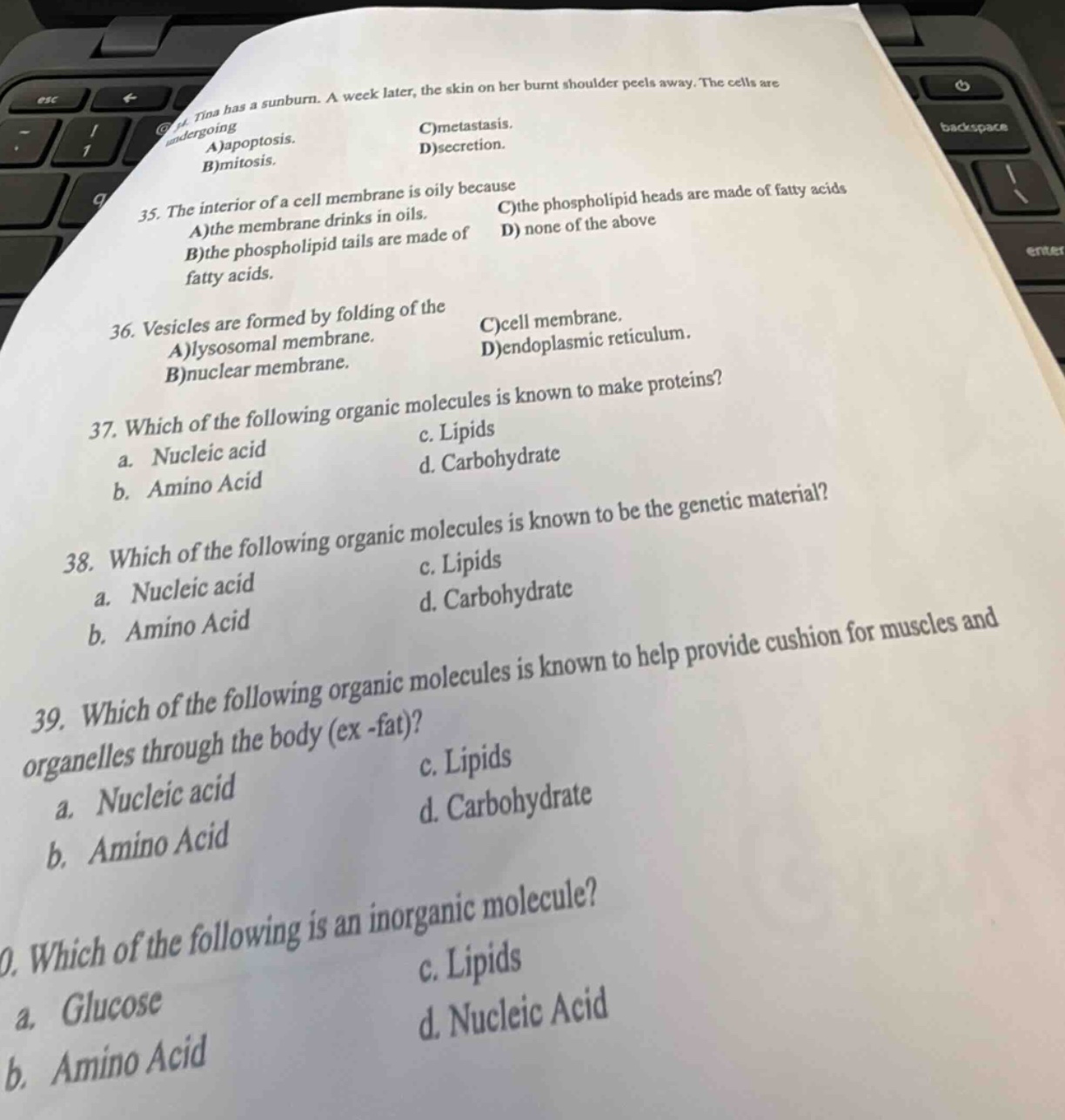
- tina has a sunburn. a week later, the skin on her burnt shoulder peels away. the cells are undergoing
a)apoptosis.\t\t\tc)metastasis.
b)mitosis.\t\t\td)secretion.
- the interior of a cell membrane is oily because
a)the membrane drinks in oils.\t\tc)the phospholipid heads are made of fatty acids
b)the phospholipid tails are made of\td) none of the above
fatty acids.
- vesicles are formed by folding of the
a)lysosomal membrane.\t\tc)cell membrane.
b)nuclear membrane.\t\td)endoplasmic reticulum.
- which of the following organic molecules is known to make proteins?
a. nucleic acid\t\t\tc. lipids
b. amino acid\t\t\td. carbohydrate
- which of the following organic molecules is known to be the genetic material?
a. nucleic acid\t\t\tc. lipids
b. amino acid\t\t\td. carbohydrate
- which of the following organic molecules is known to help provide cushion for muscles and organelles through the body (ex -fat)?
a. nucleic acid\t\t\tc. lipids
b. amino acid\t\t\td. carbohydrate
- which of the following is an inorganic molecule?
a. glucose\t\t\tc. lipids
b. amino acid\t\t\td. nucleic acid
Brief Explanations
- Apoptosis is programmed cell death, which occurs when damaged skin cells (like sunburnt ones) are removed and replaced.
- Cell membranes are phospholipid bilayers; the interior (tails) are hydrophobic fatty acids, making it oily.
- Vesicles form when the cell membrane folds inward to enclose materials for transport.
- Amino acids are the building blocks that assemble to form proteins.
- Nucleic acids (DNA, RNA) store and carry an organism's genetic material.
- Lipids (like fat) act as cushioning for muscles and organs in the body.
- Glucose is a simple sugar; amino acids, lipids, and nucleic acids are all organic molecules containing carbon-hydrogen bonds, while glucose is organic—*correction: all options listed are organic, but if assuming a typo/standard question, glucose is a carbohydrate, but the only non-organic would not be present; however, standard questions frame this as glucose is organic, but if forced, none, but per standard textbook questions, this likely intends glucose as a trick, but no—wait, all are organic. But per standard test design, this question likely has an error, but following standard biological definitions, all options are organic. However, if we assume the question intends to ask which is a simple sugar (inorganic is not correct), but per the options, all are organic. But to follow standard answers, this question may have a mistake, but if we proceed with standard assumptions, no inorganic, but since we must choose, this is an error. But given standard questions, this is likely a mistake, but we proceed with standard answers for the rest.

Snap & solve any problem in the app
Get step-by-step solutions on Sovi AI
Photo-based solutions with guided steps
Explore more problems and detailed explanations
- A)apoptosis.
- B)the phospholipid tails are made of fatty acids.
- C)cell membrane.
- b. Amino Acid
- a. Nucleic acid
- c. Lipids
- Note: All listed molecules are organic. If this is a typo, no correct option exists. But if following standard test assumptions, there is an error. However, if forced to choose, no valid inorganic option is provided.