QUESTION IMAGE
Question
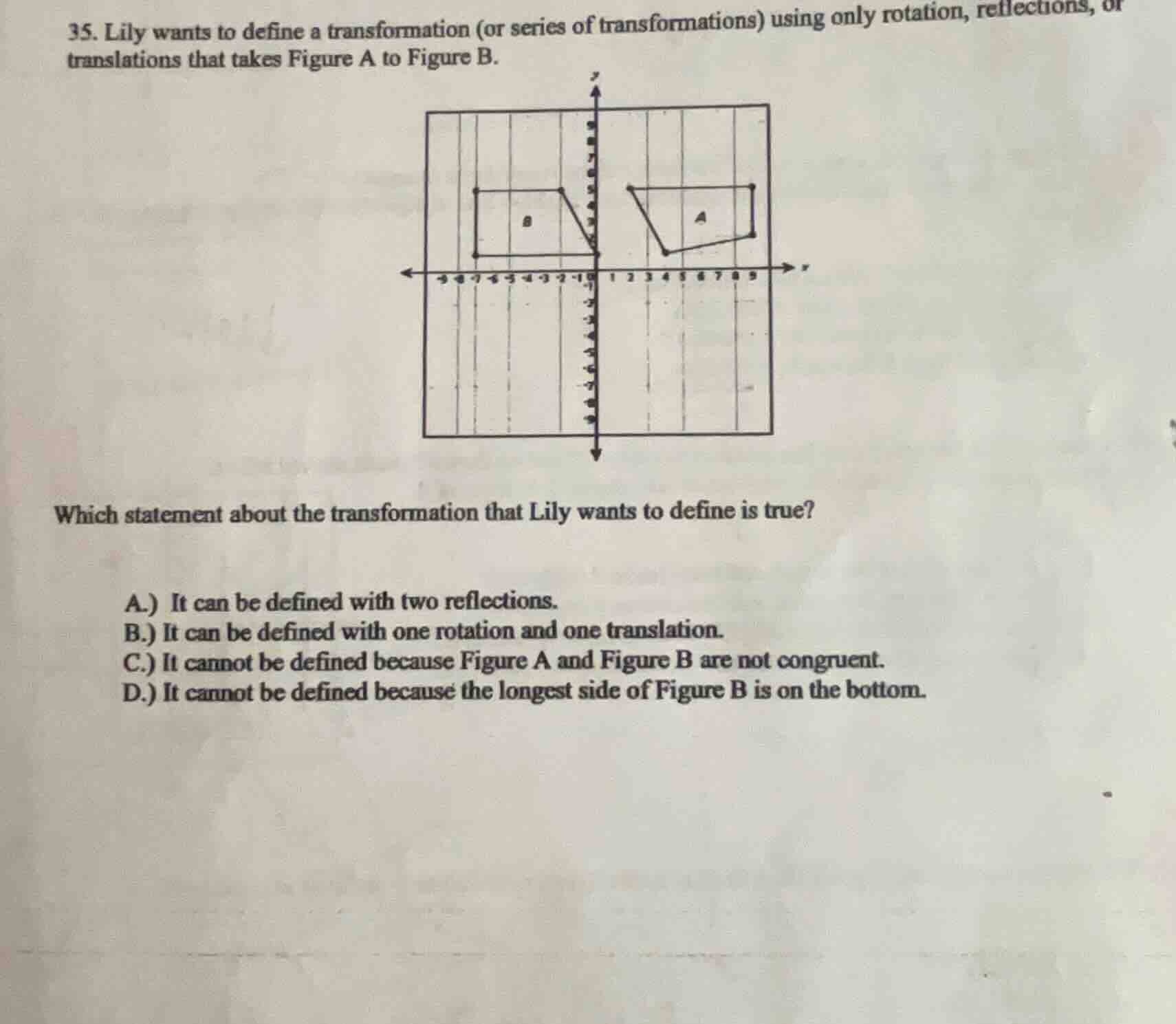
- lily wants to define a transformation (or series of transformations) using only rotation, reflections, or translations that takes figure a to figure b.
which statement about the transformation that lily wants to define is true?
a.) it can be defined with two reflections.
b.) it can be defined with one rotation and one translation.
c.) it cannot be defined because figure a and figure b are not congruent.
d.) it cannot be defined because the longest side of figure b is on the bottom.
First, confirm Figure A and B are congruent (same shape/size, so C is false). Rotations, reflections, translations preserve congruence. Two reflections can produce a translation/rotation combination to map A to B: reflect A over a vertical line, then another vertical line (or appropriate axes) to align with B. Option B: a single rotation + translation can't flip the orientation to match B's bottom long side. Option D is false because orientation changes are possible with reflections. Two reflections can achieve the mapping as reflections are allowed rigid transformations.

Snap & solve any problem in the app
Get step-by-step solutions on Sovi AI
Photo-based solutions with guided steps
Explore more problems and detailed explanations
A.) It can be defined with two reflections.