QUESTION IMAGE
Question
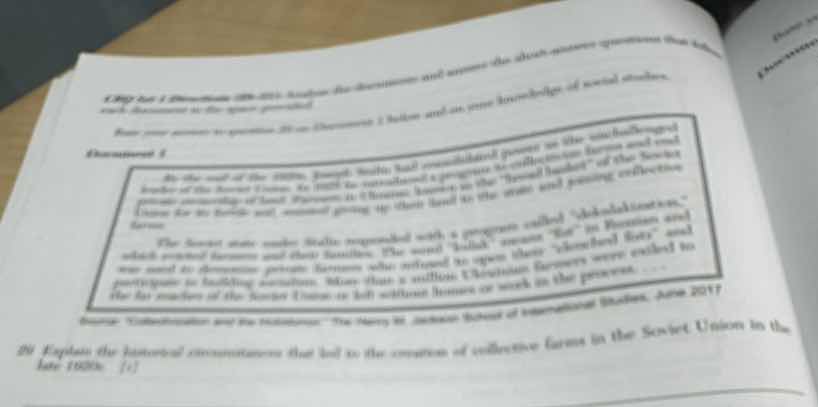
1.39 set 1 questions (28 - 31): analyze the document and answer the short - answer questions that follow. each document is to be given. base your answer to question 28 on document 1 below and on your knowledge of social studies. document 1 by the end of the 1920s, joseph stalin had consolidated power as the unchallenged leader of the soviet union. he tried to transform a system of small - scale individual farms and small - scale trading and owned property in russia to the “total control” of the soviet union. he began to force landowners to give their land to the state and passing edicts to force the building of new, enormous (in size) land... the soviet state made stalin responded with a program called “dekulakization,” which seized (took) farms and their families. the word “kulak” meant “fat (in body)” and was used to describe (name) persons who refused to open their “closed (private)” and participate in building socialism. many of these christian farmers were exiled to the far reaches of the soviet union to be left without homes or work in the present... source: introduction of the historian, “the henry m. jackson school of international studies, june 2017 28 explain the historical circumstances that led to the creation of collective farms in the soviet union in the late 1920s. 5
To explain the historical circumstances leading to collective farms in the Soviet Union late 1920s, we analyze:
- Economic Crisis: After the Russian Civil War (1918–1921), Soviet agriculture was devastated. Small, inefficient peasant farms (kulaks dominated some) struggled to meet urban food demands or supply raw materials for industry.
- Kulak Resistance: Kulaks (wealthier peasants) resisted grain requisitioning (part of War Communism, then NEP). Their hoarding/sabotage during food shortages (e.g., 1927–1928 grain crisis) threatened urban stability and industrialization plans.
- Ideological & Industrial Goals: Stalin’s vision prioritized rapid industrialization. Collective farms (kolkhozes) centralized agriculture, enabling state control over production, surplus extraction for factories, and mechanization (via tractors, etc.).
- Social Engineering: The Soviet state sought to eliminate class differences in the countryside. Collectivization aimed to transform peasants into a “proletarianized” rural class, aligned with socialist ideology, and weaken kulak influence.

Snap & solve any problem in the app
Get step-by-step solutions on Sovi AI
Photo-based solutions with guided steps
Explore more problems and detailed explanations
The creation of collective farms (kolkhozes) in the Soviet Union in the late 1920s was driven by:
- Economic Crisis: Post - Civil War agricultural collapse, peasant inefficiency, and urban food/raw material shortages.
- Kulak Resistance: Wealthy peasants (kulaks) hoarded grain, sabotaging state requisitioning (e.g., 1927–1928 grain crisis).
- Industrialization Goals: Stalin’s push for rapid industrialization required centralized agricultural production to fund factories (via surplus extraction) and supply raw materials.
- Ideological/Social Aims: Eliminate rural class differences, “proletarianize” peasants, and enforce socialist control over the countryside.
Collectivization centralized farming, enabling state - managed surplus extraction, mechanization, and ideological conformity.