QUESTION IMAGE
Question
3d objects: rectangular prisms and cubes
measurement – lesson 4
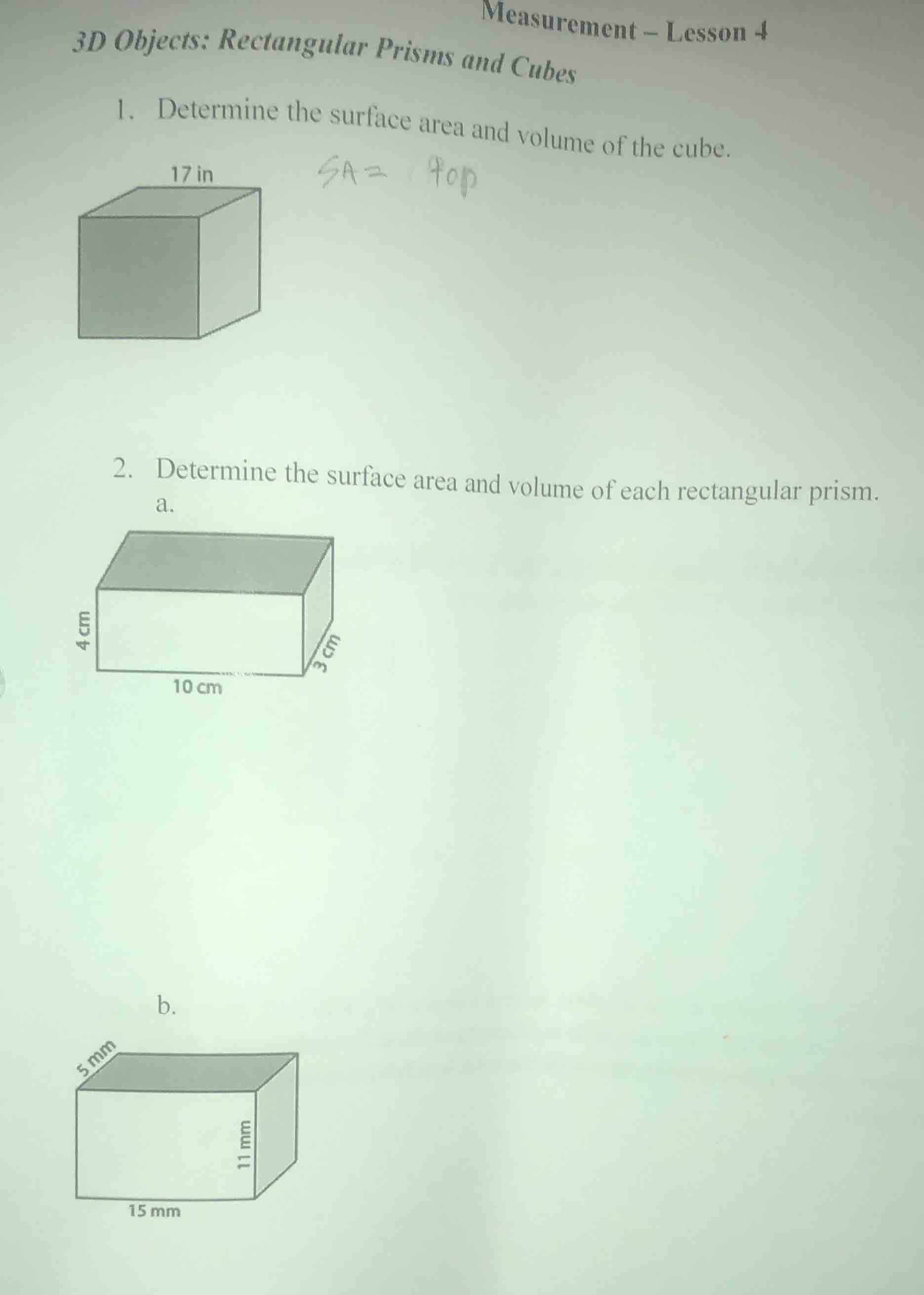
- determine the surface area and volume of the cube.
- determine the surface area and volume of each rectangular prism.
a.
b.
Problem 1: Cube with side length 17 in
Surface Area of Cube
Step1: Recall the formula for the surface area of a cube.
The surface area \( SA \) of a cube is given by the formula \( SA = 6s^2 \), where \( s \) is the length of a side of the cube.
Step2: Substitute the given side length into the formula.
Here, \( s = 17 \) in. So we substitute \( s = 17 \) into the formula:
\( SA = 6\times(17)^2 \)
First, calculate \( 17^2 = 289 \). Then, multiply by 6: \( 6\times289 = 1734 \) square inches.
Volume of Cube
Step1: Recall the formula for the volume of a cube.
The volume \( V \) of a cube is given by the formula \( V = s^3 \), where \( s \) is the length of a side of the cube.
Step2: Substitute the given side length into the formula.
Here, \( s = 17 \) in. So we substitute \( s = 17 \) into the formula:
\( V = (17)^3 \)
Calculate \( 17\times17\times17 = 4913 \) cubic inches.
Step1: Recall the formula for the surface area of a rectangular prism.
The surface area \( SA \) of a rectangular prism is given by the formula \( SA = 2(lw + lh + wh) \), where \( l \) is the length, \( w \) is the width, and \( h \) is the height.
Step2: Substitute the given dimensions into the formula.
Here, \( l = 10 \) cm, \( w = 3 \) cm, \( h = 4 \) cm.
First, calculate \( lw = 10\times3 = 30 \), \( lh = 10\times4 = 40 \), \( wh = 3\times4 = 12 \).
Then, sum these products: \( 30 + 40 + 12 = 82 \).
Multiply by 2: \( SA = 2\times82 = 164 \) square centimeters.
Volume of Rectangular Prism
Step1: Recall the formula for the volume of a rectangular prism.
The volume \( V \) of a rectangular prism is given by the formula \( V = lwh \).
Step2: Substitute the given dimensions into the formula.
Substitute \( l = 10 \) cm, \( w = 3 \) cm, \( h = 4 \) cm:
\( V = 10\times3\times4 = 120 \) cubic centimeters.
Step1: Recall the formula for the surface area of a rectangular prism.
The surface area \( SA \) of a rectangular prism is given by the formula \( SA = 2(lw + lh + wh) \), where \( l \) is the length, \( w \) is the width, and \( h \) is the height.
Step2: Substitute the given dimensions into the formula.
Here, \( l = 15 \) mm, \( w = 5 \) mm, \( h = 11 \) mm.
First, calculate \( lw = 15\times5 = 75 \), \( lh = 15\times11 = 165 \), \( wh = 5\times11 = 55 \).
Then, sum these products: \( 75 + 165 + 55 = 295 \).
Multiply by 2: \( SA = 2\times295 = 590 \) square millimeters.
Volume of Rectangular Prism
Step1: Recall the formula for the volume of a rectangular prism.
The volume \( V \) of a rectangular prism is given by the formula \( V = lwh \).
Step2: Substitute the given dimensions into the formula.
Substitute \( l = 15 \) mm, \( w = 5 \) mm, \( h = 11 \) mm:
\( V = 15\times5\times11 = 825 \) cubic millimeters.

Snap & solve any problem in the app
Get step-by-step solutions on Sovi AI
Photo-based solutions with guided steps
Explore more problems and detailed explanations
- Surface Area of the cube: \( \boldsymbol{1734} \) square inches.
- Volume of the cube: \( \boldsymbol{4913} \) cubic inches.