QUESTION IMAGE
Question
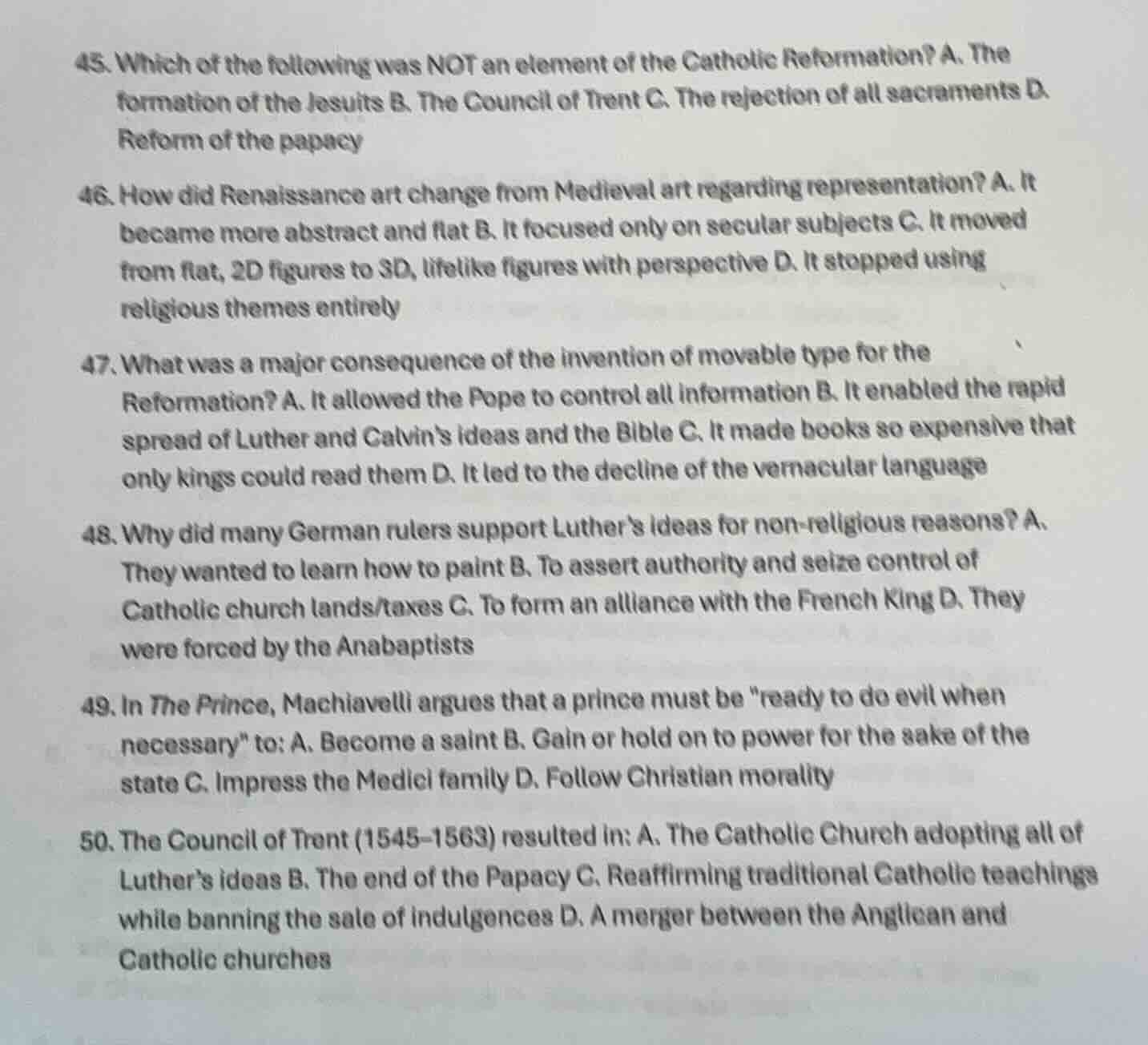
- which of the following was not an element of the catholic reformation? a. the formation of the jesuits b. the council of trent c. the rejection of all sacraments d. reform of the papacy
- how did renaissance art change from medieval art regarding representation? a. it became more abstract and flat b. it focused only on secular subjects c. it moved from flat, 2d figures to 3d, lifelike figures with perspective d. it stopped using religious themes entirely
- what was a major consequence of the invention of movable type for the reformation? a. it allowed the pope to control all information b. it enabled the rapid spread of luther and calvin’s ideas and the bible c. it made books so expensive that only kings could read them d. it led to the decline of the vernacular language
- why did many german rulers support luther’s ideas for non - religious reasons? a. they wanted to learn how to paint b. to assert authority and seize control of catholic church lands/taxes c. to form an alliance with the french king d. they were forced by the anabaptists
- in the prince, machiavelli argues that a prince must be
eady to do evil when necessary\ to: a. become a saint b. gain or hold on to power for the sake of the state c. impress the medici family d. follow christian morality
- the council of trent (1545 - 1563) resulted in: a. the catholic church adopting all of luther’s ideas b. the end of the papacy c. reaffirming traditional catholic teachings while banning the sale of indulgences d. a merger between the anglican and catholic churches
Brief Explanations
- The Catholic Reformation aimed to reform and strengthen the Church, not reject sacraments. The Jesuits, Council of Trent, and papal reform were all key elements of this movement.
- Renaissance art emphasized realism, perspective, and 3D representation, unlike the flat, stylized figures of Medieval art. It still included religious themes alongside secular ones.
- Movable type made printing faster and cheaper, which allowed Protestant ideas and vernacular Bibles to spread widely, undermining the Catholic Church's control over information.
- German rulers saw supporting Luther as a way to take control of Church lands and taxes within their territories, strengthening their own political authority.
- Machiavelli's core argument in The Prince is that a ruler should prioritize maintaining power and stability for the state, even if it requires morally questionable actions.
- The Council of Trent was a Catholic response to the Reformation: it reaffirmed traditional Catholic doctrines while addressing abuses like the sale of indulgences.

Snap & solve any problem in the app
Get step-by-step solutions on Sovi AI
Photo-based solutions with guided steps
Explore more problems and detailed explanations
- C. The rejection of all sacraments
- C. It moved from flat, 2D figures to 3D, lifelike figures with perspective
- B. It enabled the rapid spread of Luther and Calvin's ideas and the Bible
- B. To assert authority and seize control of Catholic church lands/taxes
- B. Gain or hold on to power for the sake of the state
- C. Reaffirming traditional Catholic teachings while banning the sale of indulgences