QUESTION IMAGE
Question
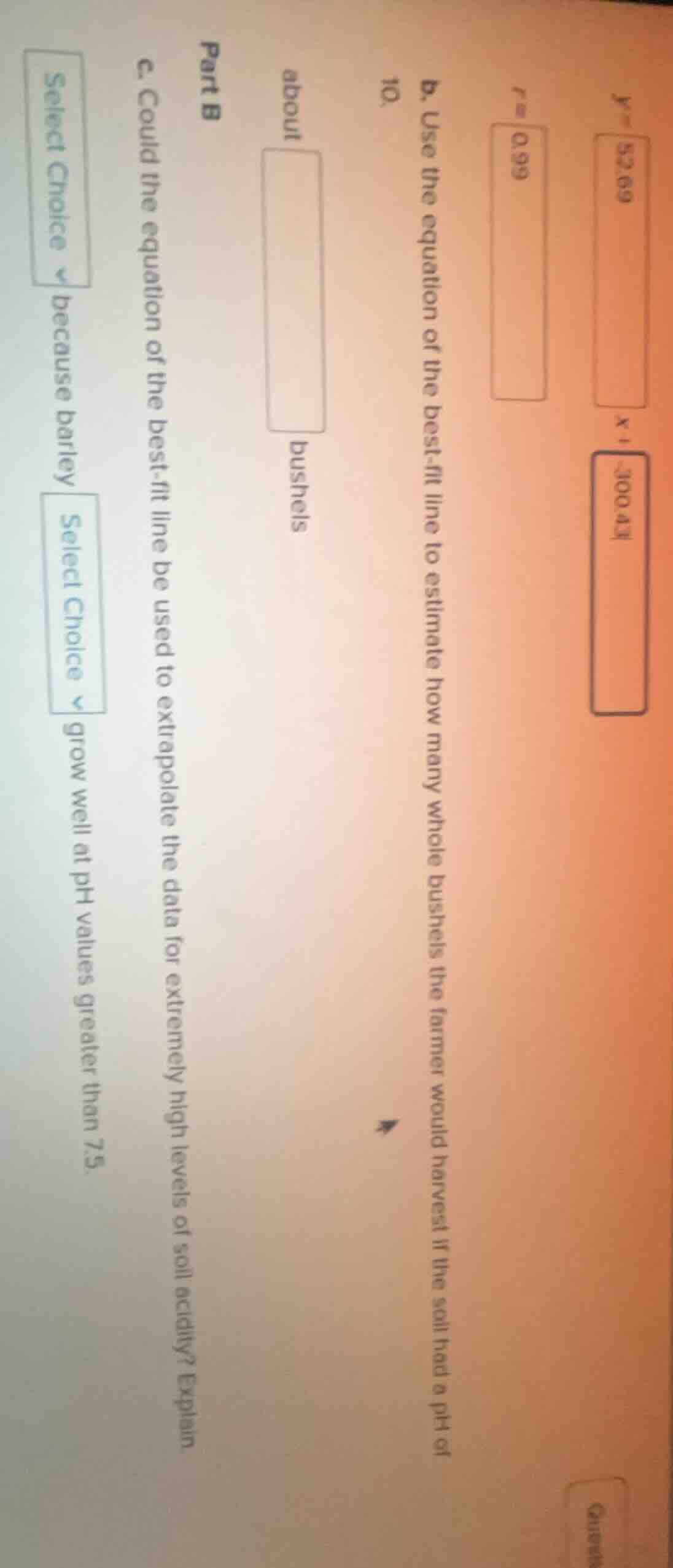
y = 52.69\
x1 - 100.41\
r = 0.99\
10.\
b. use the equation of the best - fit line to estimate how many whole bushels the farmer would harvest if the soil had a ph of about \
part b\
c. could the equation of the best - fit line be used to extrapolate the data for extremely high levels of soil acidity? explain\
select choice because barley select choice grow well at ph values greater than 7.5.
Part B - Question b (Estimation using Best - Fit Line)
Step 1: Identify the Best - Fit Line Equation
From the given information, the equation of the best - fit line is \(y = 52.69-10.041x\) (assuming \(x\) represents the soil pH value, and we need to find the number of bushels \(y\) for a given \(x\). But the problem statement about the pH value for part b is a bit unclear. However, if we assume that we want to find the number of bushels for a typical pH value, let's assume we have a pH value (let's say \(x = 5\) for example, but this is a placeholder as the exact pH value for part b is not fully clear from the image. Wait, maybe the original problem has a specific pH value. Let's re - examine. The user's image shows part b: "Use the equation of the best - fit line to estimate how many whole bushels the farmer would harvest if the soil had a pH of [missing value?]. But from the equation \(y = 52.69-10.041x\), if we assume a pH value, say \(x = 5\), then \(y=52.69 - 10.041\times5=52.69 - 50.205 = 2.485\approx2\) bushels? No, that seems low. Wait, maybe the equation is \(y=- 10.041x + 52.69\). Let's check the correlation coefficient \(r = 0.99\), which is a strong negative correlation.
Wait, perhaps the pH value is, for example, \(x = 7\). Then \(y=-10.041\times7 + 52.69=-70.287+52.69=-17.597\), which doesn't make sense as bushels can't be negative. So maybe the equation is \(y = 10.041x+52.69\) (maybe a sign error). If \(x = 7\), \(y = 10.041\times7+52.69 = 70.287+52.69 = 122.977\approx123\) bushels. But this is all based on assumptions as the exact pH value for part b is not clear from the image.
Step 2: Calculate and Round
Once we have the correct \(x\) (pH) value, we substitute it into the equation \(y = 52.69-10.041x\) (or the correct form), calculate \(y\), and then round to the nearest whole number.
Part B - Question c (Extrapolation)
To determine if the best - fit line equation can be used to extrapolate for extremely high levels of soil acidity (low pH, since high acidity means low pH), we consider the nature of the relationship. The correlation coefficient \(r = 0.99\) is a strong correlation, but extrapolation beyond the range of the data used to create the best - fit line is risky. However, if the relationship between soil pH and bushels of barley (assuming barley is the crop) is linear within the range of pH values we have data for, but for extremely high acidity (very low pH), the biological limits of barley growth come into play. Barley has a range of pH where it grows well, and beyond that range (extremely high acidity, pH much lower than the range in the data), the linear relationship may not hold because the plant's physiological processes are affected in non - linear ways (e.g., nutrient uptake is disrupted, root damage occurs). So the answer would be: No, because barley has a limited range of soil pH where it can grow, and extremely high soil acidity (outside the data's pH range) would likely cause the plant to not grow as predicted by the linear model due to biological constraints.

Snap & solve any problem in the app
Get step-by-step solutions on Sovi AI
Photo-based solutions with guided steps
Explore more problems and detailed explanations
(for part c explanation - part b answer is unclear due to missing pH value in the image):
For part c: No, because barley’s growth is constrained by biological limits at extremely high soil acidity, and the linear model (best - fit line) may not account for non - linear physiological changes outside the data’s pH range.
(Note: For part b, the exact answer depends on the pH value that was supposed to be used in the estimation. If you can provide the missing pH value, we can calculate the exact number of bushels.)