QUESTION IMAGE
Question
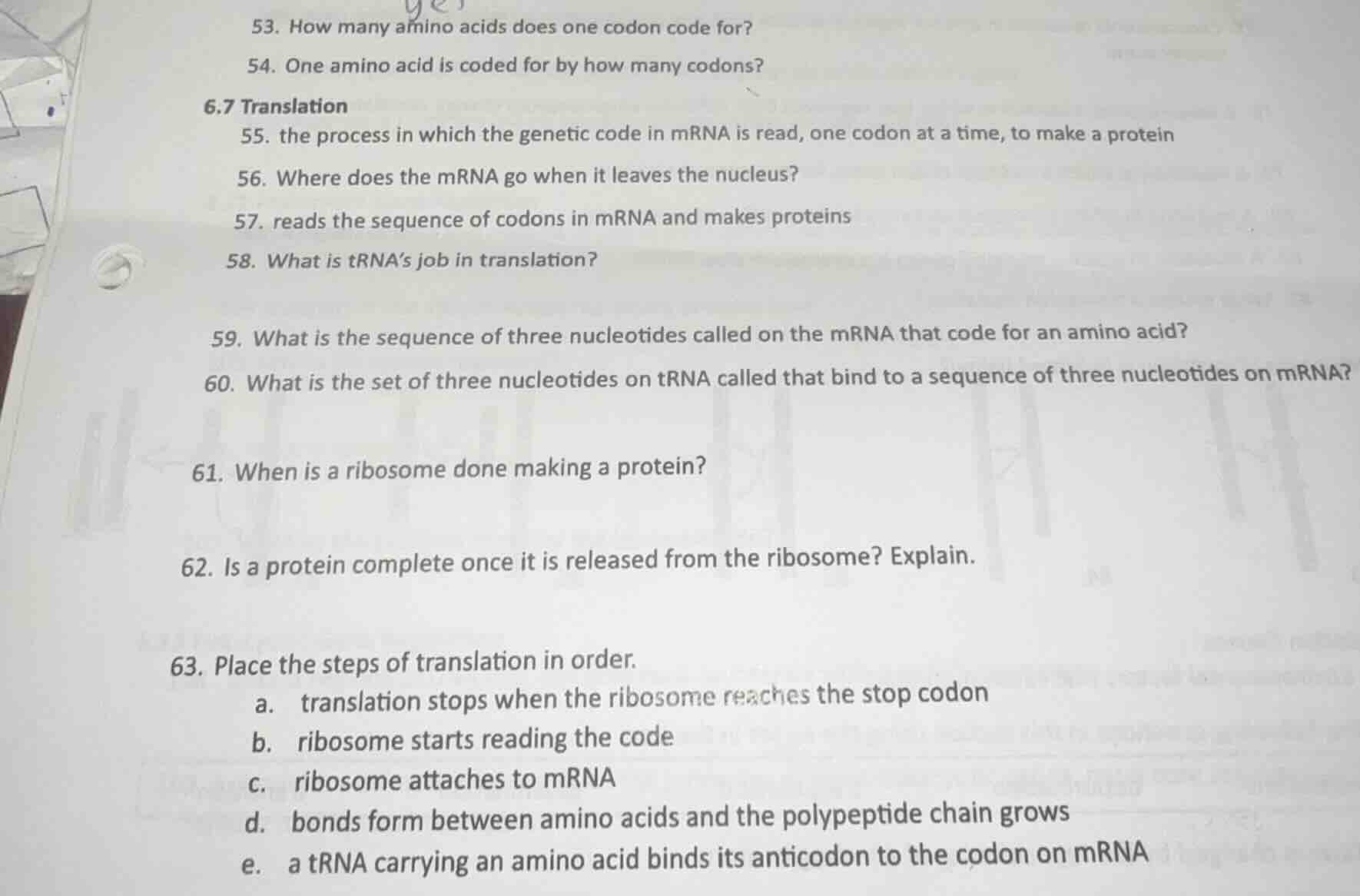
- how many amino acids does one codon code for?
- one amino acid is coded for by how many codons?
6.7 translation
- the process in which the genetic code in mrna is read, one codon at a time, to make a protein
- where does the mrna go when it leaves the nucleus?
- reads the sequence of codons in mrna and makes proteins
- what is trna’s job in translation?
- what is the sequence of three nucleotides called on the mrna that code for an amino acid?
- what is the set of three nucleotides on trna called that bind to a sequence of three nucleotides on mrna?
- when is a ribosome done making a protein?
- is a protein complete once it is released from the ribosome? explain.
- place the steps of translation in order.
a. translation stops when the ribosome reaches the stop codon
b. ribosome starts reading the code
c. ribosome attaches to mrna
d. bonds form between amino acids and the polypeptide chain grows
e. a trna carrying an amino acid binds its anticodon to the codon on mrna
Brief Explanations
- Defined property of genetic code: one codon corresponds to a single amino acid.
- Genetic code is degenerate; most amino acids have multiple codons.
- This is the standard definition of translation in molecular biology.
- mRNA travels to the cytoplasm to interact with ribosomes for translation.
- This describes the function of ribosomes in protein synthesis.
- tRNA's core role is to deliver matching amino acids to the ribosome.
- This is the formal term for mRNA's 3-nucleotide amino acid code.
- This is the complementary tRNA sequence that pairs with mRNA codons.
- Ribosomes halt when they encounter a non-amino-acid coding stop signal.
- Proteins need post-translational modifications to become functional.
- Translation follows a sequential assembly, reading, elongation, and termination pathway.

Snap & solve any problem in the app
Get step-by-step solutions on Sovi AI
Photo-based solutions with guided steps
Explore more problems and detailed explanations
- One (1) amino acid
- Multiple (1 to 6, depending on the amino acid; most have 2+ codons)
- Translation
- It moves to the cytoplasm (to a ribosome)
- Ribosome
- tRNA carries the specific amino acid matching the mRNA codon to the ribosome, and its anticodon binds to the mRNA codon to position the amino acid for polypeptide chain formation.
- Codon
- Anticodon
- When the ribosome reaches a stop codon (UAA, UAG, or UGA) on the mRNA
- No. The protein often needs post-translational modifications (like folding, adding chemical groups, or cutting segments) to become a fully functional, mature protein.
63.
c. ribosome attaches to mRNA
b. ribosome starts reading the code
e. a tRNA carrying an amino acid binds its anticodon to the codon on mRNA
d. bonds form between amino acids and the polypeptide chain grows
a. translation stops when the ribosome reaches the stop codon