QUESTION IMAGE
Question
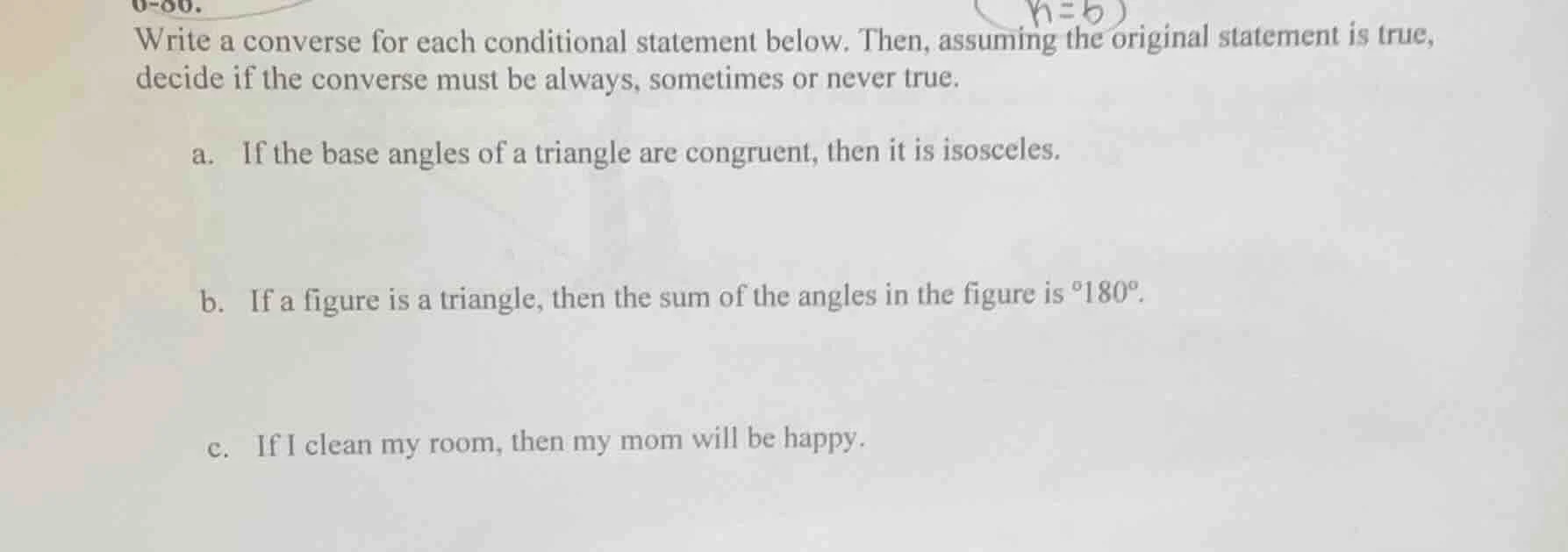
6-86.
write a converse for each conditional statement below. then, assuming the original statement is true,
decide if the converse must be always, sometimes or never true.
a. if the base angles of a triangle are congruent, then it is isosceles.
b. if a figure is a triangle, then the sum of the angles in the figure is $180^\circ$.
c. if i clean my room, then my mom will be happy.
For each conditional statement "If P, then Q", the converse is "If Q, then P". We then evaluate the truthfulness of the converse based on definitions, logical rules, or real-world context.
- Part a: Use the definition of isosceles triangles, which states that isosceles triangles have congruent base angles.
- Part b: Use the angle sum property; only triangles have an angle sum of 180°, no other polygon does.
- Part c: Consider real-world context: a mom could be happy for other reasons besides a clean room, or not happy even if the room is clean.

Snap & solve any problem in the app
Get step-by-step solutions on Sovi AI
Photo-based solutions with guided steps
Explore more problems and detailed explanations
a. Converse: If a triangle is isosceles, then its base angles are congruent.
Truth value: Always true
b. Converse: If the sum of the angles in a figure is 180°, then the figure is a triangle.
Truth value: Always true
c. Converse: If my mom is happy, then I cleaned my room.
Truth value: Sometimes true