QUESTION IMAGE
Question
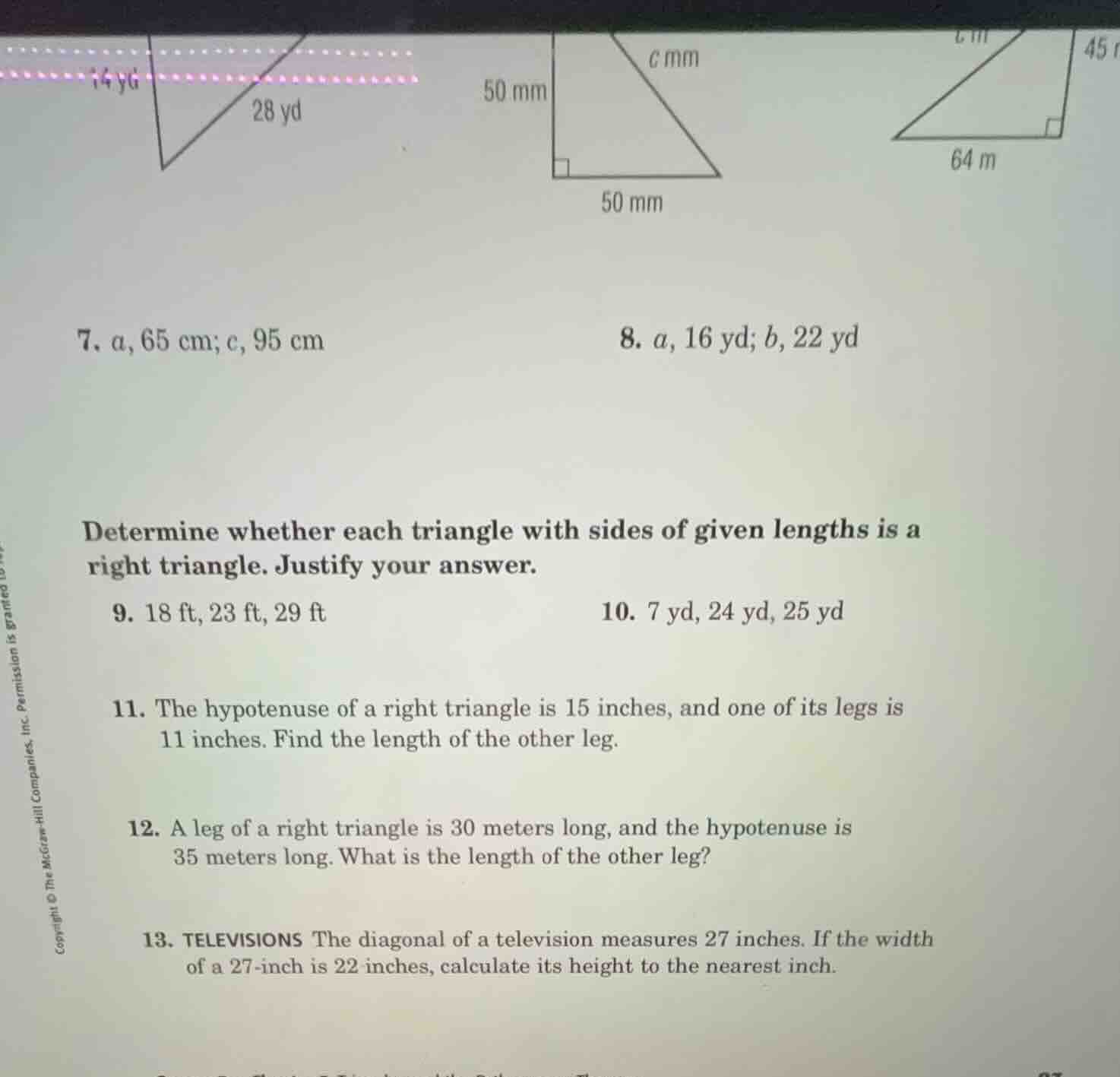
- a, 65 cm; c, 95 cm 8. a, 16 yd; b, 22 yd determine whether each triangle with sides of given lengths is a right triangle. justify your answer. 9. 18 ft, 23 ft, 29 ft 10. 7 yd, 24 yd, 25 yd 11. the hypotenuse of a right triangle is 15 inches, and one of its legs is 11 inches. find the length of the other leg. 12. a leg of a right triangle is 30 meters long, and the hypotenuse is 35 meters long. what is the length of the other leg? 13. televisions the diagonal of a television measures 27 inches. if the width of a 27 - inch is 22 inches, calculate its height to the nearest inch.
Let's solve these problems one by one using the Pythagorean theorem ($a^2 + b^2 = c^2$, where $c$ is the hypotenuse, and $a, b$ are the legs).
Problem 7: \( a = 65 \, \text{cm}, c = 95 \, \text{cm} \) (Find \( b \))
Step 1: Recall the Pythagorean theorem
The Pythagorean theorem states \( a^2 + b^2 = c^2 \). We need to solve for \( b \), so rearrange the formula: \( b^2 = c^2 - a^2 \).
Step 2: Substitute the given values
Substitute \( a = 65 \) and \( c = 95 \) into the formula:
\( b^2 = 95^2 - 65^2 \)
Calculate \( 95^2 = 9025 \) and \( 65^2 = 4225 \).
Step 3: Simplify the equation
\( b^2 = 9025 - 4225 = 4800 \)
Step 4: Take the square root of \( b^2 \)
\( b = \sqrt{4800} \approx 69.28 \, \text{cm} \) (rounded to two decimal places)
Step 1: Recall the Pythagorean theorem
\( a^2 + b^2 = c^2 \)
Step 2: Substitute the given values
Substitute \( a = 16 \) and \( b = 22 \):
\( c^2 = 16^2 + 22^2 \)
Calculate \( 16^2 = 256 \) and \( 22^2 = 484 \).
Step 3: Simplify the equation
\( c^2 = 256 + 484 = 740 \)
Step 4: Take the square root of \( c^2 \)
\( c = \sqrt{740} \approx 27.20 \, \text{yd} \) (rounded to two decimal places)
Step 1: Identify the hypotenuse (longest side)
The longest side is \( 29 \, \text{ft} \), so assume \( c = 29 \), \( a = 18 \), \( b = 23 \).
Step 2: Apply the Pythagorean theorem
Check if \( a^2 + b^2 = c^2 \).
Calculate \( 18^2 = 324 \), \( 23^2 = 529 \), \( 29^2 = 841 \).
Step 3: Sum the squares of the legs
\( 324 + 529 = 853 \)
Step 4: Compare to the square of the hypotenuse
\( 853
eq 841 \), so \( a^2 + b^2
eq c^2 \).

Snap & solve any problem in the app
Get step-by-step solutions on Sovi AI
Photo-based solutions with guided steps
Explore more problems and detailed explanations
\( b \approx 69.28 \, \text{cm} \)