QUESTION IMAGE
Question
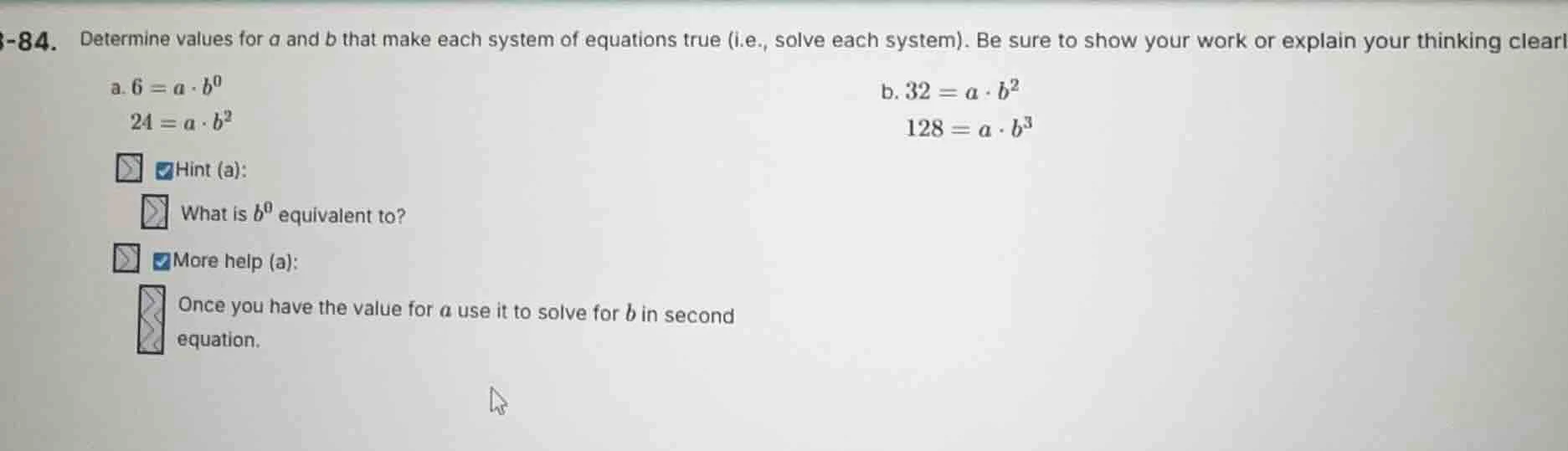
8-84. determine values for a and b that make each system of equations true (i.e., solve each system). be sure to show your work or explain your thinking clearly
a. $6 = a \cdot b^0$
$24 = a \cdot b^2$
hint (a):
what is $b^0$ equivalent to?
more help (a):
once you have the value for a use it to solve for b in second equation.
b. $32 = a \cdot b^2$
$128 = a \cdot b^3$
Part (a)
Step1: Solve for \( a \) using \( b^0 \)
Recall that any non - zero number to the power of 0 is 1, so \( b^0 = 1 \) (assuming \( b
eq0 \)). From the equation \( 6=a\cdot b^0 \), we substitute \( b^0 = 1 \) into the equation:
\( 6=a\times1 \)
So, \( a = 6 \).
Step2: Solve for \( b \) using the second equation
Now we know \( a = 6 \), substitute \( a = 6 \) into the second equation \( 24=a\cdot b^2 \). We get:
\( 24 = 6\times b^2 \)
Divide both sides of the equation by 6:
\( \frac{24}{6}=b^2 \)
\( 4 = b^2 \)
Take the square root of both sides. Since \( b^2 = 4 \), we have \( b=\pm2 \). But if we consider the context of exponential equations (usually \( b>0 \) for real - valued exponential functions in such systems), we take \( b = 2 \) (we can also check with \( b=- 2 \), \( b^2=4 \) also works, but let's go with the positive value first).
Part (b)
Step1: Eliminate \( a \) by dividing the two equations
We have the system of equations:
\( 32=a\cdot b^2\) (Equation 1)
\( 128=a\cdot b^3\) (Equation 2)
Divide Equation 2 by Equation 1:
\( \frac{128}{32}=\frac{a\cdot b^3}{a\cdot b^2} \)
Simplify the left - hand side: \( \frac{128}{32} = 4 \)
Simplify the right - hand side: \( \frac{a\cdot b^3}{a\cdot b^2}=b \) (since \( a
eq0 \) and we can cancel out \( a \) and \( b^2 \) using the rule \( \frac{x^m}{x^n}=x^{m - n} \), here \( m = 3 \), \( n = 2 \), so \( \frac{b^3}{b^2}=b^{3-2}=b \))
So, \( b = 4 \).
Step2: Solve for \( a \) using the first equation
Substitute \( b = 4 \) into the first equation \( 32=a\cdot b^2 \). We know that \( b^2=4^2 = 16 \), so the equation becomes:
\( 32=a\times16 \)
Divide both sides by 16:
\( a=\frac{32}{16}=2 \)

Snap & solve any problem in the app
Get step-by-step solutions on Sovi AI
Photo-based solutions with guided steps
Explore more problems and detailed explanations
Part (a)
\( a = 6 \), \( b = 2 \) (or \( b=-2 \))
Part (b)
\( a = 2 \), \( b = 4 \)