QUESTION IMAGE
Question
90° counterclockwise rotation
rule (x, y): (□, □)
d (□, □)
e (□, □)
f (□, □)
g (□, □)
Step1: Recall 90° counterclockwise rotation rule
The rule for a \(90^\circ\) counterclockwise rotation about the origin is \((x, y) \to (-y, x)\).
Step2: Find coordinates of original points
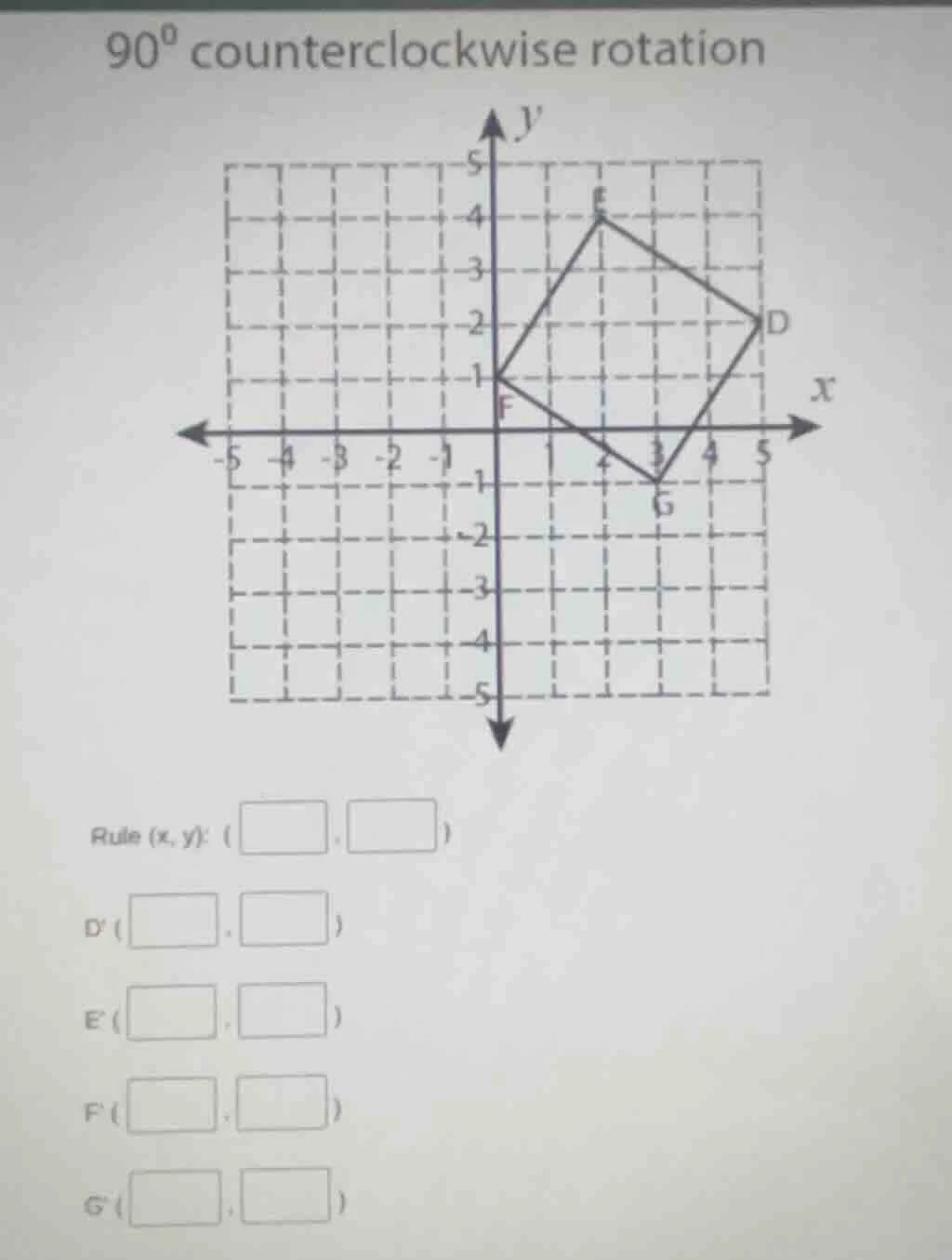
- \(D\): From the graph, \(D\) is at \((5, 2)\).
- \(E\): \(E\) is at \((2, 4)\).
- \(F\): \(F\) is at \((0, 1)\).
- \(G\): \(G\) is at \((3, -1)\).
Step3: Apply rotation rule to each point
- For \(D(5, 2)\): Using \((x, y) \to (-y, x)\), we get \(D'(-2, 5)\).
- For \(E(2, 4)\): Applying the rule, \((2, 4) \to (-4, 2)\), so \(E'(-4, 2)\).
- For \(F(0, 1)\): Using the rule, \((0, 1) \to (-1, 0)\), so \(F'(-1, 0)\).
- For \(G(3, -1)\): Applying the rule, \((3, -1) \to (1, 3)\), so \(G'(1, 3)\).

Snap & solve any problem in the app
Get step-by-step solutions on Sovi AI
Photo-based solutions with guided steps
Explore more problems and detailed explanations
Rule \((x, y)\): \((-y, x)\)
\(D'(-2, 5)\)
\(E'(-4, 2)\)
\(F'(-1, 0)\)
\(G'(1, 3)\)