QUESTION IMAGE
Question
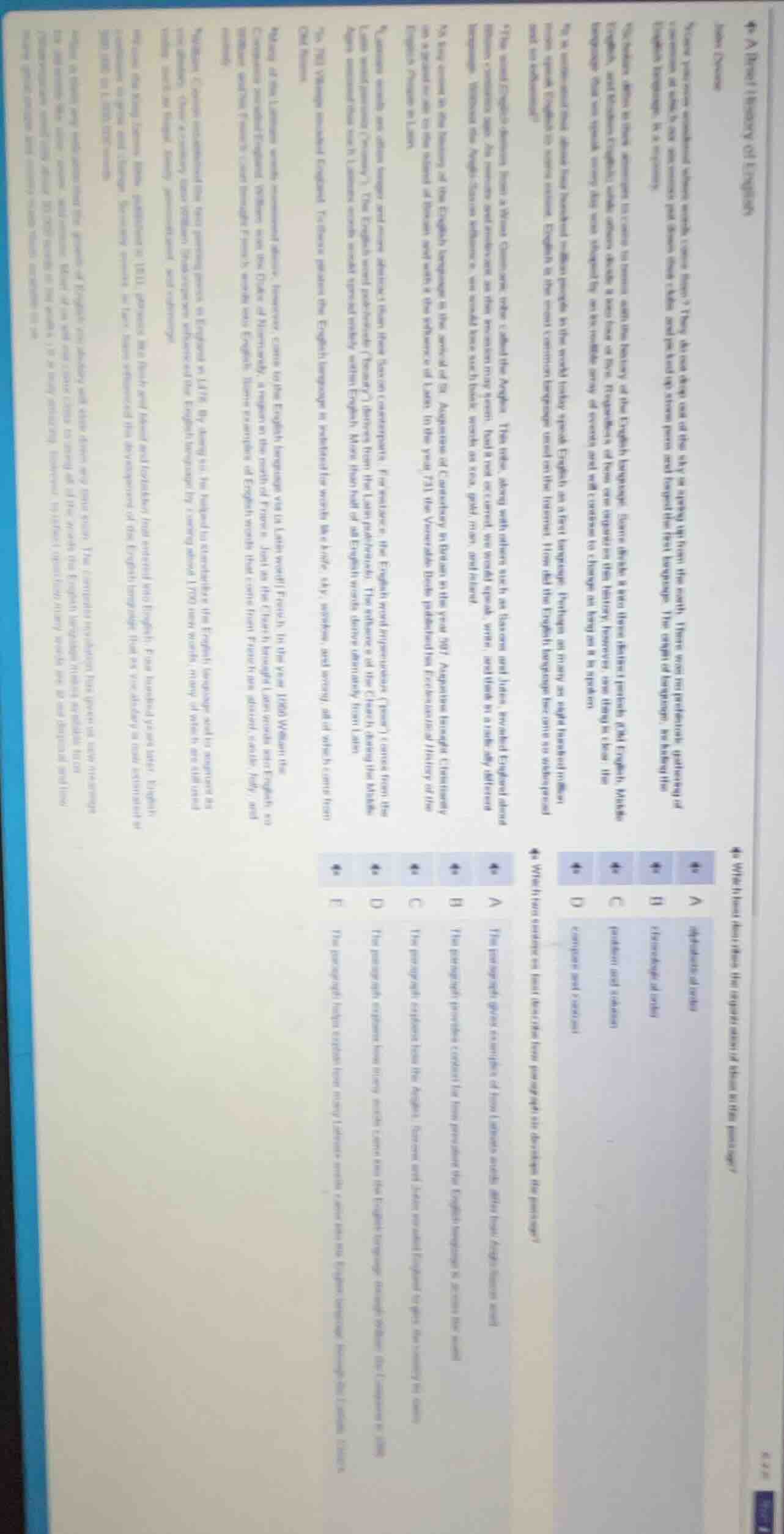
about 7,000 years ago, mankinds ancestors made a huge choice: they decided to give up on the sky, to speak with fire from the earth. there were two prehistoric populations, the celts and the germans, in what is now the country that became known as england. they spoke a language called proto - germanic. then the romans invaded in 43 ad to control the territory. in the history of the english language, theres a word thats a direct link between the history of england and the history of the english language: that word is anglo - saxon. the anglo - saxons were a group of germanic tribes. some of them decided to leave their homeland in what is now northern germany and denmark to cross the north sea to britain. they brought with them their language, which was a dialect of proto - germanic. over time, this language evolved into what we now know as old english. old english was very different from the english we speak today. it was a language with a complex grammar and a vocabulary that was mostly germanic, but also included some words from latin (because of the roman presence in britain) and some from the celtic languages (the languages spoken by the native britons). then, in 1066, the normans, led by william the conqueror, invaded england. the normans spoke a dialect of old french. after the norman conquest, the english language changed dramatically. the norman elite spoke french, and the common people spoke english, but over time, the two languages began to mix. this led to the development of middle english. middle english was still different from modern english, but it was starting to look more familiar. it had a simpler grammar than old english, and its vocabulary was a mix of english (germanic) and french (romance) words. for example, many words related to government, law, and culture came from french, while words related to everyday life (like house, bread, water) remained english. then, during the renaissance (14th - 17th centuries), there was a huge influx of new words into the english language, mostly from latin and greek. scholars and writers were interested in the classical learning of ancient greece and rome, so they borrowed many words from these languages to use in their works. this helped to enrich the english vocabulary even more. in the 16th century, the printing press was introduced to england by william caxton. this had a huge impact on the english language. it helped to standardize the spelling and grammar of english, because books were now being printed and distributed widely. before the printing press, there were many different ways to spell words, but the printing press helped to fix a standard form. then, in the 17th and 18th centuries, the english language began to spread around the world as the british empire expanded. english was taken to north america, australia, india, and many other places. in each of these places, the english language evolved in its own way, influenced by the local languages and cultures. this led to the development of different varieties of english, like american english, australian english, indian english, and so on. today, english is the most widely spoken language in the world (if we count both native and non - native speakers). its the language of international business, science, technology, and popular culture. its a language that continues to evolve, with new words being added all the time, often from other languages or from new technologies and cultural trends.
which of the following statements best describes the main idea of this passage?
a. the passage talks about the combination of latin, norman, and other languages with anglo - saxon words.
b. the passage mainly explains how the history of the english language is related to the history of england.
c. the passage mainly explains how the anglo - saxons, normans, and others contributed to the development of the english language.
d. the passage mainly explains how many words came into the english language through different historical periods (like the renaissance).
e. the passage mainly explains how many latin, norman, and other words are included in the english language through different historical periods (like the renaissance).
For question 1: The passage starts by addressing misconceptions about language origin, then outlines the three main periods of English (Old, Middle, Modern) and the historical events shaping each, which is a chronological account of English's development.
For question 2: The passage explains that English developed over time from the arrival of the Angles, Saxons, and Jutes, then through the influence of Latin, Norman French, etc., showing it evolved through contact and external influences, not a sudden, invented origin.
For question 3: The passage gives examples like "impression" (from Latin "impressio") and "pork/porker" (from Latin "porcus") to show Latin roots of English words, matching this option.
For question 4: The passage details how the Angles, Saxons, Jutes (invaders) brought their language, then how Latin entered via Christianity, then French via the Norman Conquest, and later the Renaissance adding Latin/Greek words—all showing how contact with groups shaped English across history.
For question 5: The passage notes that over half of English words come from Latin, and gives examples of how Latin entered via the Church and later the Renaissance, which explores the scale of Latin-derived words in English.

Snap & solve any problem in the app
Get step-by-step solutions on Sovi AI
Photo-based solutions with guided steps
Explore more problems and detailed explanations
- B. chronological order
- D. compare and contrast
- A. The paragraph gives examples of how Latin words differ from Anglo-Saxon words
- B. The paragraph provides context for how pressures the English language is across the world
- E. The paragraph helps explain how many Latin words came into the English language through the Latin Church