QUESTION IMAGE
Question
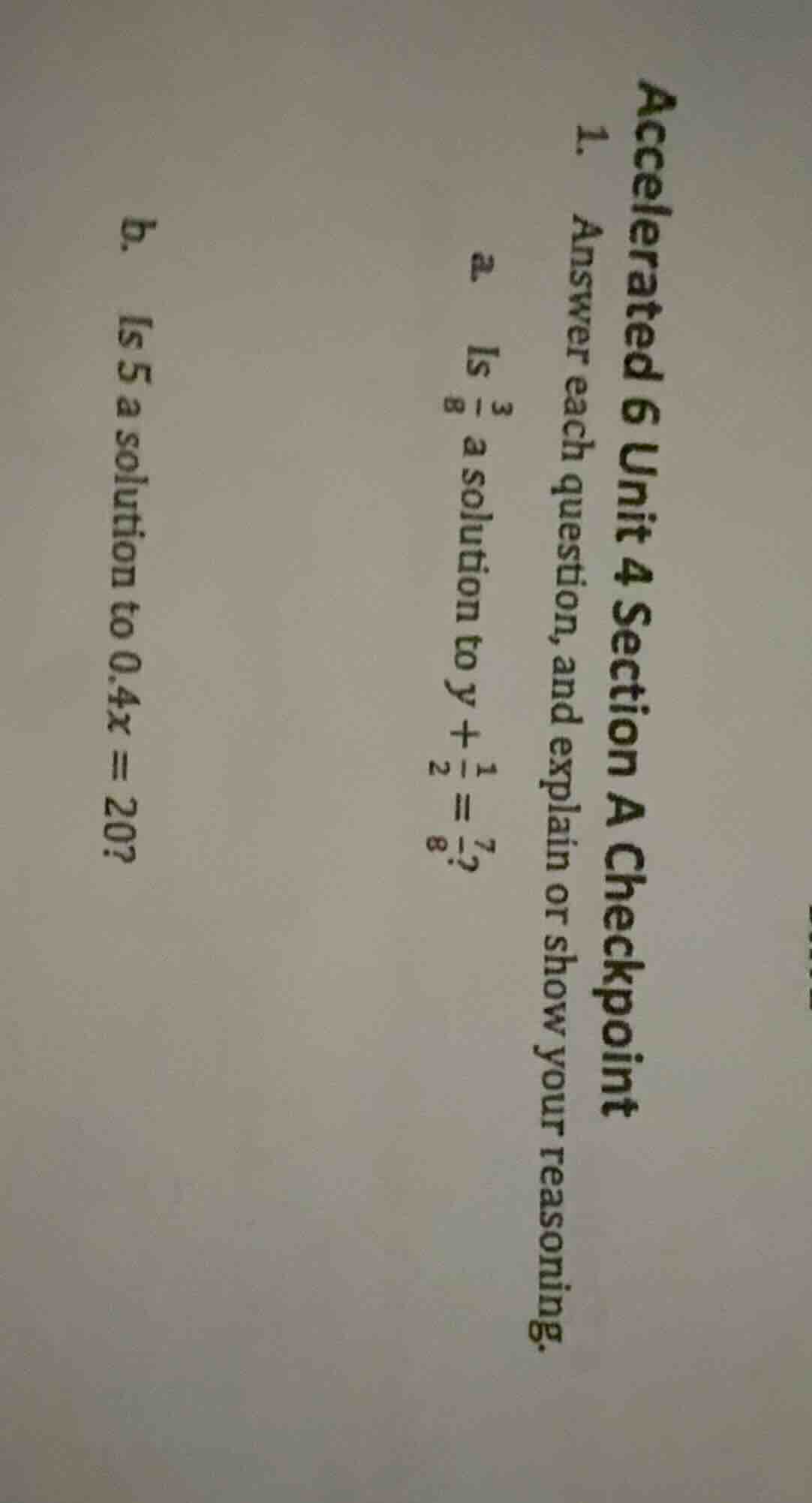
accelerated 6 unit 4 section a checkpoint 1. answer each question, and explain or show your reasoning. a is \\(\frac{3}{8}\\) a solution to \\(y + \frac{1}{2} = \frac{7}{8}\\)? b. is 5 a solution to \\(0.4x = 20\\)?
Part a: Is $\frac{3}{8}$ a solution to $y + \frac{1}{2} = \frac{7}{8}$?
Step1: Substitute $y$ with $\frac{3}{8}$
Substitute $y = \frac{3}{8}$ into the equation: $\frac{3}{8} + \frac{1}{2}$
Step2: Simplify the left - hand side
First, find a common denominator for $\frac{3}{8}$ and $\frac{1}{2}$. The common denominator of 8 and 2 is 8. So $\frac{1}{2}=\frac{1\times4}{2\times4}=\frac{4}{8}$. Then $\frac{3}{8}+\frac{4}{8}=\frac{3 + 4}{8}=\frac{7}{8}$
Step3: Compare with the right - hand side
The right - hand side of the equation is $\frac{7}{8}$. Since the left - hand side ($\frac{7}{8}$) is equal to the right - hand side ($\frac{7}{8}$) when $y=\frac{3}{8}$, $\frac{3}{8}$ is a solution.
Part b: Is 5 a solution to $0.4x = 20$?
Step1: Substitute $x$ with 5
Substitute $x = 5$ into the equation: $0.4\times5$
Step2: Calculate the left - hand side
$0.4\times5 = 2$
Step3: Compare with the right - hand side
The right - hand side of the equation is 20. Since $2
eq20$, 5 is not a solution.

Snap & solve any problem in the app
Get step-by-step solutions on Sovi AI
Photo-based solutions with guided steps
Explore more problems and detailed explanations
a. Yes, because when we substitute $y = \frac{3}{8}$ into $y+\frac{1}{2}=\frac{7}{8}$, the left - hand side equals the right - hand side.
b. No, because when we substitute $x = 5$ into $0.4x = 20$, the left - hand side ($2$) is not equal to the right - hand side ($20$).