QUESTION IMAGE
Question
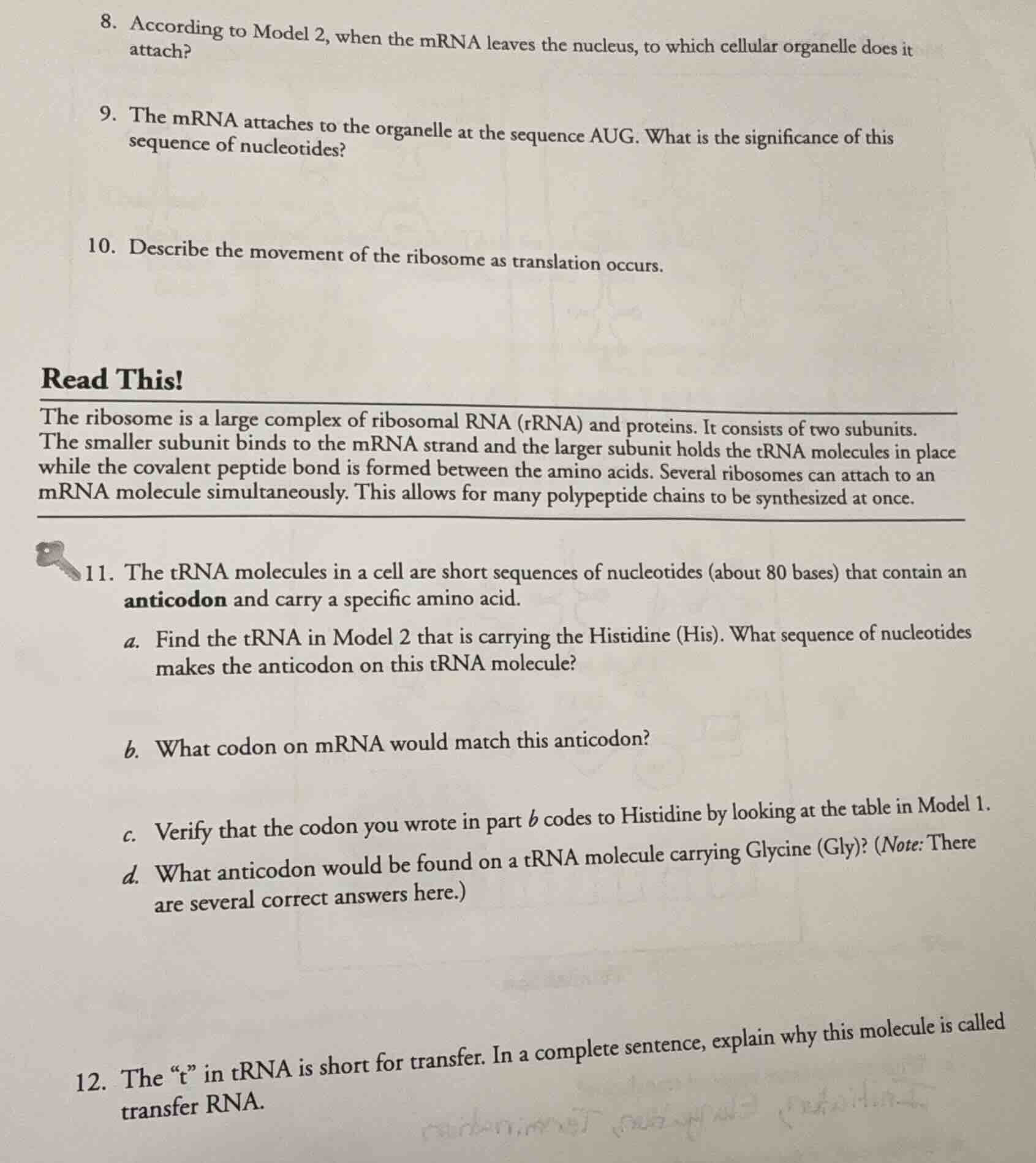
- according to model 2, when the mrna leaves the nucleus, to which cellular organelle does it attach?
- the mrna attaches to the organelle at the sequence aug. what is the significance of this sequence of nucleotides?
- describe the movement of the ribosome as translation occurs.
read this!
the ribosome is a large complex of ribosomal rna (rrna) and proteins. it consists of two subunits. the smaller subunit binds to the mrna strand and the larger subunit holds the trna molecules in place while the covalent peptide bond is formed between the amino acids. several ribosomes can attach to an mrna molecule simultaneously. this allows for many polypeptide chains to be synthesized at once.
- the trna molecules in a cell are short sequences of nucleotides (about 80 bases) that contain an anticodon and carry a specific amino acid.
a. find the trna in model 2 that is carrying the histidine (his). what sequence of nucleotides makes the anticodon on this trna molecule?
b. what codon on mrna would match this anticodon?
c. verify that the codon you wrote in part b codes to histidine by looking at the table in model 1.
d. what anticodon would be found on a trna molecule carrying glycine (gly)? (note: there are several correct answers here.)
- the “t” in trna is short for transfer. in a complete sentence, explain why this molecule is called transfer rna.
Question 8
When mRNA leaves the nucleus, it attaches to the ribosome. Ribosomes are the sites of protein synthesis (translation), and the small subunit of the ribosome binds to the mRNA to start the translation process.
The sequence AUG is the start codon. It signals the beginning of translation, where the ribosome starts to assemble amino acids into a polypeptide chain. It also codes for the amino acid methionine, which is the first amino acid in most newly synthesized proteins.
During translation, the ribosome moves along the mRNA strand in a 5' to 3' direction. It reads the mRNA codons one by one, allowing tRNAs with complementary anticodons to bring in amino acids. As the ribosome moves, it catalyzes the formation of peptide bonds between adjacent amino acids, elongating the polypeptide chain until it reaches a stop codon.

Snap & solve any problem in the app
Get step-by-step solutions on Sovi AI
Photo-based solutions with guided steps
Explore more problems and detailed explanations
The mRNA attaches to the ribosome.