QUESTION IMAGE
Question
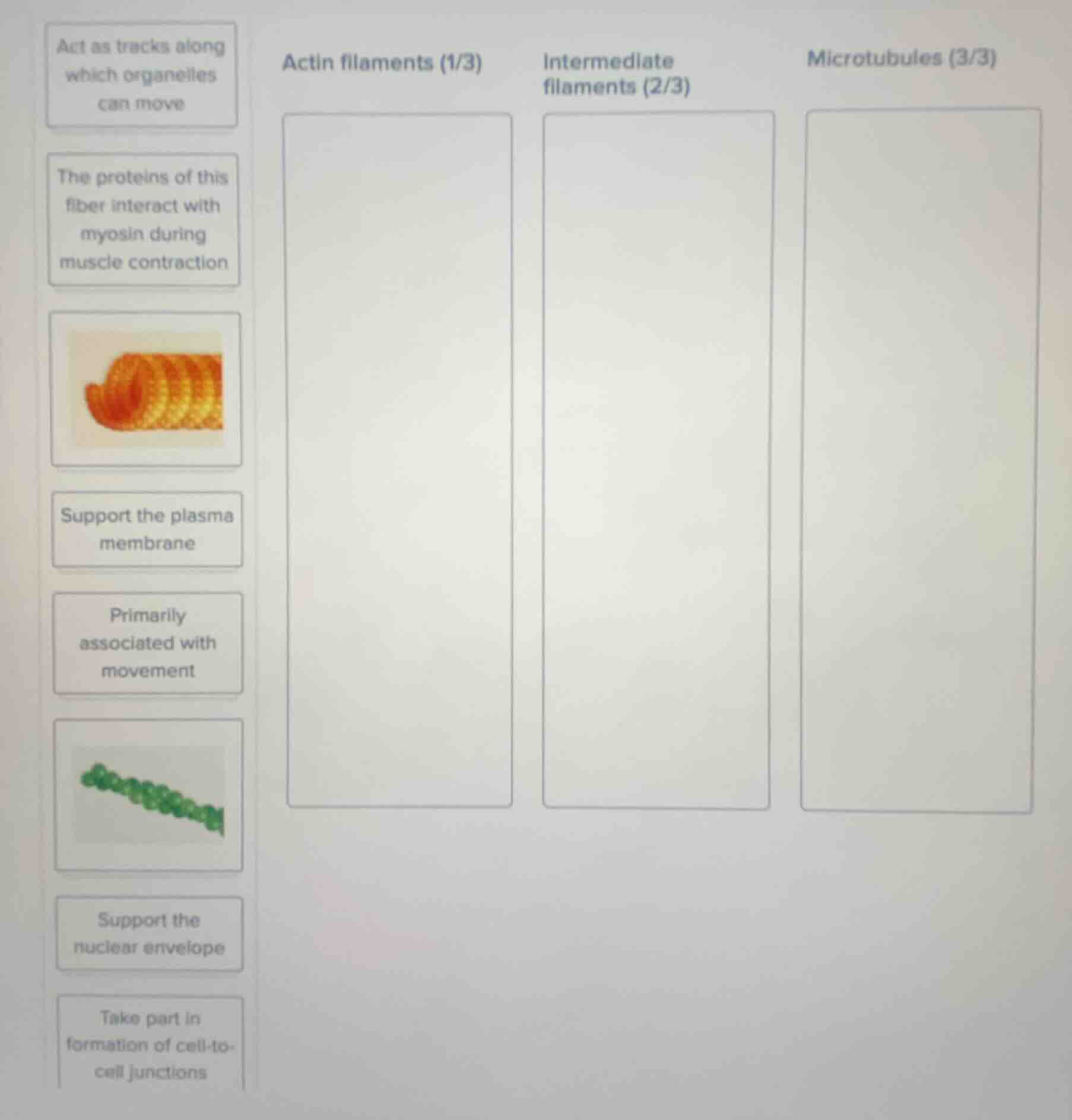
act as tracks along which organelles can move; the proteins of this fiber interact with myosin during muscle contraction; image; support the plasma membrane; primarily associated with movement; image; support the nuclear envelope; take part in formation of cell - to - cell junctions; actin filaments (1/3); intermediate filaments (2/3); microtubules (3/3)
To solve this problem, we analyze the functions and characteristics of each cytoskeletal component:
Actin filaments (1/3)
- "The proteins of this fiber interact with myosin during muscle contraction" – Actin (thin filaments) interacts with myosin in muscle contraction.
- "Primarily associated with movement" – Actin is key for cell motility (e.g., muscle contraction, cell crawling).
- "Support the plasma membrane" – Actin helps maintain cell shape and supports the plasma membrane.
- The orange coiled image likely represents actin-myosin interaction in muscle (sarcomere-like structure).
Intermediate filaments (2/3)
- "Support the nuclear envelope" – Intermediate filaments (e.g., lamin) support the nuclear envelope.
- "Take part in formation of cell - to - cell junctions" – Intermediate filaments anchor at cell - cell junctions (e.g., desmosomes).
- The green beaded - chain image matches the rope - like structure of intermediate filaments.
Microtubules (3/3)
- "Act as tracks along which organelles can move" – Microtubules (with motor proteins like kinesin/dynein) act as tracks for organelle transport.
Final Categorization:
| Actin filaments (1/3) | Intermediate filaments (2/3) | Microtubules (3/3) |
|---|---|---|
| Primarily associated with movement | Take part in formation of cell - to - cell junctions | |
| Support the plasma membrane | ||
| (Orange coiled image) | (Green beaded - chain image) |
This organizes the functions/features to their respective cytoskeletal components based on biological knowledge of actin, intermediate filaments, and microtubules.

Snap & solve any problem in the app
Get step-by-step solutions on Sovi AI
Photo-based solutions with guided steps
Explore more problems and detailed explanations
To solve this problem, we analyze the functions and characteristics of each cytoskeletal component:
Actin filaments (1/3)
- "The proteins of this fiber interact with myosin during muscle contraction" – Actin (thin filaments) interacts with myosin in muscle contraction.
- "Primarily associated with movement" – Actin is key for cell motility (e.g., muscle contraction, cell crawling).
- "Support the plasma membrane" – Actin helps maintain cell shape and supports the plasma membrane.
- The orange coiled image likely represents actin-myosin interaction in muscle (sarcomere-like structure).
Intermediate filaments (2/3)
- "Support the nuclear envelope" – Intermediate filaments (e.g., lamin) support the nuclear envelope.
- "Take part in formation of cell - to - cell junctions" – Intermediate filaments anchor at cell - cell junctions (e.g., desmosomes).
- The green beaded - chain image matches the rope - like structure of intermediate filaments.
Microtubules (3/3)
- "Act as tracks along which organelles can move" – Microtubules (with motor proteins like kinesin/dynein) act as tracks for organelle transport.
Final Categorization:
| Actin filaments (1/3) | Intermediate filaments (2/3) | Microtubules (3/3) |
|---|---|---|
| Primarily associated with movement | Take part in formation of cell - to - cell junctions | |
| Support the plasma membrane | ||
| (Orange coiled image) | (Green beaded - chain image) |
This organizes the functions/features to their respective cytoskeletal components based on biological knowledge of actin, intermediate filaments, and microtubules.