QUESTION IMAGE
Question
must do activities source: adapted from colin nicolson, the first world war, europe 1914 - 1918, essex, england, pearson education limited, 2001.
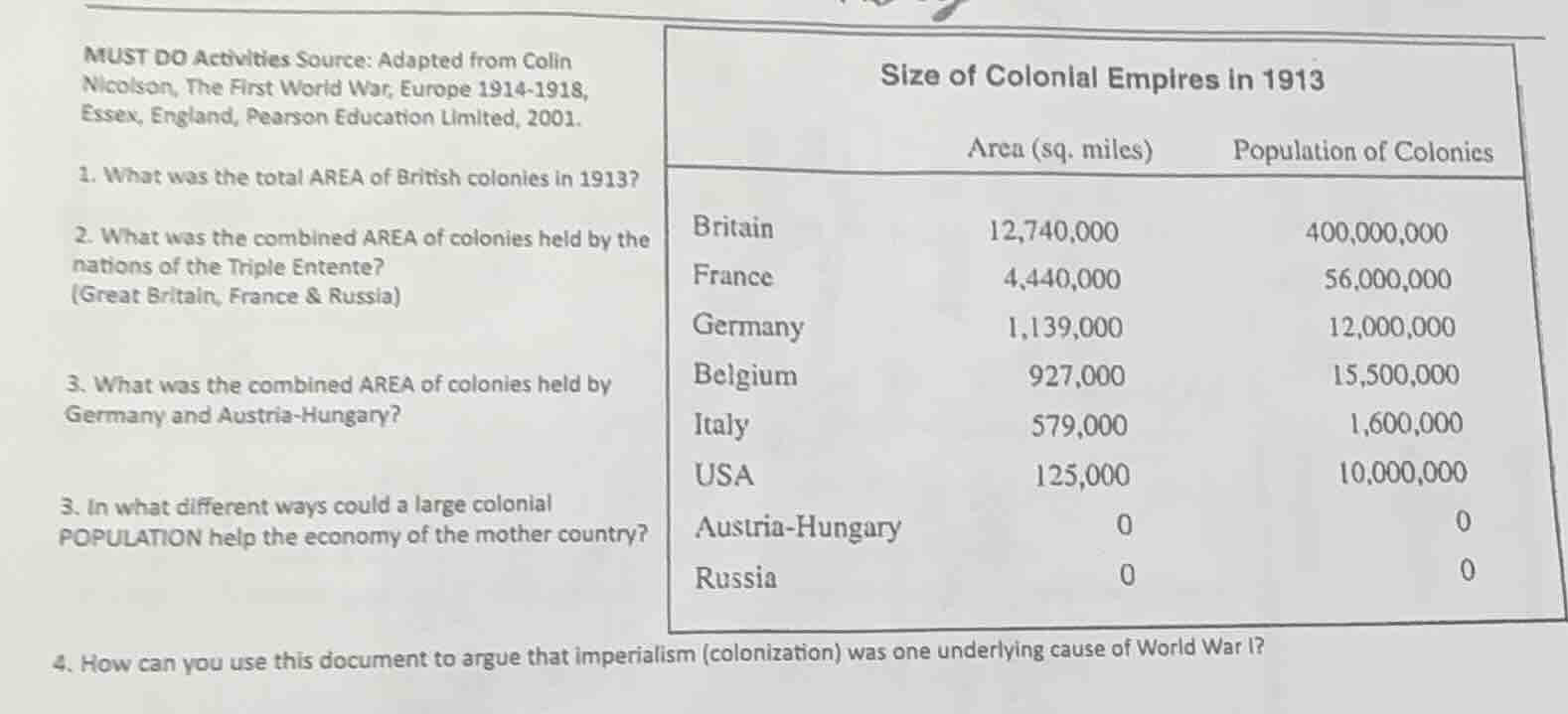
- what was the total area of british colonies in 1913?
- what was the combined area of colonies held by the nations of the triple entente? (great britain, france & russia)
- what was the combined area of colonies held by germany and austria - hungary?
- in what different ways could a large colonial population help the economy of the mother country?
- how can you use this document to argue that imperialism (colonization) was one underlying cause of world war i?
size of colonial empires in 1913
| area (sq. miles) | population of colonies | |
|---|---|---|
| france | 4,440,000 | 56,000,000 |
| germany | 1,139,000 | 12,000,000 |
| belgium | 927,000 | 15,500,000 |
| italy | 579,000 | 1,600,000 |
| usa | 125,000 | 10,000,000 |
| austria - hungary | 0 | 0 |
| russia | 0 | 0 |
Brief Explanations
- Directly extract Britain's colonial area from the table.
- Sum the colonial areas of Britain, France, and Russia: $12,740,000 + 4,440,000 + 0 = 17,180,000$.
- Sum the colonial areas of Germany and Austria-Hungary: $1,139,000 + 0 = 1,139,000$.
- Key economic benefits of large colonial populations include market access, labor supply, and demand stimulation.
- The unequal distribution of colonial territory and population created tensions and competition between imperial powers, as less powerful nations sought to expand their empires to match the resources and influence of dominant colonial powers, contributing to the outbreak of WWI.

Snap & solve any problem in the app
Get step-by-step solutions on Sovi AI
Photo-based solutions with guided steps
Explore more problems and detailed explanations
- 12,740,000 square miles
- 17,180,000 square miles
- 1,139,000 square miles
- A large colonial population can provide a captive market for the mother country's goods, a low-cost labor force for colonial industries/resource extraction, and a source of demand that drives domestic production in the mother country.
- The data shows extreme inequality in colonial holdings: Britain, France, and the US control vast colonial land and populations, while Germany, Austria-Hungary, and Russia have almost no colonies. This imbalance would have created resentment and competition among powers without significant colonial assets, pushing them to seek territorial expansion (and conflict) to access the resources, markets, and prestige that came with large empires, making imperialism a key underlying cause of WWI.