QUESTION IMAGE
Question
activity 3
apply what you have learnt about change during the
industrial revolution
(assessment aims and skills: 2,6,7)
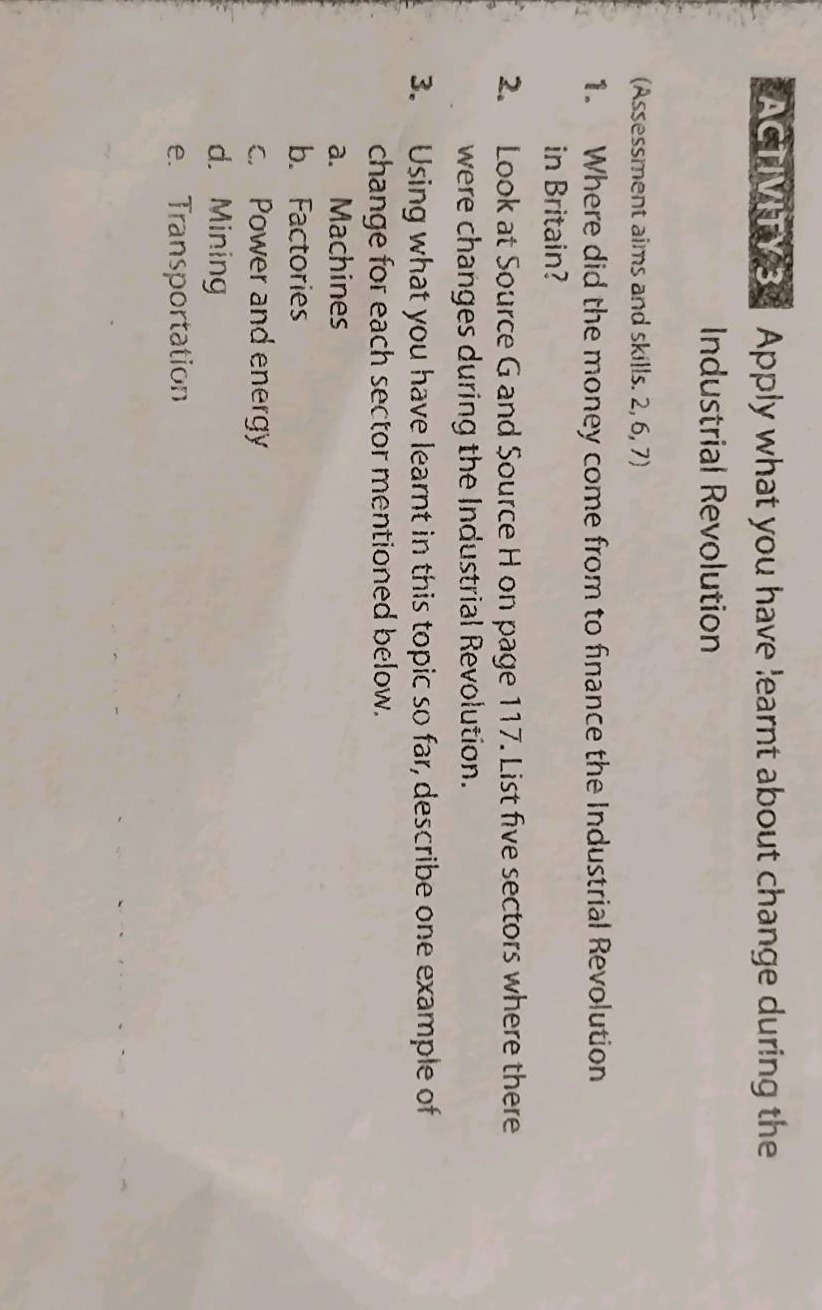
- where did the money come from to finance the industrial revolution in britain?
- look at source g and source h on page 117. list five sectors where there were changes during the industrial revolution.
- using what you have learnt in this topic so far, describe one example of change for each sector mentioned below.
a. machines
b. factories
c. power and energy
d. mining
e. transportation
Question 1: Where did the money come from to finance the Industrial Revolution in Britain?
To finance the Industrial Revolution in Britain, capital came from several key sources:
- Domestic Savings: Wealthy merchants, landowners, and entrepreneurs reinvested profits from trade (e.g., colonial trade, textiles) and agriculture into new industrial ventures.
- Colonial Profits: Britain’s colonial empire (e.g., India, Americas) provided resources, markets, and profits from trade in goods like sugar, tea, and slaves, which were reinvested.
- Banking and Credit: The growth of banks (e.g., the Bank of England) and joint - stock companies (e.g., the East India Company) allowed for pooling of capital through loans, shares, and credit, enabling investment in factories and infrastructure.
- Landowners’ Investment: Aristocrats and landlords invested in mines, canals, and railroads, using rental income or land - related profits to fund industrial projects.
- Government Support: While limited, government sometimes backed infrastructure (e.g., canals, roads) or granted monopolies/charters to companies, indirectly facilitating capital flow.
Question 2: Look at Source G and Source H on page 117. List five sectors where there were changes during the Industrial Revolution.
During the Industrial Revolution, major sectors of change included:
- Machines (Manufacturing): Shift from hand - tools to mechanized production (e.g., spinning jennies, power looms in textiles).
- Factories: Transition from home - based (cottage) industries to centralized factory production, enabling mass production.
- Power and Energy: Move from water/wind power to steam power (via steam engines) and later coal - based energy for factories and transport.
- Mining: Expansion of coal and iron mining to fuel factories, machines, and transport (e.g., deeper mines, new extraction technologies).
- Transportation: Development of canals, railways, and steamships, replacing horse - drawn carts and improving goods/services distribution.
Question 3: Using what you have learnt in this topic so far, describe one example of change for each sector mentioned below.
a. Machines
In the Machines sector, a key change was in textile manufacturing. Before the Industrial Revolution, textiles were made by hand (e.g., hand - spinning, hand - weaving). With the invention of the spinning jenny (by James Hargreaves) and the power loom (by Edmund Cartwright), production became mechanized. The spinning jenny could spin multiple threads at once, increasing the speed and quantity of yarn production. The power loom automated weaving, reducing the need for manual labor and drastically increasing textile output, which transformed the industry from a cottage - based to a factory - based system.
b. Factories

Snap & solve any problem in the app
Get step-by-step solutions on Sovi AI
Photo-based solutions with guided steps
Explore more problems and detailed explanations
s:
- (For Q1) Capital for the Industrial Revolution in Britain came from domestic savings, colonial profits, banking/credit, landowners’ investment, and (to a lesser extent) government support.
- (For Q2) Five sectors of change: Machines, Factories, Power and Energy, Mining, Transportation.
- (For Q3 - a) Machines: Textile manufacturing shifted from hand - tools to mechanized production (e.g., spinning jennies, power looms).
(For Q3 - b) Factories: Textile production moved from cottage industry to centralized factories (e.g., Arkwright’s water - powered mill).
(For Q3 - c) Power and Energy: Shift from water/wind to Watt’s improved steam engine for factory/mine/transport power.
(For Q3 - d) Mining: Coal mining expanded with steam - powered pumps (e.g., Newcomen’s engine) for deeper, more productive mines.
(For Q3 - e) Transportation: Railways (e.g., Stephenson’s “Rocket”) revolutionized land transport, replacing horse - drawn wagons/canals for goods/people.