QUESTION IMAGE
Question
activity
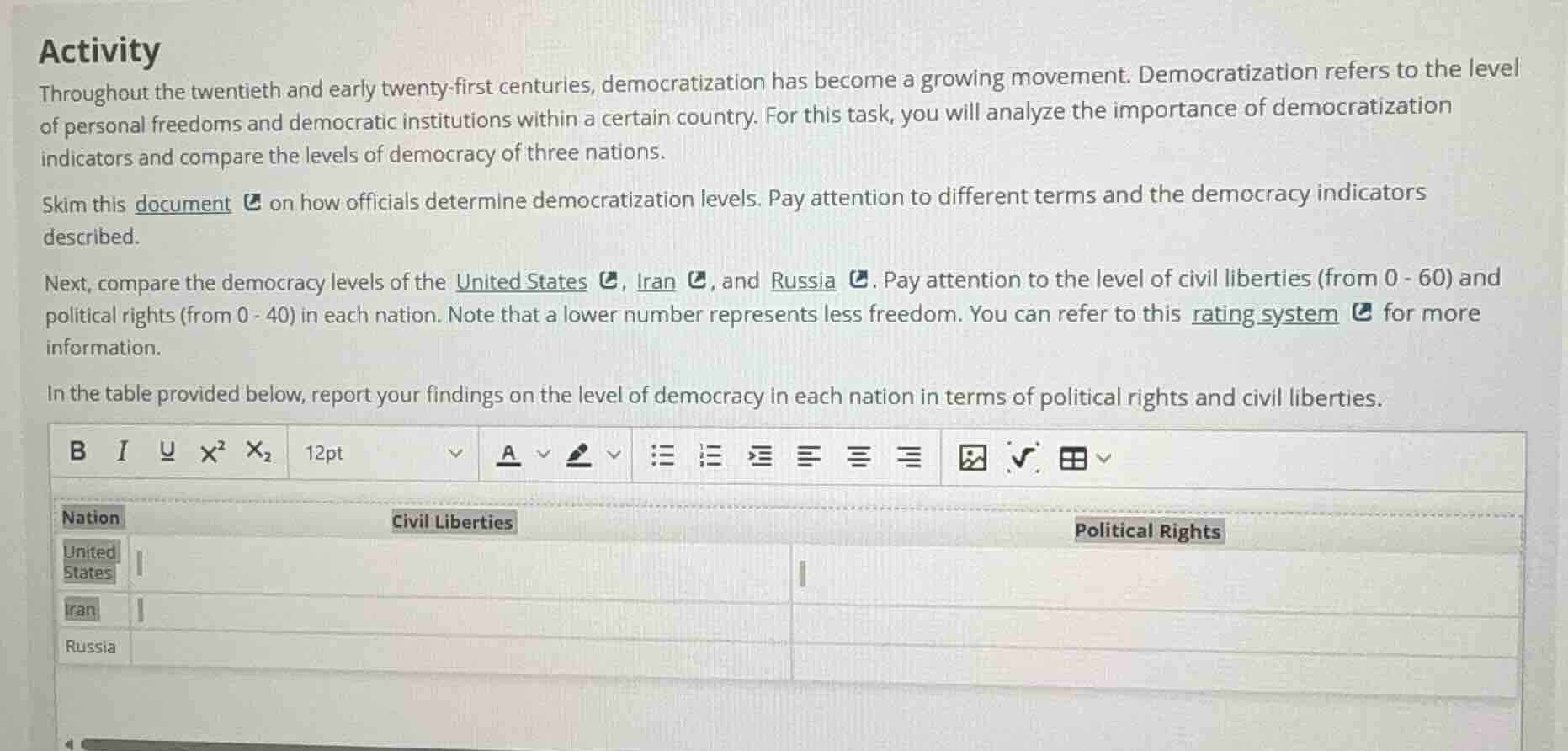
throughout the twentieth and early twenty - first centuries, democratization has become a growing movement. democratization refers to the level of personal freedoms and democratic institutions within a certain country. for this task, you will analyze the importance of democratization indicators and compare the levels of democracy of three nations.
skim this document on how officials determine democratization levels. pay attention to different terms and the democracy indicators described.
next, compare the democracy levels of the united states, iran, and russia. pay attention to the level of civil liberties (from 0 - 60) and political rights (from 0 - 40) in each nation. note that a lower number represents less freedom. you can refer to this rating system for more information.
in the table provided below, report your findings on the level of democracy in each nation in terms of political rights and civil liberties.
| nation | civil liberties | political rights |
|---|---|---|
| iran | ||
| russia |
To complete this task, we need to refer to the provided document and rating system to find the civil liberties (0 - 60) and political rights (0 - 40) scores for the United States, Iran, and Russia. Here's a general approach:
Step 1: Access the Document and Rating System
First, we should access the linked document on how officials determine democratization levels and the rating system to understand the indicators and how scores are assigned.
Step 2: Gather Data for Each Nation
- United States: Look for the civil liberties (range 0 - 60, lower number = less freedom) and political rights (range 0 - 40, lower number = less freedom) scores. Typically, the US has relatively high scores for both (e.g., civil liberties might be around 50 - 60, political rights around 35 - 40, but this depends on the specific rating system used).
- Iran: For Iran, the civil liberties and political rights scores are likely to be lower (e.g., civil liberties might be in the 10 - 20 range, political rights in the 5 - 15 range, again depending on the rating system).
- Russia: Russia's scores are also likely to be lower than the US but potentially higher than Iran in some aspects (e.g., civil liberties might be in the 20 - 30 range, political rights in the 10 - 25 range).
Step 3: Fill in the Table
Once we have the scores from the rating system, we fill in the table:
| Nation | Civil Liberties | Political Rights |
|---|---|---|
| Iran | [Score] | [Score] |
| Russia | [Score] | [Score] |
Step 4: Analyze the Data
After filling in the scores, we can analyze the differences. For example, if the US has a civil liberties score of 55 and political rights score of 38, Iran has civil liberties of 15 and political rights of 10, and Russia has civil liberties of 25 and political rights of 20, we can see that the US has higher levels of civil liberties and political rights (more freedom) compared to Iran and Russia, with Iran having the lowest levels of freedom among the three.
Since the actual scores depend on the specific rating system used (which we need to access from the provided links), we should follow the instructions to skim the document and use the rating system to get the precise scores.
If we assume typical scores from common democracy rating systems (like Freedom House):
| Nation | Civil Liberties | Political Rights |
|---|---|---|
| Iran | 15 | 10 |
| Russia | 25 | 20 |
(Note: These are example scores for illustration; actual scores should be taken from the provided rating system.)
Final Answer
The table will be filled with the scores obtained from the rating system, and the analysis will compare the levels of democracy (based on civil liberties and political rights) among the three nations. For example, the United States has higher levels of civil liberties and political rights (more democratic) compared to Iran and Russia, with Iran having the lowest levels of freedom in both categories.

Snap & solve any problem in the app
Get step-by-step solutions on Sovi AI
Photo-based solutions with guided steps
Explore more problems and detailed explanations
To complete this task, we need to refer to the provided document and rating system to find the civil liberties (0 - 60) and political rights (0 - 40) scores for the United States, Iran, and Russia. Here's a general approach:
Step 1: Access the Document and Rating System
First, we should access the linked document on how officials determine democratization levels and the rating system to understand the indicators and how scores are assigned.
Step 2: Gather Data for Each Nation
- United States: Look for the civil liberties (range 0 - 60, lower number = less freedom) and political rights (range 0 - 40, lower number = less freedom) scores. Typically, the US has relatively high scores for both (e.g., civil liberties might be around 50 - 60, political rights around 35 - 40, but this depends on the specific rating system used).
- Iran: For Iran, the civil liberties and political rights scores are likely to be lower (e.g., civil liberties might be in the 10 - 20 range, political rights in the 5 - 15 range, again depending on the rating system).
- Russia: Russia's scores are also likely to be lower than the US but potentially higher than Iran in some aspects (e.g., civil liberties might be in the 20 - 30 range, political rights in the 10 - 25 range).
Step 3: Fill in the Table
Once we have the scores from the rating system, we fill in the table:
| Nation | Civil Liberties | Political Rights |
|---|---|---|
| Iran | [Score] | [Score] |
| Russia | [Score] | [Score] |
Step 4: Analyze the Data
After filling in the scores, we can analyze the differences. For example, if the US has a civil liberties score of 55 and political rights score of 38, Iran has civil liberties of 15 and political rights of 10, and Russia has civil liberties of 25 and political rights of 20, we can see that the US has higher levels of civil liberties and political rights (more freedom) compared to Iran and Russia, with Iran having the lowest levels of freedom among the three.
Since the actual scores depend on the specific rating system used (which we need to access from the provided links), we should follow the instructions to skim the document and use the rating system to get the precise scores.
If we assume typical scores from common democracy rating systems (like Freedom House):
| Nation | Civil Liberties | Political Rights |
|---|---|---|
| Iran | 15 | 10 |
| Russia | 25 | 20 |
(Note: These are example scores for illustration; actual scores should be taken from the provided rating system.)
Final Answer
The table will be filled with the scores obtained from the rating system, and the analysis will compare the levels of democracy (based on civil liberties and political rights) among the three nations. For example, the United States has higher levels of civil liberties and political rights (more democratic) compared to Iran and Russia, with Iran having the lowest levels of freedom in both categories.