QUESTION IMAGE
Question
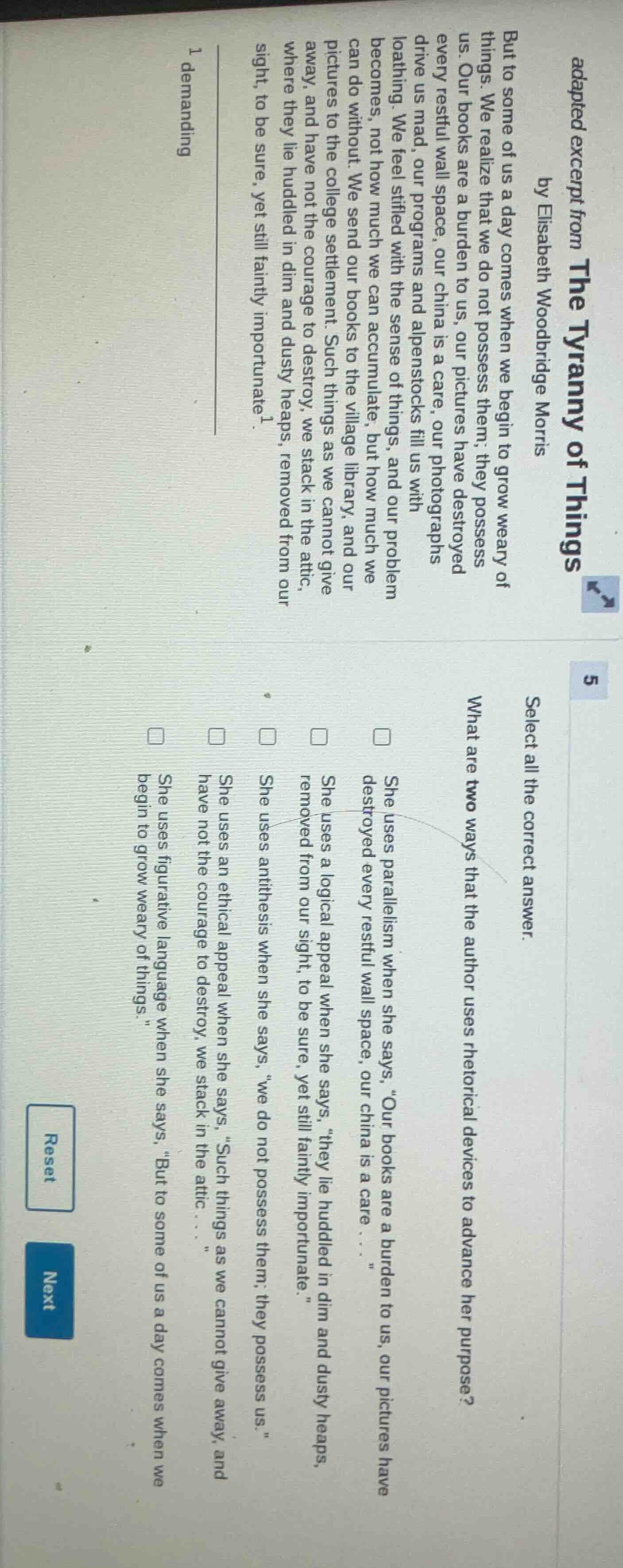
adapted excerpt from the tyranny of things by elisabeth woodbridge morris but to some of us a day comes when we begin to grow weary of things. we realize that we do not possess them; they possess us. our books are a burden to us, our pictures have destroyed every restful wall space, our china is a care, our photographs drive us mad, our programs and alpenstocks fill us with loathing. we feel stifled with the sense of things, and our problem becomes, not how much we can accumulate, but how much we can do without. we send our books to the village library, and our pictures to the college settlement. such things as we cannot give away, and have not the courage to destroy, we stack in the attic, where they lie huddled in dim and dusty heaps, removed from our sight, to be sure, yet still faintly importunate. 1 demanding select all the correct answer. what are two ways that the author uses rhetorical devices to advance her purpose? she uses parallelism when she says, “our books are a burden to us, our pictures have destroyed every restful wall space, our china is a care...” she uses a logical appeal when she says, “they lie huddled in dim and dusty heaps, removed from our sight, to be sure, yet still faintly importunate.” she uses antithesis when she says, “we do not possess them; they possess us.” she uses an ethical appeal when she says, “such things as we cannot give away, and have not the courage to destroy; we stack in the attic...” she uses figurative language when she says, “but to some of us a day comes when we begin to grow weary of things.”
- Parallelism is seen in the repeated structure "our [noun] is/are a [negative noun/verb phrase]" in the sentence listing the burdens of possessions, which matches the first option.
- Antithesis is used in the contrasting statement "we do not possess them; they possess us," which directly opposes the usual idea of ownership, matching the third option.
- The second option refers to a logical appeal, but the quoted text describes avoiding disposal, not a logical argument. The fourth option refers to an ethical appeal, but the text does not make a moral argument about the possessions. The fifth option's phrase uses a relatable observation, not figurative language like metaphor or simile.

Snap & solve any problem in the app
Get step-by-step solutions on Sovi AI
Photo-based solutions with guided steps
Explore more problems and detailed explanations
- She uses parallelism when she says, "Our books are a burden to us, our pictures have destroyed every restful wall space, our china is a care . . ."
- She uses antithesis when she says, "we do not possess them; they possess us."