QUESTION IMAGE
Question
adjacent
angles that share a side
congruent
angles with the same
measure.
supplementary
2 angles whose sum is 180°
vertical
opposite angles
made by two
intersecting lines
complementary
2 angles whose sum 90°
linear pair
2 angles that form a line.
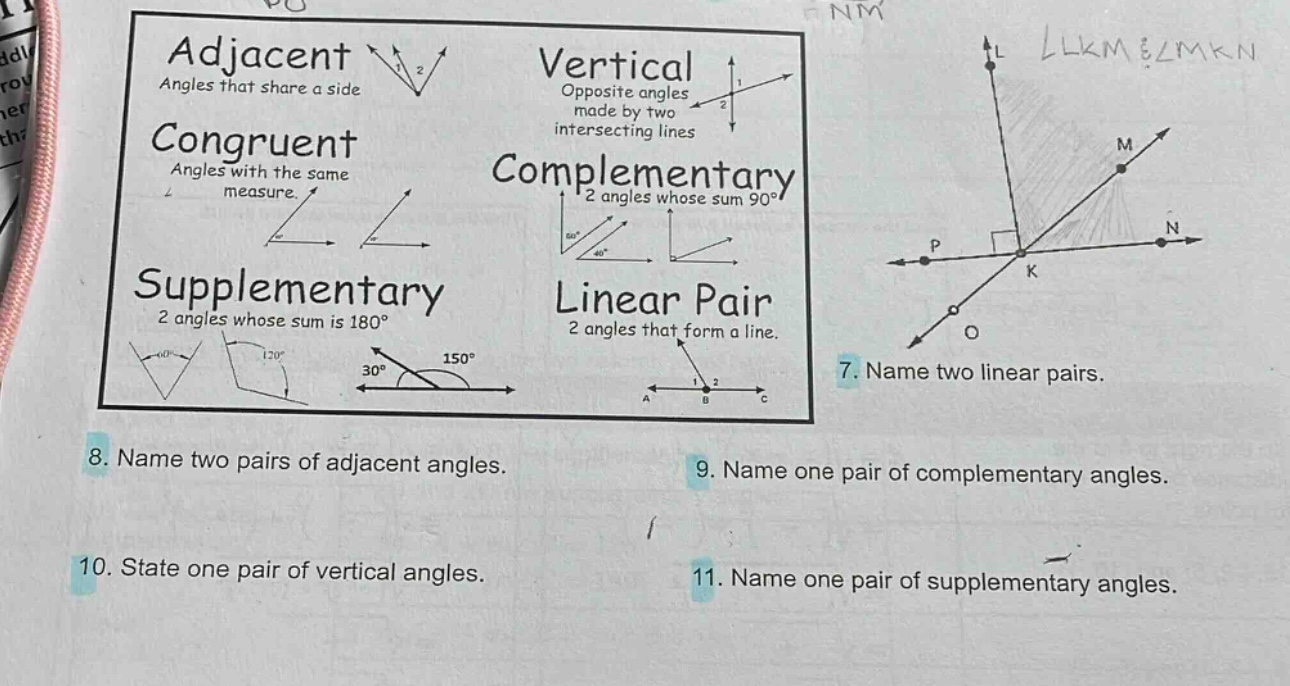
- name two linear pairs.
- name two pairs of adjacent angles.
- name one pair of complementary angles.
- state one pair of vertical angles.
- name one pair of supplementary angles.
Question 7: Name two linear pairs.
A linear pair consists of two adjacent angles that form a straight line (sum to \(180^\circ\)). From the diagram, \(\angle LKM\) and \(\angle MKN\) form a line? Wait, no, looking at the intersection at \(K\). Let's identify:
- \(\angle LKP\) and \(\angle PK O\)? No, better: \(\angle LKM\) and \(\angle MK N\)? Wait, the right angle is at \(K\) between \(L\) and \(P N\)? Wait, the diagram has \(P - K - N\) as a straight line, \(L - K - O\) as another? Wait, no, the vertical line is \(L - K\) with a right angle to \(P - N\). So linear pairs:
- \(\angle LKP\) and \(\angle LKN\)? No, wait, linear pair is two angles forming a line. So \(\angle LKM\) and \(\angle MK N\) (but \(\angle MK N\) is adjacent? Wait, maybe \(\angle PK L\) and \(\angle LKN\)? No, let's re-express. A linear pair is two angles adjacent and forming a straight line. So:
- \(\angle LKP\) and \(\angle PK O\) (but \(P - K - O\) is a straight line? Wait, the diagram has \(P\), \(K\), \(N\) on a horizontal line, and \(L\), \(K\), \(O\) on a line? Wait, no, \(P\) and \(O\) are on one line, \(N\) and... Wait, the intersection: \(P - K - N\) (horizontal), \(L - K - O\) (another line, with \(L\) up, \(O\) down). Also, \(M\) is on a line from \(K\) to \(M\). So linear pairs:
- \(\angle LKM\) and \(\angle MK N\) (no, \(\angle MK N\) is with \(M\) and \(N\)). Wait, better:
- \(\angle PK L\) and \(\angle LKN\): \(P - K - N\) is straight, \(L\) is up, so \(\angle PK L\) (between \(P - K - L\)) and \(\angle LKN\) (between \(L - K - N\)) form a line? No, \(\angle PK L\) is a right angle? Wait, the right angle is at \(K\) between \(L\) and \(P N\), so \(\angle LKP = 90^\circ\), \(\angle PKN = 90^\circ\)? Wait, maybe I misread. Let's correct:
Linear pairs are two angles adjacent, sharing a side, and forming a straight line. So:
- \(\angle LKM\) and \(\angle MK N\) (no, \(\angle MK N\) is adjacent? Wait, maybe \(\angle PK L\) and \(\angle LKN\) (but \(\angle LKN\) is \(90^\circ + \angle MK N\)? No, let's take two angles that form a line. So:
- \(\angle PK O\) and \(\angle OK N\) (but \(P - K - N\) is straight, \(O\) is below \(K\), so \(\angle PK O\) and \(\angle OK N\) form a line? Wait, \(P - K - N\) is horizontal, \(O\) is on the line through \(P\) and \(O\), so \(P - K - O\) is a straight line? No, \(P\) and \(O\) are on opposite sides of \(K\), so \(P - K - O\) is a straight line. So \(\angle LKP\) and \(\angle LKO\) (no, \(L - K - O\) is a straight line? \(L\) is up, \(O\) is down, so \(L - K - O\) is a straight line. So:
- \(\angle LKP\) and \(\angle PK O\): No, better examples:
- \(\angle LKM\) and \(\angle MK N\) (wait, \(\angle MK N\) is adjacent to \(\angle LKM\) and forms a line? No, \(\angle LKM\) and \(\angle MK N\) sum to... Wait, the right angle: \(\angle LKP = 90^\circ\), so \(\angle LKM + \angle MK P\)? No, maybe I'm overcomplicating. Let's use the definition: two angles adjacent, sharing a common side, and their non-common sides form a straight line.
So two linear pairs:
- \(\angle LKP\) and \(\angle LKN\) (but \(\angle LKN\) is \(90^\circ\) +... No, wait, \(P - K - N\) is straight, \(L - K\) is vertical (right angle), so \(\angle LKP = 90^\circ\), \(\angle LKN = 90^\circ\)? No, that can't be. Wait, maybe \(\angle PK M\) and \(\angle MK N\)? No, let's look at the other line: \(M\) is on a line from \(K\) to \(M\), so \(\angle LKM\) and \(\angle MK O\)? No, perhaps the correct linear pairs are:
- \(\angle LKP\) and \(\angle PK O\) (since \(P - K - O\) is a straight line, and they share side \(KP\)).
- \(\angle LKN\) and \(\angle NKO\) (since \(L - K - O\) is a stra…
Adjacent angles share a common side and vertex, but do not overlap. From the diagram:
- \(\angle LKM\) and \(\angle MK P\) (share side \(KM\), vertex \(K\)).
- \(\angle LKP\) and \(\angle PK M\) (share side \(KP\), vertex \(K\)).
Complementary angles sum to \(90^\circ\). From the diagram, \(\angle LKM\) and \(\angle MK P\) (if \(\angle LKP = 90^\circ\), then \(\angle LKM + \angle MK P = 90^\circ\)).

Snap & solve any problem in the app
Get step-by-step solutions on Sovi AI
Photo-based solutions with guided steps
Explore more problems and detailed explanations
- \(\angle PK L\) and \(\angle LKN\)
- \(\angle PK O\) and \(\angle OK N\)