QUESTION IMAGE
Question
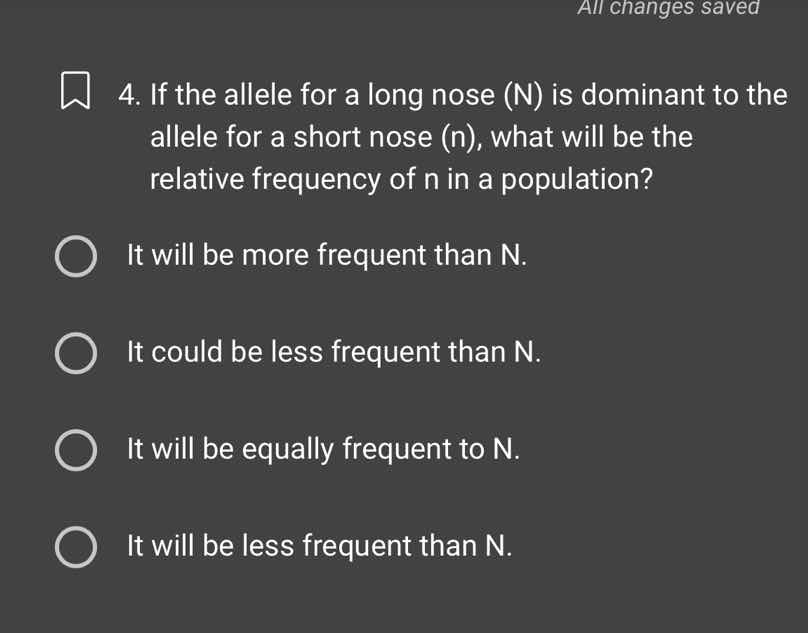
- if the allele for a long nose (n) is dominant to the allele for a short nose (n), what will be the relative frequency of n in a population?
it will be more frequent than n.
it could be less frequent than n.
it will be equally frequent to n.
it will be less frequent than n.
Dominance of an allele (N is dominant over n) does not directly determine the relative frequency of the recessive allele (n) in a population. Allele frequencies depend on factors like natural selection, genetic drift, mutation, and gene flow. So the frequency of n could be less than N, equal, or even more (though less likely if N is advantageous, but not a certainty). The first option is wrong as dominance doesn't mean recessive is more. Third is wrong as there's no guarantee of equality. Fourth is wrong as it's not a definite "will be less"—it's possible but not certain. The second option acknowledges the uncertainty.

Snap & solve any problem in the app
Get step-by-step solutions on Sovi AI
Photo-based solutions with guided steps
Explore more problems and detailed explanations
B. It could be less frequent than N.