QUESTION IMAGE
Question
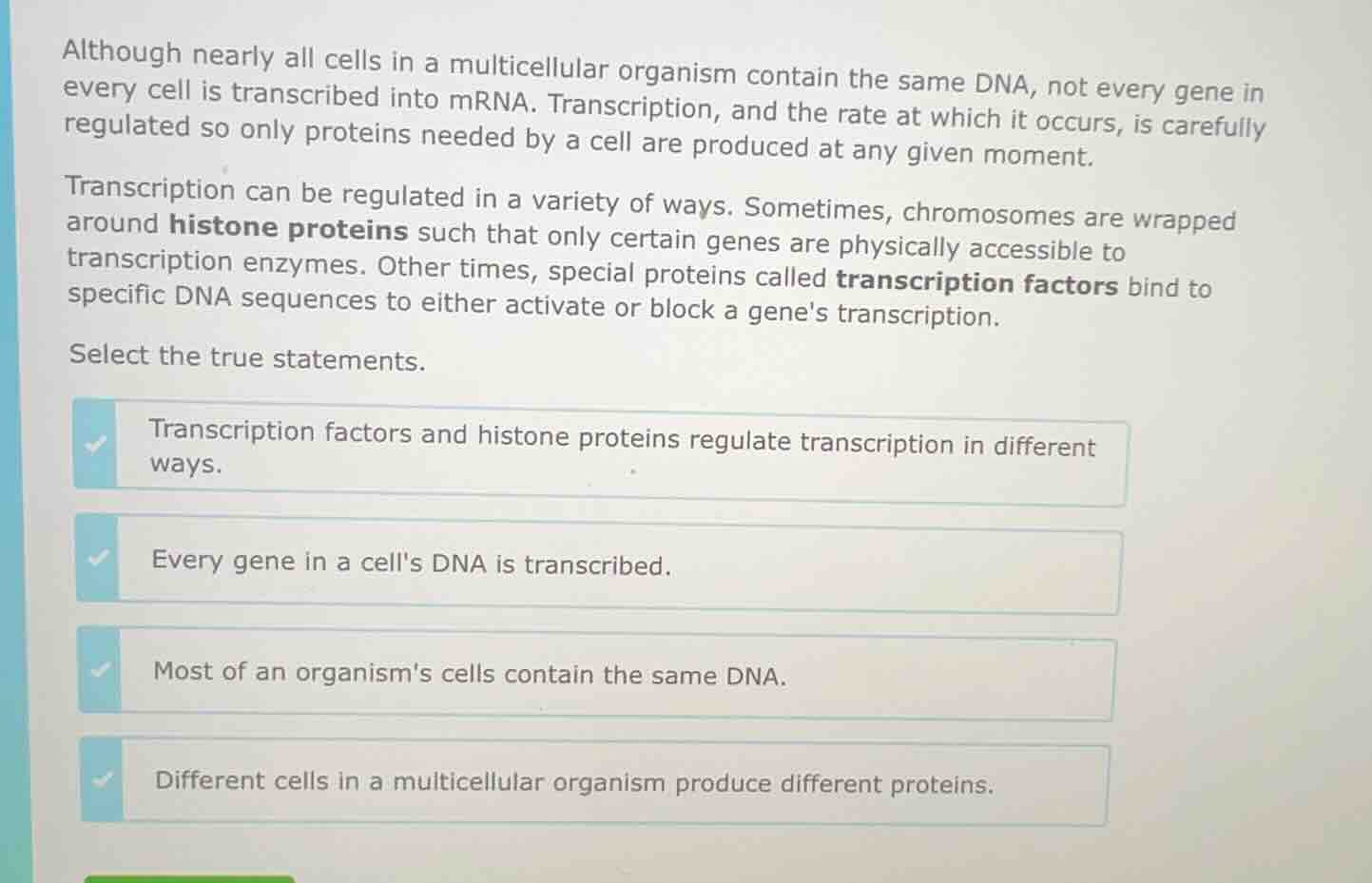
although nearly all cells in a multicellular organism contain the same dna, not every gene in every cell is transcribed into mrna. transcription, and the rate at which it occurs, is carefully regulated so only proteins needed by a cell are produced at any given moment.
transcription can be regulated in a variety of ways. sometimes, chromosomes are wrapped around histone proteins such that only certain genes are physically accessible to transcription enzymes. other times, special proteins called transcription factors bind to specific dna sequences to either activate or block a genes transcription.
select the true statements.
- transcription factors and histone proteins regulate transcription in different ways.
- every gene in a cells dna is transcribed.
- most of an organisms cells contain the same dna.
- different cells in a multicellular organism produce different proteins.
- Transcription factors act by binding specific DNA sequences to activate/block transcription, while histones regulate by controlling physical access of enzymes to genes, so they use different mechanisms.
- The text states "not every gene in every cell is transcribed", so the claim that every gene is transcribed is false.
- The text specifies "nearly all cells in a multicellular organism contain the same DNA", which aligns with "most of an organism's cells contain the same DNA".
- Since transcription is regulated to produce only proteins a cell needs, different cells will produce different proteins based on their function.

Snap & solve any problem in the app
Get step-by-step solutions on Sovi AI
Photo-based solutions with guided steps
Explore more problems and detailed explanations
- Transcription factors and histone proteins regulate transcription in different ways.
- Most of an organism's cells contain the same DNA.
- Different cells in a multicellular organism produce different proteins.