QUESTION IMAGE
Question
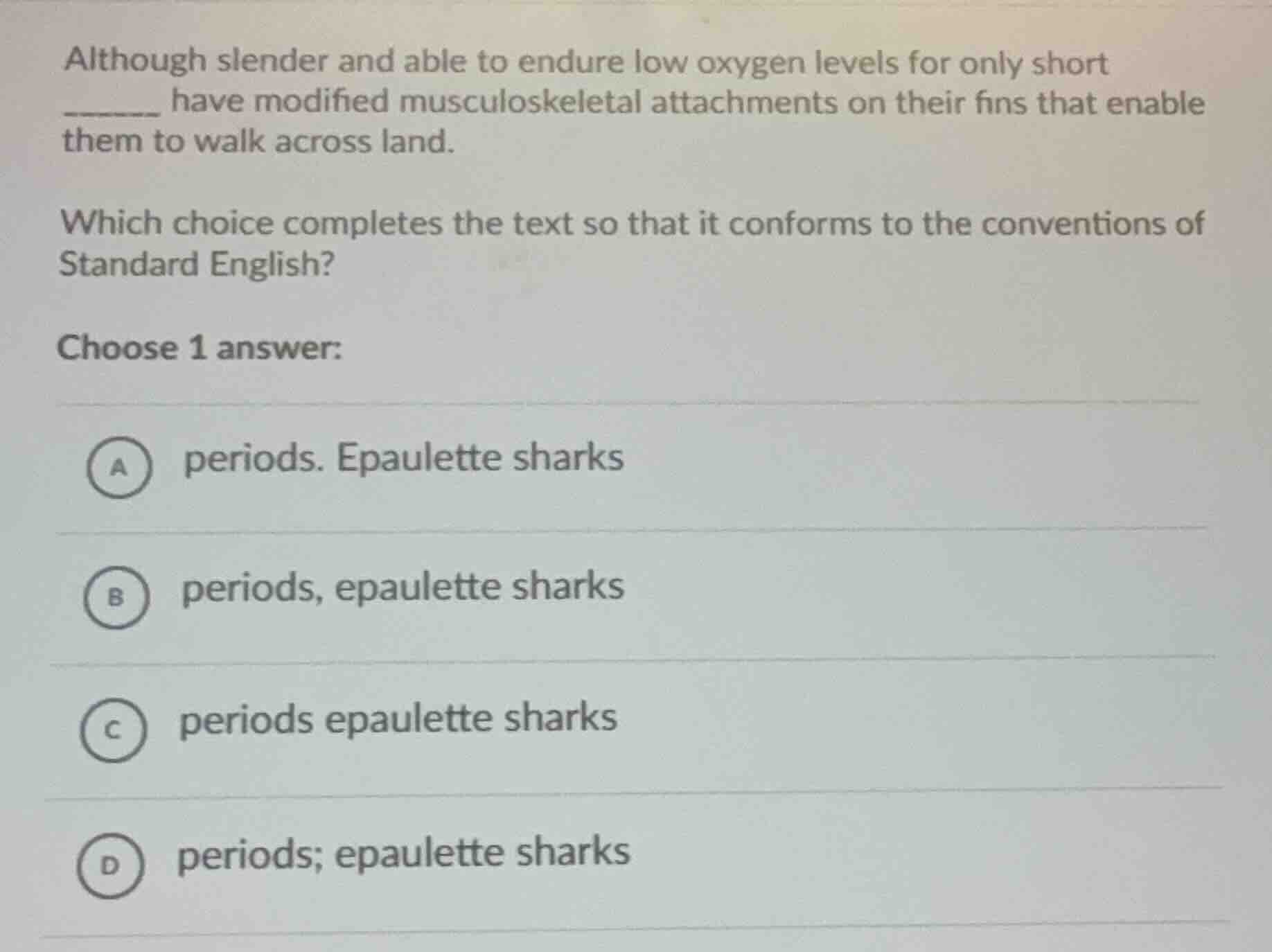
although slender and able to endure low oxygen levels for only short ______ have modified musculoskeletal attachments on their fins that enable them to walk across land. which choice completes the text so that it conforms to the conventions of standard english? choose 1 answer: a periods. epaulette sharks b periods, epaulette sharks c periods epaulette sharks d periods; epaulette sharks
To determine the correct answer, we analyze the sentence structure and punctuation rules. The first part of the sentence ("Although slender and able to endure low oxygen levels for only short periods") is an independent clause? No, actually, the first part is a dependent clause followed by the main clause. Wait, no, let's re - examine. The first part "Although slender and able to endure low oxygen levels for only short ____" is a dependent clause, and then we need to start the main clause. But actually, the first part is a phrase leading up to the main clause. Wait, the key is the punctuation between "periods" and the next part.
Option A: "periods. Epaulette sharks" - The first part "Although... short periods" is a complete thought? No, "Although" introduces a subordinate clause, so the first part is not a complete sentence. Wait, no, "Although slender and able to endure low oxygen levels for only short periods" is a subordinate clause, and then "Epaulette sharks have modified..." is the main clause. But if we use a period after "periods", the first part would be a sentence, but "Although" makes it a subordinate clause, so it can't stand alone. Wait, maybe I'm overcomplicating. Let's look at the options for punctuation.
The two parts of the sentence are related: the first part describes a characteristic of epaulette sharks, and the second part describes another characteristic. So we need a punctuation that connects them appropriately. A semicolon is used to separate two independent clauses that are related in meaning. Let's check each option:
- Option A: Uses a period. The first part "Although... short periods" is not a complete sentence (because of "Although"), so a period is incorrect.
- Option B: Uses a comma. "periods, epaulette sharks" - The comma would make the second part a dependent clause, but "epaulette sharks have..." is an independent clause, so a comma here is incorrect (it would be a comma splice if the first part were independent, but the first part is not independent).
- Option C: No punctuation. "periods epaulette sharks" - This is a run - on sentence.
- Option D: Uses a semicolon. The first part "Although slender and able to endure low oxygen levels for only short periods" can be considered as a clause (even with "Although"), and the second part "epaulette sharks have modified..." is an independent clause. A semicolon is appropriate to connect two related clauses. Wait, actually, the first part is a subordinate clause, but maybe in terms of the sentence structure here, the author is treating the first part as a clause that can be separated with a semicolon from the main clause. Alternatively, maybe the first part is a complete thought when we consider the context. Let's think about the meaning: The first part says that epaulette sharks can endure low oxygen for short periods, and the second part says they have modified fin attachments. These are two related facts about epaulette sharks. So using a semicolon to separate the two independent clauses (even if the first one has "Although", maybe in this case, the "Although" is part of the first clause and the clause is still independent in terms of the sentence structure here) is correct.
Wait, maybe a better way: Let's recall that a semicolon is used between two independent clauses that are not joined by a conjunction. The two clauses here are: (1) [Epaulette sharks are] slender and able to endure low oxygen levels for only short periods; (2) Epaulette sharks have modified musculoskeletal attachments... So the semicolon is used to separate these two related clauses…

Snap & solve any problem in the app
Get step-by-step solutions on Sovi AI
Photo-based solutions with guided steps
Explore more problems and detailed explanations
D. periods; epaulette sharks