QUESTION IMAGE
Question
american unrest
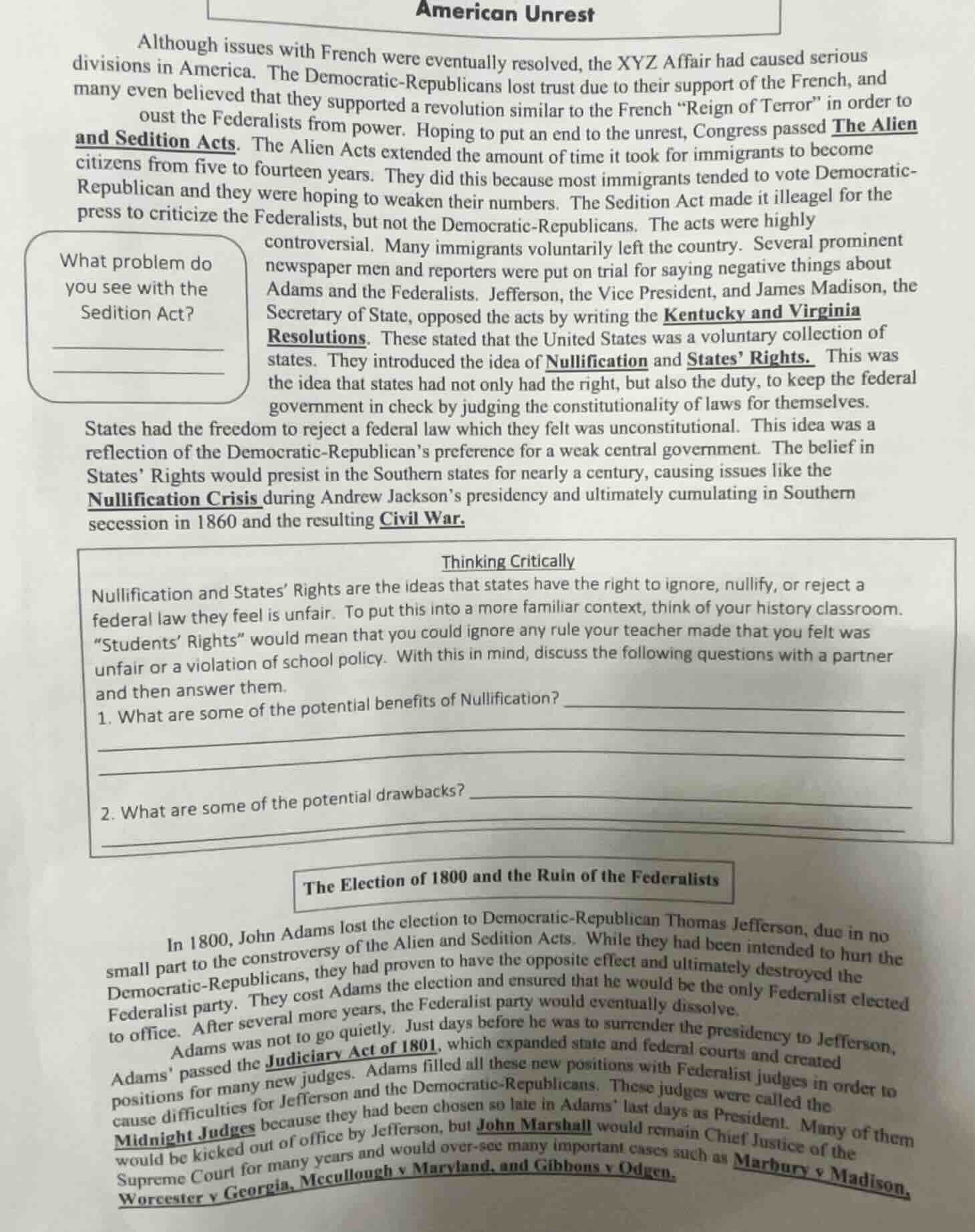
although issues with french were eventually resolved, the xyz affair had caused serious divisions in america. the democratic - republicans lost trust due to their support of the french, and many even believed that they supported a revolution similar to the french
eign of terror\ in order to oust the federalists from power. hoping to put an end to the unrest, congress passed the alien and sedition acts. the alien acts extended the amount of time it took for immigrants to become citizens from five to fourteen years. they did this because most immigrants tended to vote democratic - republican and they were hoping to weaken their numbers. the sedition act made it illegal for the press to criticize the federalists, but not the democratic - republicans. the acts were highly controversial. many immigrants voluntarily left the country. several prominent newspaper men and reporters were put on trial for saying negative things about adams and the federalists. jefferson, the vice president, and james madison, the secretary of state, opposed the acts by writing the kentucky and virginia resolutions. these stated that the united states was a voluntary collection of states. they introduced the idea of nullification and states’ rights. this was the idea that states had not only had the right, but also the duty, to keep the federal government in check by judging the constitutionality of laws for themselves.
what problem do you see with the sedition act?
states had the freedom to reject a federal law which they felt was unconstitutional. this idea was a reflection of the democratic - republican’s preference for a weak central government. the belief in states’ rights would persist in the southern states for nearly a century, causing issues like the nullification crisis during andrew jackson’s presidency and ultimately cumulating in southern secession in 1860 and the resulting civil war.
thinking critically
nullification and states’ rights are the ideas that states have the right to ignore, nullify, or reject a federal law they feel is unfair. to put this into a more familiar context, think of your history classroom. “students’ rights” would mean that you could ignore any rule your teacher made that you felt was unfair or a violation of school policy. with this in mind, discuss the following questions with a partner and then answer them.
- what are some of the potential benefits of nullification?
- what are some of the potential drawbacks?
the election of 1800 and the ruin of the federalists
in 1800, john adams lost the election to democratic - republican thomas jefferson, due in no small part to the controversy of the alien and sedition acts. while they had been intended to hurt the democratic - republicans, they had proven to have the opposite effect and ultimately destroyed the federalist party. they cost adams the election and ensured that he would be the only federalist elected to office. after several more years, the federalist party would eventually dissolve.
adams was not to go quietly. just days before he was to surrender the presidency to jefferson, adams’ passed the judiciary act of 1801, which expanded state and federal courts and created positions for many new judges. adams filled all these new positions with federalist judges in order to cause difficulties for jefferson and the democratic - republicans. these judges were called the midnight judges because they had been chosen so late in adams’ last days as president. many of them would be kicked out of office by jefferson, but john marshall would remain chief justice of the supreme court for many years and would over - see many important cases such as marbury v madison, worcester v georgia, mccullough v maryland, and gibbons v odgen.
For "What problem do you see with the Sedition Act?":
The Sedition Act violated the U.S. Constitution's First Amendment, which protects freedom of speech and the press. It only criminalized criticism of Federalists, creating unequal enforcement and suppressing political dissent.
For "1. What are some of the potential benefits of Nullification?":
Nullification lets states push back against federal laws they view as unconstitutional, acting as a check on overreach by the central government. It can protect states' unique interests and local autonomy when federal laws do not align with regional needs.
For "2. What are some of the potential drawbacks?":
Nullification undermines the supremacy of federal law, which is foundational to a unified nation. It can lead to legal chaos, as states may reject laws critical to national function (like civil rights or economic regulations), and it can deepen sectional divides, potentially leading to secession or national conflict as seen in the lead-up to the Civil War.

Snap & solve any problem in the app
Get step-by-step solutions on Sovi AI
Photo-based solutions with guided steps
Explore more problems and detailed explanations
- The Sedition Act violated the First Amendment's protections of free speech and free press, and it was enforced unequally to target only critics of the Federalist Party.
- Potential benefits of Nullification include:
- Acting as a check on federal government overreach
- Protecting state-level autonomy and regional unique interests
- Potential drawbacks of Nullification include:
- Undermining the supremacy of federal law and national unity
- Creating legal inconsistency across states
- Fueling sectional tensions that can lead to secession or national conflict