QUESTION IMAGE
Question
analysis questions.
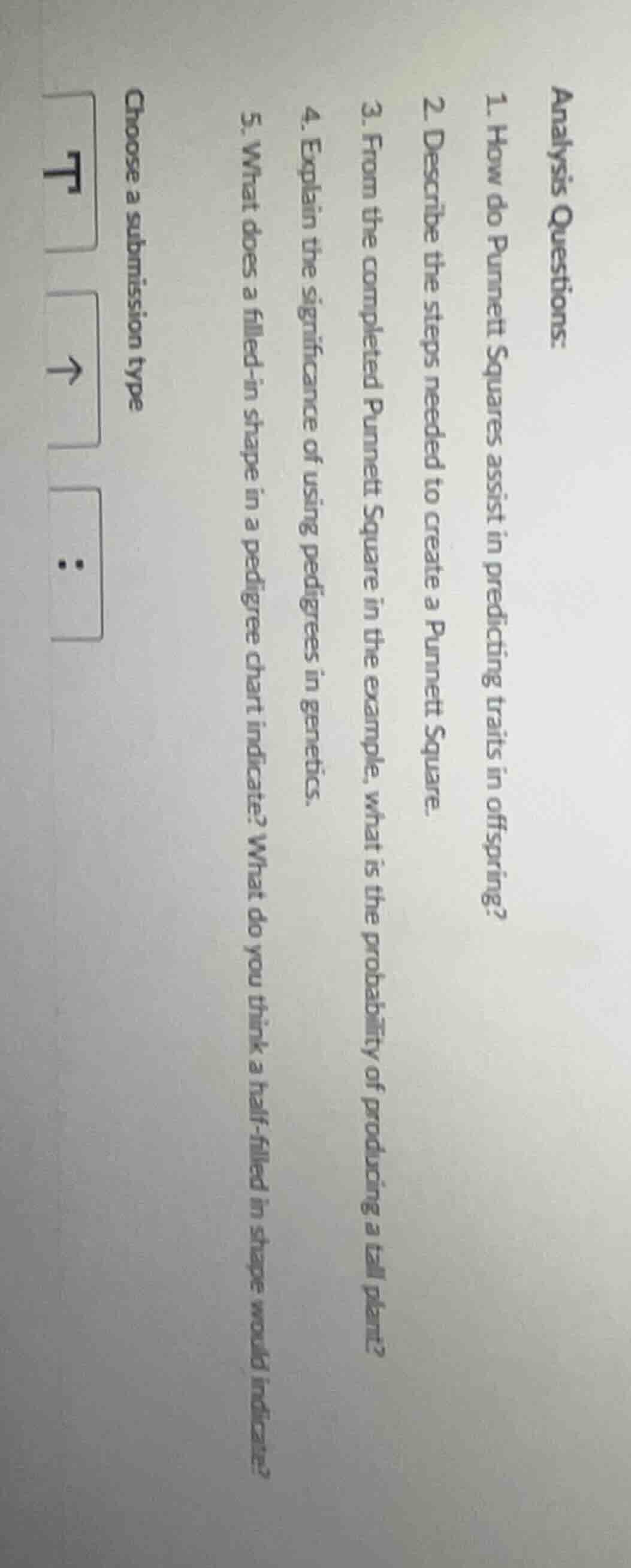
- how do punnett squares assist in predicting traits in offspring?
- describe the steps needed to create a punnett square.
- from the completed punnett square in the example, what is the probability of producing a tall plant?
- explain the significance of using pedigrees in genetics.
- what does a filled - in shape in a pedigree chart indicate? what do you think a half - filled in shape would indicate?
choose a submission type
Question 1
A Punnett Square is a tool in genetics. It lists the possible gametes (sex cells with alleles) of each parent along the top and side. By combining these gametes in the squares, it shows all possible genetic combinations (genotypes) of offspring. From these genotypes, we can determine the probability of different phenotypes (traits) appearing in the offspring. For example, if crossing two heterozygous tall plants (Tt x Tt), the Punnett Square shows the ratio of TT, Tt, and tt genotypes, which correspond to tall or short phenotypes, helping predict how likely each trait is in the offspring.
- Determine Parental Genotypes: First, find out the genotypes of the two parents for the trait in question. For example, if studying plant height, a tall parent might be Tt (heterozygous) and another tall parent Tt.
- Identify Gametes: Figure out the possible gametes each parent can produce. Using the example, a Tt parent can produce T and t gametes.
- Set Up the Square: Draw a grid. Place the gametes of one parent along the top row and the gametes of the other parent along the left - hand column.
- Fill in the Square: For each cell in the grid, combine the allele from the top (parent 1's gamete) and the allele from the side (parent 2's gamete) to get the offspring's genotype.
- Analyze the Results: Count the number of each genotype and phenotype to determine the ratios and probabilities of different traits in the offspring.
To answer this, we need the completed Punnett Square. Let's assume a common example: Tt (tall) x Tt (tall) cross. The Punnett Square would have cells: TT, Tt, Tt, tt. The tall phenotype is associated with TT or Tt (since T is dominant). There are 3 out of 4 cells with either TT or Tt, so the probability of a tall plant is $\frac{3}{4}$ (75%). If the example was different, like TT x tt, all offspring would be Tt (tall), so probability is 1 (100%).

Snap & solve any problem in the app
Get step-by-step solutions on Sovi AI
Photo-based solutions with guided steps
Explore more problems and detailed explanations
A Punnett Square lists parental gametes (allele - carrying sex cells) along axes. Combining gametes in squares shows all possible offspring genotypes. From genotypes, we calculate the probability of each phenotype (trait) in offspring.