QUESTION IMAGE
Question
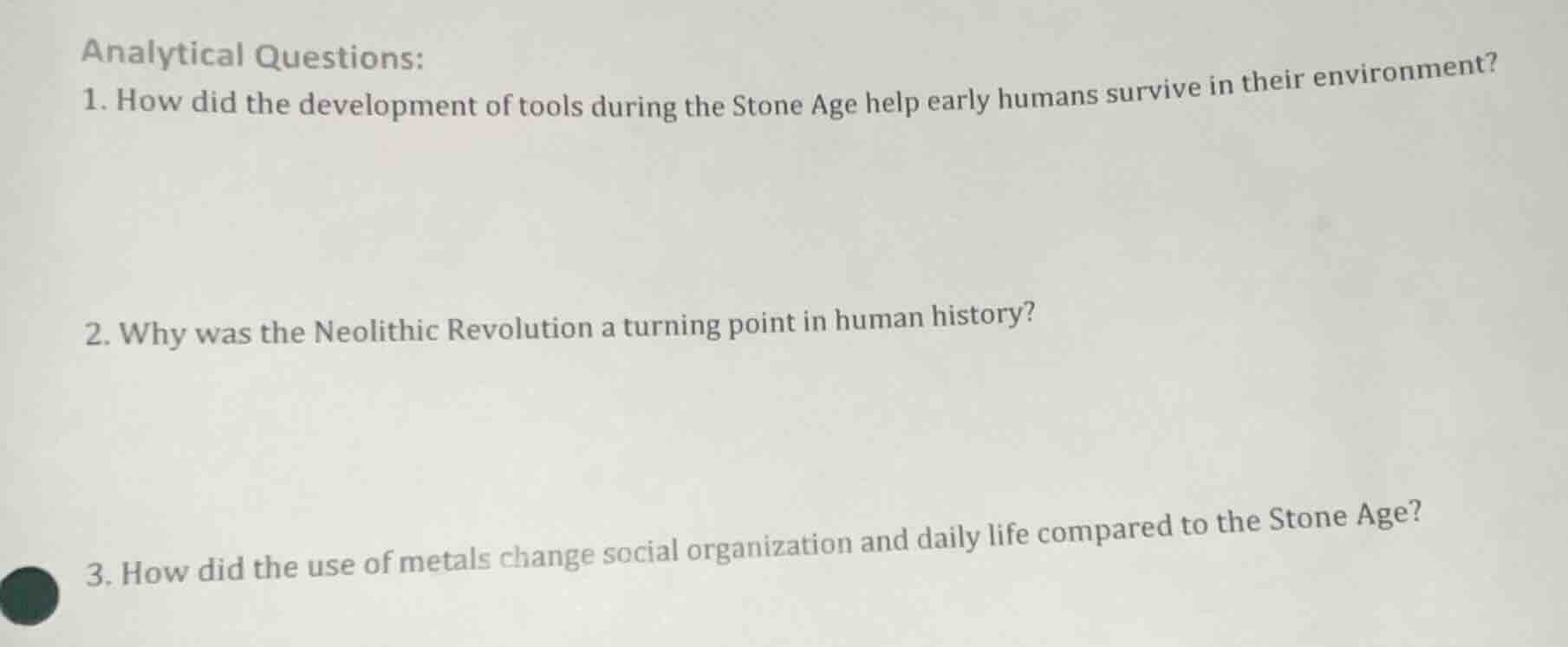
analytical questions:
- how did the development of tools during the stone age help early humans survive in their environment?
- why was the neolithic revolution a turning point in human history?
- how did the use of metals change social organization and daily life compared to the stone age?
Response
Sub - question 1: How did the development of tools during the Stone Age help early humans survive in their environment?
Brief Explanations
- Hunting and Gathering: Stone tools like handaxes, spears, and arrowheads made it easier for early humans to hunt animals. For example, sharp - edged stone tools could be used to kill or butcher prey, providing a more reliable source of meat, which was rich in protein and fat, essential for survival.
- Food Processing: Tools such as scrapers and grindstones were used to process food. Scrapers could be used to remove meat from bones, and grindstones could be used to crush seeds or roots, making them easier to digest and unlocking more nutritional value from plant - based foods.
- Defense: Stone tools were also used for defense against predators. A well - made stone tool could be used to fend off dangerous animals, increasing the chances of survival in a hostile environment.
- Shelter and Clothing: Tools were used in the construction of shelters. For instance, stone axes could be used to cut branches or shape wood for building huts. Also, tools were used to process animal hides, making them suitable for clothing, which helped in regulating body temperature and protecting against the elements.
Brief Explanations
- Shift to Agriculture: The Neolithic Revolution saw the shift from hunting and gathering to agriculture. Humans began to domesticate plants (like wheat, barley) and animals (like sheep, cattle). This led to a more stable food supply as they were no longer solely dependent on the availability of wild food sources.
- Sedentary Lifestyle: With agriculture, people could settle in one place as they no longer needed to follow herds or move with the seasons to find food. This led to the development of permanent settlements, which was a major change from the nomadic lifestyle of the Paleolithic era.
- Social and Technological Advancements: Permanent settlements led to the development of more complex social structures. There was a division of labor, with some people specializing in farming, others in crafting (like making pottery, weaving), and some in leadership or religious roles. Technological advancements also occurred, such as the development of better farming tools, pottery for storing food, and weaving for making clothing.
- Population Growth: A more stable food supply from agriculture allowed for population growth. Larger populations could then support more complex societies and the development of early civilizations.
Brief Explanations
- Social Organization:
- Specialization and Trade: The production of metal tools (like bronze, later iron) required specialized skills. This led to the emergence of metalworkers as a distinct group in society. Also, metals were valuable, and trade in metals and metal products developed. For example, regions with metal resources could trade with those without, leading to the growth of trade networks and more complex economic systems.
- Social Hierarchy: Metal tools and weapons were often associated with power. Those who controlled the production or access to metal weapons could gain more power, leading to the development of more complex social hierarchies, with rulers and an elite class emerging in some societies.
- Daily Life:
- Technology and Productivity: Metal tools were more durable and efficient than stone tools. For example, metal plows in agriculture made farming more efficient, allowing for larger - scale cultivation and higher crop yields. Metal tools also improved craftsmanship, leading to better - quality pottery, textiles, and other goods.
- Warfare: Metal weapons (like swords, spears) were more effective in warfare than stone weapons. This changed the nature of conflicts, with more organized and potentially more destructive warfare, but also led to the development of military strategies and defenses.
- Infrastructure: Metal tools were used in the construction of better infrastructure. For example, metal - tipped tools could be used in building more durable and larger - scale buildings, roads, and irrigation systems.

Snap & solve any problem in the app
Get step-by-step solutions on Sovi AI
Photo-based solutions with guided steps
Explore more problems and detailed explanations
The development of Stone Age tools helped early humans survive by aiding in hunting (e.g., spears for killing prey), food processing (e.g., grindstones for crushing seeds), defense against predators, and the construction of shelters and processing of animal hides for clothing.