QUESTION IMAGE
Question
analyzing rays and segments
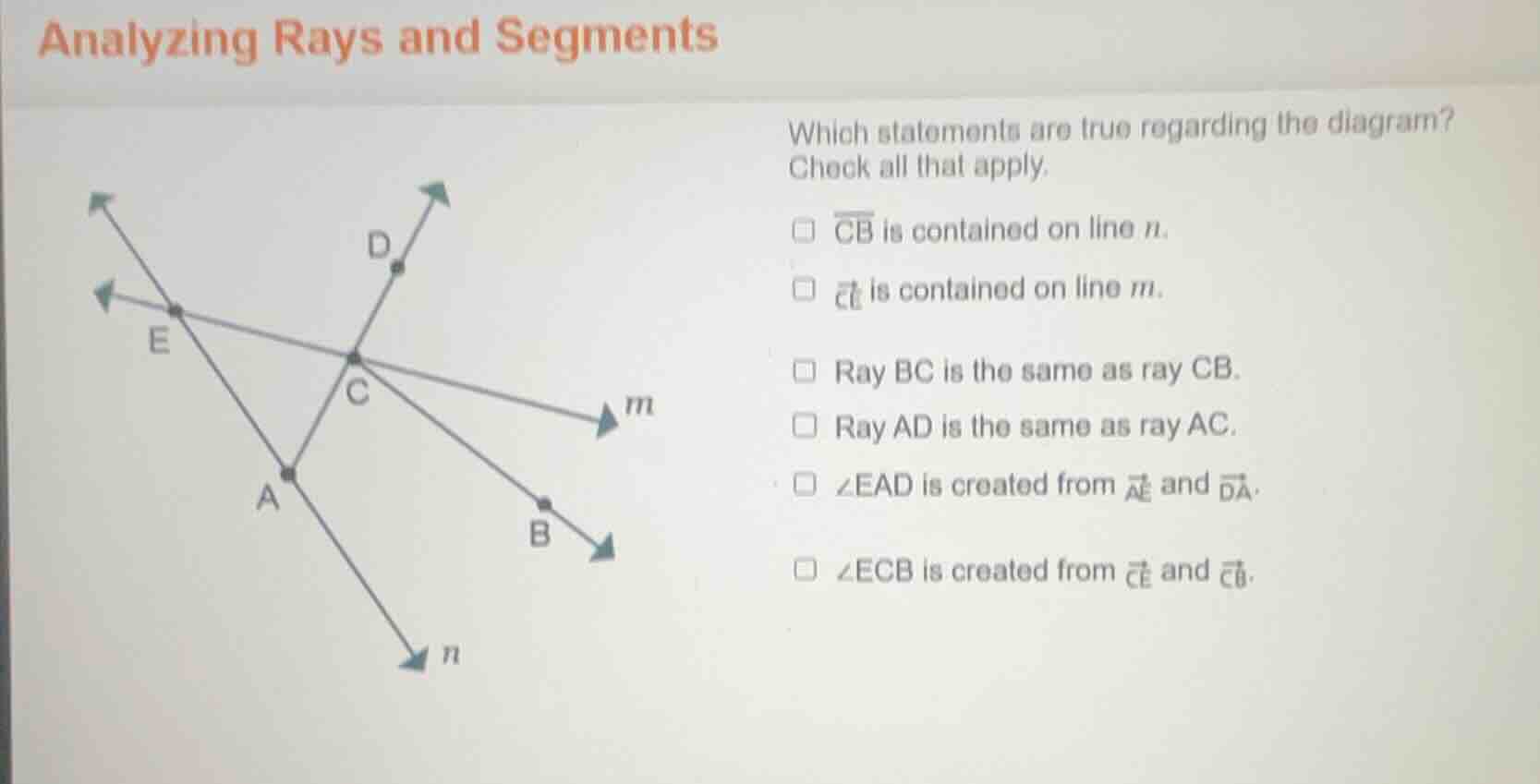
which statements are true regarding the diagram?
check all that apply.
$square$ $overline{cb}$ is contained on line $n$.
$square$ $overrightarrow{ce}$ is contained on line $m$.
$square$ ray $bc$ is the same as ray $cb$.
$square$ ray $ad$ is the same as ray $ac$.
$square$ $angle ead$ is created from $overrightarrow{ae}$ and $overrightarrow{da}$.
$square$ $angle ecb$ is created from $overrightarrow{ce}$ and $overrightarrow{cb}$.
- For $\overline{CB}$: Line \( n \) contains points \( A, E, C \)? No, wait, looking at the diagram, line \( n \) has points \( A \) and the direction, but \( \overline{CB} \) – wait, actually, line \( n \) (the one with \( A \) and the arrow down) – no, wait, let's re-examine. Wait, the first option: \( \overline{CB} \) is on line \( n \)? Wait, no, maybe I misread. Wait, actually, let's check each option:
- Option 1: \( \overline{CB} \) is contained on line \( n \)? Wait, line \( n \) has points \( A \) and the arrow, but \( C \) is on line \( n \)? Wait, the diagram: line \( n \) goes through \( A \) and \( E \) and \( C \)? Wait, no, the line with \( A \) and the downward arrow is \( n \), and it passes through \( E \) and \( C \)? Wait, maybe. Wait, \( \overline{CB} \): segment \( CB \) – if \( C \) is on line \( n \), and \( B \) is on a ray from \( C \), but maybe line \( n \) contains \( C \) and \( A \), and \( \overline{CB} \) – no, maybe the first option is false? Wait, no, let's check the correct options.
Wait, the correct options are:
- \( \overrightarrow{CE} \) is on line \( m \)? No, line \( m \) is the one with the arrow from \( C \) to the right. Wait, \( \overrightarrow{CE} \): \( C \) to \( E \) – line \( m \) is \( C \) to the right, but \( E \) is on the other line. Wait, no, maybe I messed up.
Wait, let's recall:
- Ray \( BC \) vs \( CB \): A ray is defined by its endpoint and direction. Ray \( BC \) has endpoint \( B \) and goes through \( C \); ray \( CB \) has endpoint \( C \) and goes through \( B \). So they are different. So that option is false.
- Ray \( AD \): endpoint \( A \), direction through \( D \); ray \( AC \): endpoint \( A \), direction through \( C \). If \( D \) is on the same line as \( AC \) (since \( D \) is on the ray from \( C \) upwards), then ray \( AD \) (from \( A \) through \( D \)) and ray \( AC \) (from \( A \) through \( C \)) – if \( D \) is on the extension of \( AC \) beyond \( C \), then yes, ray \( AD \) is same as ray \( AC \). So that option is true.
- \( \angle EAD \): created by \( \overrightarrow{AE} \) and \( \overrightarrow{DA} \)? Wait, \( \angle EAD \) has vertex \( A \), sides \( AE \) and \( AD \). So \( \overrightarrow{AE} \) (from \( A \) to \( E \)) and \( \overrightarrow{DA} \) (from \( D \) to \( A \)) – but angle at \( A \), so the sides should be \( \overrightarrow{AE} \) and \( \overrightarrow{AD} \), but \( \overrightarrow{DA} \) is from \( D \) to \( A \), which is the same as \( \overrightarrow{AD} \) reversed? No, angle \( EAD \) is between \( AE \) (from \( A \) to \( E \)) and \( AD \) (from \( A \) to \( D \)). Wait, \( \overrightarrow{DA} \) is from \( D \) to \( A \), so the angle between \( \overrightarrow{AE} \) (A to E) and \( \overrightarrow{DA} \) (D to A) – that would be the same as angle \( EAD \), because \( \overrightarrow{DA} \) is the same as \( \overrightarrow{AD} \) reversed, but the angle at \( A \) between \( AE \) and \( AD \) is \( \angle EAD \). So that option is true? Wait, no, the option says "created from \( \overrightarrow{AE} \) and \( \overrightarrow{DA} \)". So vertex \( A \), sides \( \overrightarrow{AE} \) (A to E) and \( \overrightarrow{DA} \) (D to A) – yes, that forms \( \angle EAD \).
- \( \angle ECB \): created from \( \overrightarrow{CE} \) (C to E) and \( \overrightarrow{CB} \) (C to B) – yes, because \( \angle ECB \) has vertex \( C \), sides \( CE \) and \( CB \), so that's true.
Wait, let's re-express:
- \( \overline{CB} \) on line \( n \): Line \( n \) is the one with \( A \) and the downward arrow.…

Snap & solve any problem in the app
Get step-by-step solutions on Sovi AI
Photo-based solutions with guided steps
Explore more problems and detailed explanations
- Ray \( AD \) is the same as ray \( AC \).
- \( \angle EAD \) is created from \( \overrightarrow{AE} \) and \( \overrightarrow{DA} \).
- \( \angle ECB \) is created from \( \overrightarrow{CE} \) and \( \overrightarrow{CB} \).
(In boxed form with options, but since it's check all that apply, the correct ones are:
- Ray \( AD \) is the same as ray \( AC \).
- \( \angle EAD \) is created from \( \overrightarrow{AE} \) and \( \overrightarrow{DA} \).
- \( \angle ECB \) is created from \( \overrightarrow{CE} \) and \( \overrightarrow{CB} \).
So the answer is the options corresponding to these, which are:
- Ray \( AD \) is the same as ray \( AC \).
- \( \angle EAD \) is created from \( \overrightarrow{AE} \) and \( \overrightarrow{DA} \).
- \( \angle ECB \) is created from \( \overrightarrow{CE} \) and \( \overrightarrow{CB} \).
So in the list, the checkboxes for these are marked. So the answer is those three options.)