QUESTION IMAGE
Question
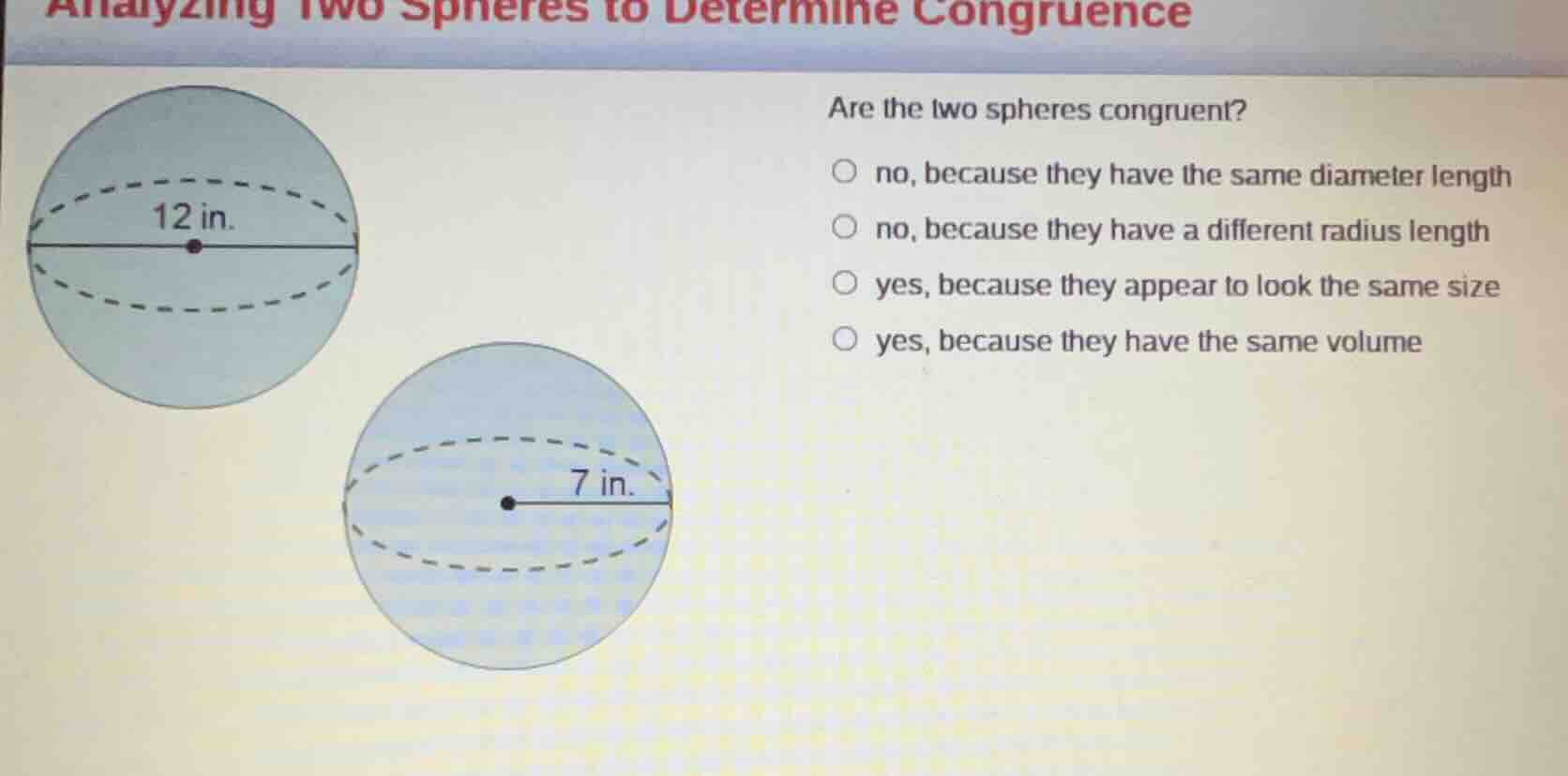
analyzing two spheres to determine congruence
are the two spheres congruent?
○ no, because they have the same diameter length
○ no, because they have a different radius length
○ yes, because they appear to look the same size
○ yes, because they have the same volume
To determine if two spheres are congruent, we check their radii (or diameters, since radius is half of diameter). The first sphere has a diameter of 12 in, so its radius is \( \frac{12}{2} = 6 \) in. The second sphere has a radius of 7 in. Congruent spheres must have the same radius (and thus same diameter/volume). Let's analyze each option:
- First option: "no, because they have the same diameter length" is wrong—they don't have the same diameter (12 in vs. 14 in (since radius 7 in means diameter 14 in)).
- Second option: "no, because they have a different radius length" is correct—6 in vs. 7 in radii.
- Third option: "yes, because they appear to look the same size" is wrong—appearance isn't a valid geometric congruence criterion.
- Fourth option: "yes, because they have the same volume" is wrong—different radii mean different volumes (volume of a sphere is \( \frac{4}{3}\pi r^3 \), so different \( r \) means different volume).

Snap & solve any problem in the app
Get step-by-step solutions on Sovi AI
Photo-based solutions with guided steps
Explore more problems and detailed explanations
B. no, because they have a different radius length