QUESTION IMAGE
Question
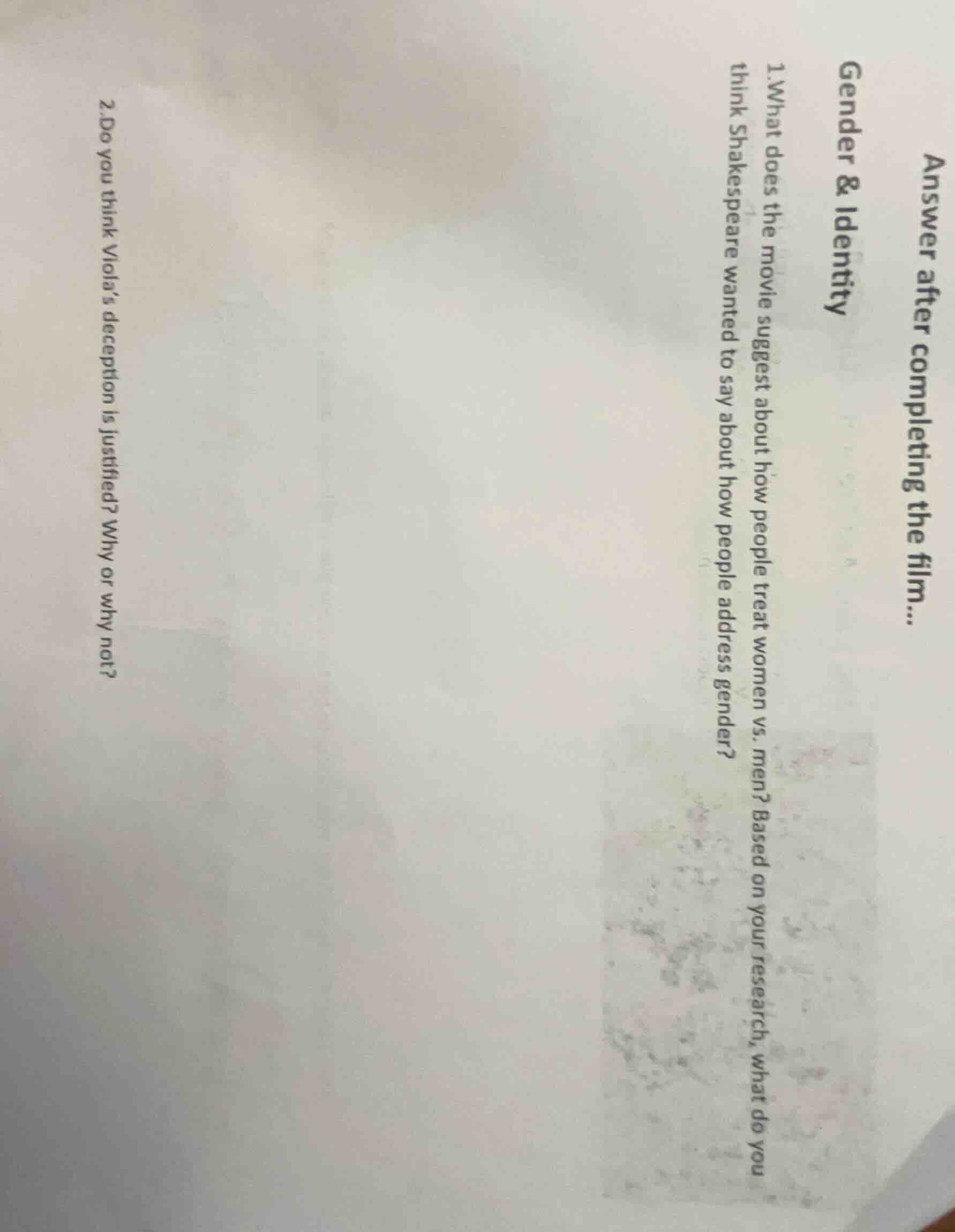
answer after completing the film...
gender & identity
1.what does the movie suggest about how people treat women vs. men? based on your research, what do you think shakespeare wanted to say about how people address gender?
2.do you think viola’s deception is justified? why or why not?
Question 1
To answer this, we analyze gender dynamics. The film (likely Twelfth Night adaptation) and Shakespeare’s work show gendered treatment: women faced restrictions (e.g., Viola’s disguise to access opportunities), men had more freedom. Shakespeare suggests gender roles are social constructs—disguise reveals how gender impacts interaction (e.g., Viola as Cesario is taken seriously, showing gendered expectations of competence/authority). The movie might highlight modern parallels (e.g., workplace gender bias) or reinforce Shakespeare’s view on fluidity.
Viola’s deception (disguising as Cesario) in Twelfth Night can be justified. She is shipwrecked, alone, and in a society with strict gender roles—disguise is her only way to survive (get a job, access resources) and navigate a male - dominated world. It also reveals gender’s artificiality: her “male” persona’s success shows gendered expectations are arbitrary. Morally, while deception is usually wrong, her intent (self - preservation, not harm) and the insight it provides (exposing gender bias) make it justifiable.

Snap & solve any problem in the app
Get step-by-step solutions on Sovi AI
Photo-based solutions with guided steps
Explore more problems and detailed explanations
The film (e.g., a Twelfth Night adaptation) and Shakespeare’s work suggest people treat women and men with gender - based biases: women face restrictions (e.g., limited agency, societal expectations of passivity/domesticity), men get more freedom/authority. Shakespeare uses Viola’s disguise to show gender is a social construct—when Viola (as Cesario) acts “masculine,” she gains respect, revealing how gendered expectations (e.g., men as competent/authoritative, women as subordinate) shape treatment. The movie may echo this, highlighting modern gender inequities (e.g., workplace, social) or reinforcing gender fluidity.