QUESTION IMAGE
Question
answer
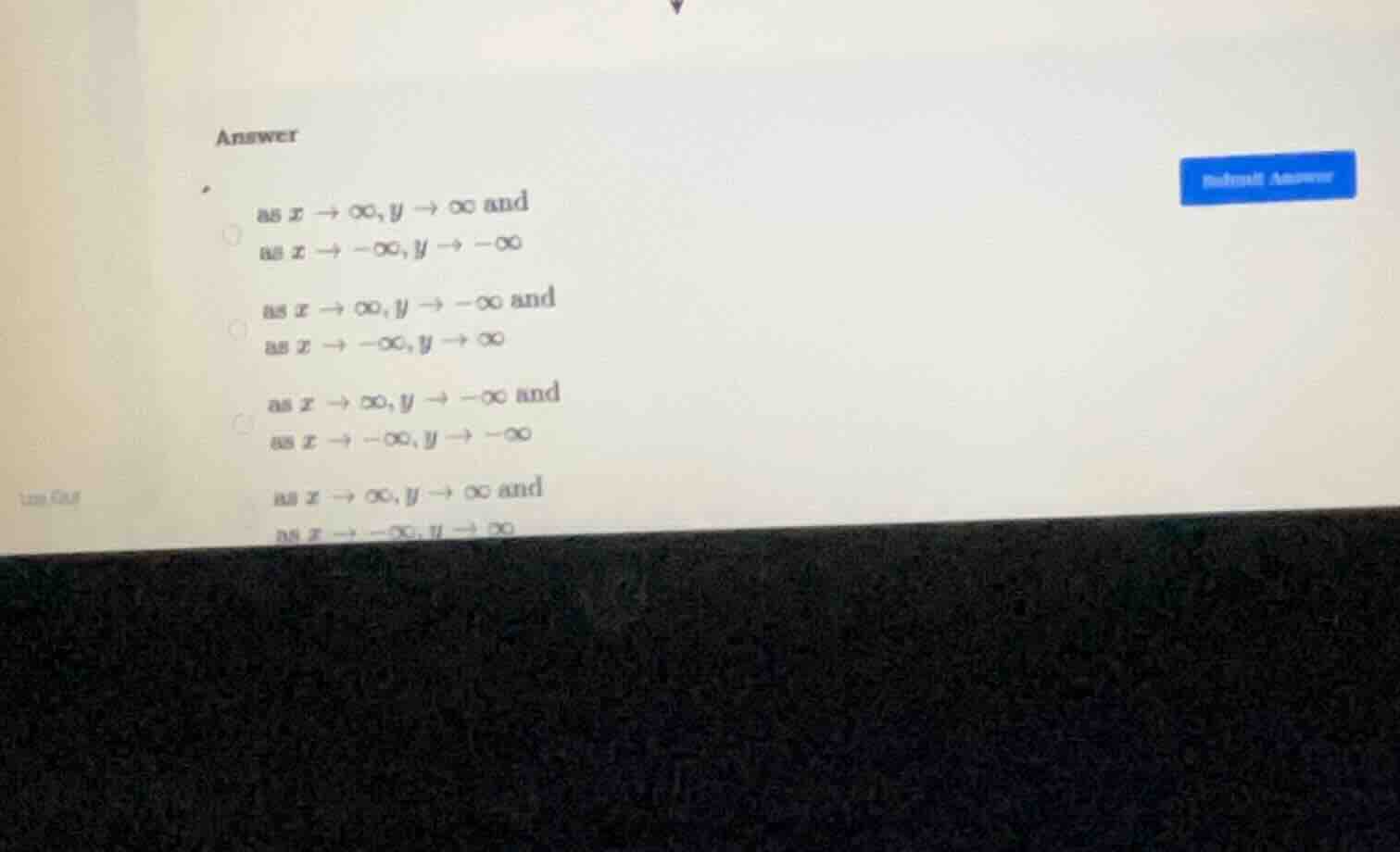
as ( x \to infty, y \to infty ) and
as ( x \to -infty, y \to -infty )
as ( x \to infty, y \to -infty ) and
as ( x \to -infty, y \to infty )
as ( x \to infty, y \to -infty ) and
as ( x \to -infty, y \to -infty )
as ( x \to infty, y \to infty ) and
as ( x \to -infty, y \to infty )
To solve this, we analyze the end - behavior of a function (usually a polynomial, but the principle applies to other functions too). For a function with a positive leading coefficient and an odd degree (or a function with a similar growth pattern), when \(x\to\infty\), \(y\to\infty\) and when \(x\to-\infty\), \(y\to-\infty\) is not the case here. Wait, actually, for a function with a positive leading coefficient and an even degree, as \(x\to\pm\infty\), \(y\to\infty\). But looking at the options, the first option says "as \(x\to\infty,y\to\infty\) and as \(x\to-\infty,y\to-\infty\)" - no, that's for odd degree with positive leading coefficient? Wait, no, let's re - evaluate. Wait, maybe the function is a linear function with a positive slope. For a linear function \(y = mx + b\) where \(m>0\), as \(x\to\infty\), \(y\to\infty\) and as \(x\to-\infty\), \(y\to-\infty\). But the second option is "as \(x\to\infty,y\to-\infty\) and as \(x\to-\infty,y\to\infty\)" which is for a linear function with negative slope (\(m < 0\)). Wait, but the first option: "as \(x\to\infty,y\to\infty\) and as \(x\to-\infty,y\to-\infty\)" is the end - behavior of a function with a positive leading coefficient and odd degree (like \(y=x\), \(y = x^{3}\) etc.). If we assume the function is of the form with positive leading coefficient and odd degree, the first option is correct. Wait, but let's check the options again.
Wait, the first option is: "as \(x\to\infty,y\to\infty\) and as \(x\to-\infty,y\to-\infty\)"
The second option: "as \(x\to\infty,y\to-\infty\) and as \(x\to-\infty,y\to\infty\)"
The third option: "as \(x\to\infty,y\to-\infty\) and as \(x\to-\infty,y\to-\infty\)"
The fourth option: "as \(x\to\infty,y\to\infty\) and as \(x\to-\infty,y\to\infty\)"
For a function like \(y = x\) (linear, slope positive), as \(x\to\infty\), \(y\to\infty\) and as \(x\to-\infty\), \(y\to-\infty\). So the first option is correct.

Snap & solve any problem in the app
Get step-by-step solutions on Sovi AI
Photo-based solutions with guided steps
Explore more problems and detailed explanations
as \(x\to\infty,y\to\infty\) and as \(x\to-\infty,y\to-\infty\) (the first option in the list of options provided)