QUESTION IMAGE
Question
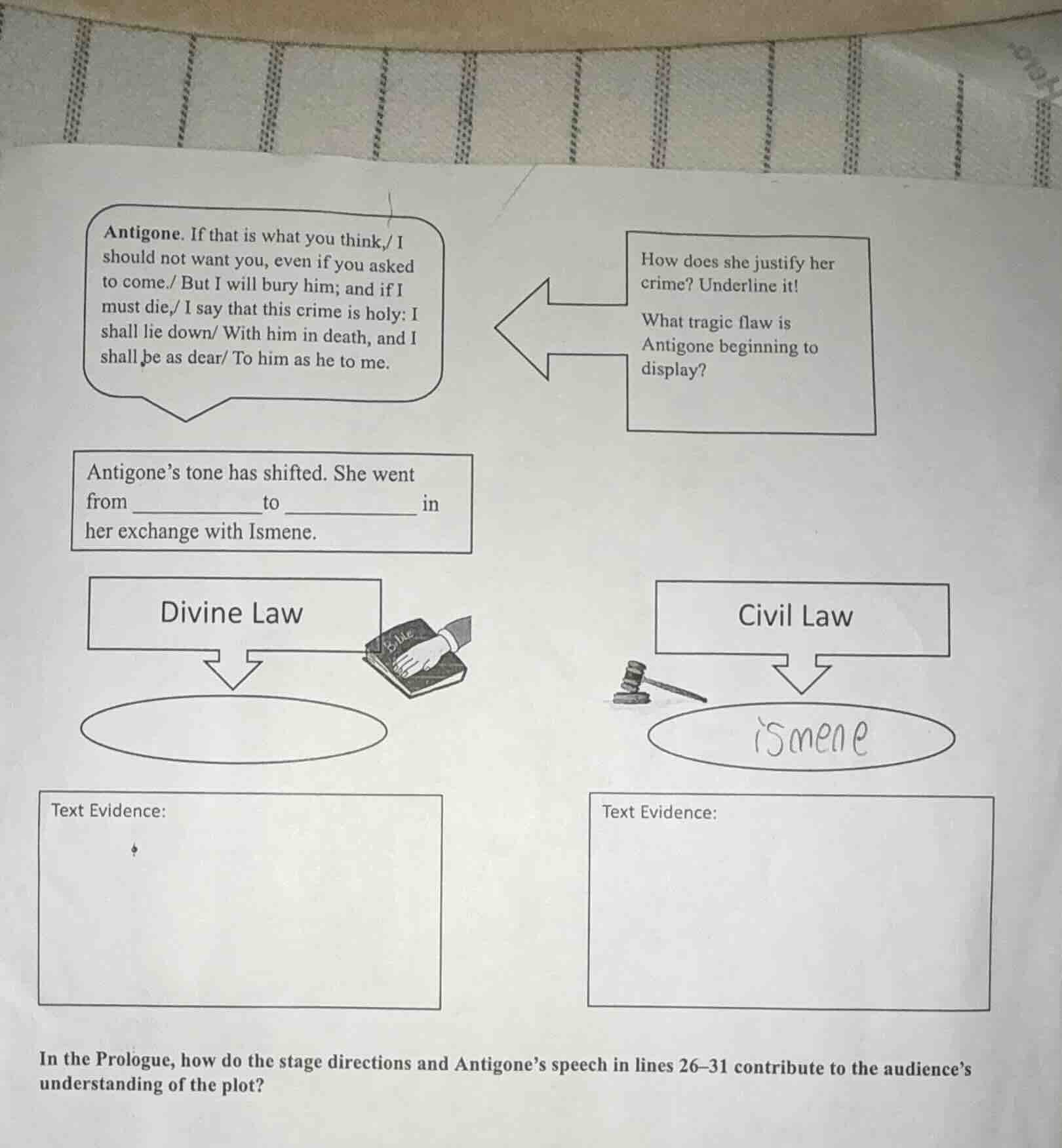
antigone. if that is what you think,/ i should not want you, even if you asked to come./ but i will bury him; and if i must die,/ i say that this crime is holy: i shall lie down/ with him in death, and i shall be as dear/ to him as he to me.
how does she justify her crime? underline it!
what tragic flaw is antigone beginning to display?
antigones tone has shifted. she went from __________to __________ in her exchange with ismene.
divine law
civil law
text evidence:
text evidence:
in the prologue, how do the stage directions and antigones speech in lines 26-31 contribute to the audiences understanding of the plot?
- Justification of her crime: The line where Antigone frames her act as holy is the justification; it ties her choice to divine, moral duty over civil law.
- Tragic flaw: Antigone's unyielding refusal to compromise, even with her sister, shows excessive pride (hubris) and rigid adherence to her beliefs, which is her emerging tragic flaw.
- Tone shift: Initially, Antigone may have been pleading or urgent with Ismene, but she shifts to bitter, defiant rejection when Ismene refuses to help.
- Divine Law alignment: Antigone follows divine law, as she prioritizes religious burial customs for her brother. Text evidence: "But I will bury him; and if I must die,/ I say that this crime is holy"
- Civil Law text evidence (Ismene): Ismene defies Antigone, citing the king's edict (civil law): "We must remember that we are women, not meant to fight against men" (from the full Prologue, context of her refusal to help).
- Prologue contribution: Antigone's speech establishes her core conflict (divine vs. civil law) and resolute character, while stage directions (e.g., her urgent, determined bearing) signal the immediate, high-stakes conflict that drives the play's plot, letting the audience know the central crisis will be her act of defiance against the state.

Snap & solve any problem in the app
Get step-by-step solutions on Sovi AI
Photo-based solutions with guided steps
Explore more problems and detailed explanations
- Underline: "I say that this crime is holy"
- Tragic flaw: Excessive pride (hubris)/rigid defiance
- Tone shift: from pleading/urgent to bitter/defiant
- Divine Law: Antigone; Text Evidence: "But I will bury him; and if I must die,/ I say that this crime is holy"
- Civil Law Text Evidence: "We must remember that we are women, not meant to fight against men" (Ismene's adherence to Creon's edict)
- Prologue contribution: It establishes the central conflict (divine vs. civil law), introduces Antigone's unyielding character, and signals the high-stakes defiance that will drive the play's plot.