QUESTION IMAGE
Question
applied biology midterm review
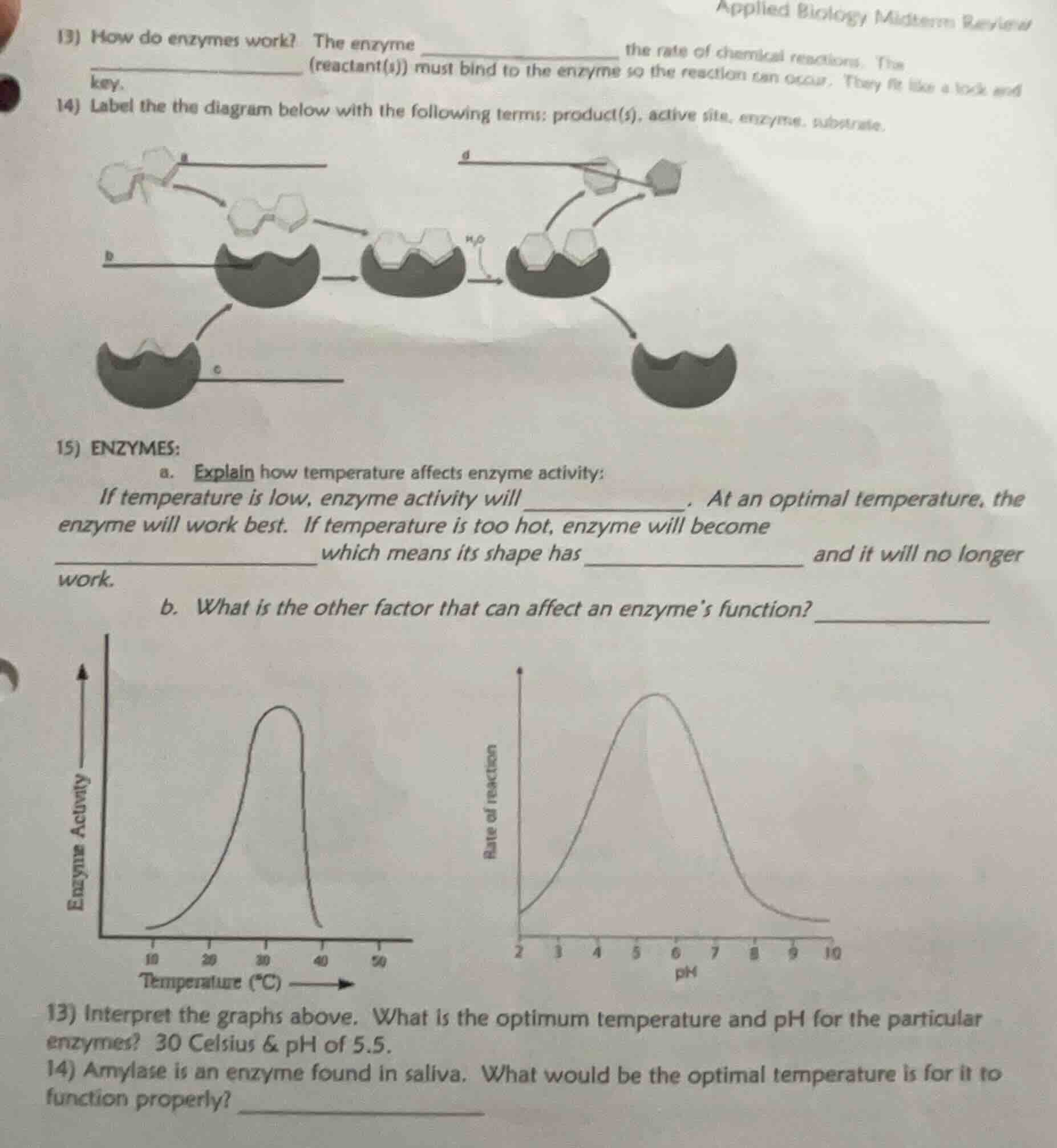
- how do enzymes work? the enzyme ______________ the rate of chemical reactions. the ______________ (reactant(s)) must bind to the enzyme so the reaction can occur. they fit like a lock and key.
- label the the diagram below with the following terms: product(s), active site, enzyme, substrate.
- enzymes:
a. explain how temperature affects enzyme activity:
if temperature is low, enzyme activity will _________. at an optimal temperature, the enzyme will work best. if temperature is too hot, enzyme will become ____________ which means its shape has ______________ and it will no longer work.
b. what is the other factor that can affect an enzyme’s function? ___________
- interpret the graphs above. what is the optimum temperature and ph for the particular enzymes? 30 celsius & ph of 5.5.
- amylase is an enzyme found in saliva. what would be the optimal temperature is for it to function properly? ________________
Question 13 (Enzyme Function Basics)
Enzymes are biological catalysts. Catalysts increase the rate of chemical reactions without being consumed. The reactants in an enzyme - catalyzed reaction are called substrates. The enzyme - substrate complex forms when the substrate binds to the enzyme's active site, following the lock - and - key model (or induced - fit model, but lock - and - key is a simpler initial concept here) where the substrate fits into the enzyme's active site like a key into a lock.
So, the enzyme increases the rate of chemical reactions. The substrate (reactant(s)) must bind to the enzyme so the reaction can occur. They fit like a lock and key.
- Substrate (a): The substrate is the reactant that binds to the enzyme. In the diagram, the molecules that are going to bind to the enzyme (the ones before binding) are the substrates.
- Active Site (b): The active site is the region on the enzyme where the substrate binds. It's the specific area of the enzyme with a complementary shape to the substrate.
- Enzyme (c): The enzyme is the biological catalyst, the protein (or RNA in some cases) with the active site. The larger, more stable structures (the "lock" in the lock - and - key model) are the enzymes.
- Product (d): The products are the molecules formed after the enzyme - catalyzed reaction. These are the molecules that are released from the enzyme after the reaction.
So, labeling:
- \(a\): Substrate
- \(b\): Active Site
- \(c\): Enzyme
- \(d\): Product
- At low temperatures, the kinetic energy of the enzyme and substrate molecules is low. This means there are fewer collisions between the substrate and the enzyme's active site, so enzyme activity will decrease (or be low/slow down).
- At high temperatures (too hot), the enzyme's structure is affected. The enzyme is a protein, and high temperatures can break the weak bonds (like hydrogen bonds) that maintain its three - dimensional structure, including the active site. When this happens, the enzyme becomes denatured. Denaturation means its shape has changed (or been altered) in a way that the active site is no longer functional, so the enzyme can't catalyze the reaction anymore.

Snap & solve any problem in the app
Get step-by-step solutions on Sovi AI
Photo-based solutions with guided steps
Explore more problems and detailed explanations
The enzyme \(\boldsymbol{\text{increases}}\) the rate of chemical reactions. The \(\boldsymbol{\text{substrate}}\) (reactant(s)) must bind to the enzyme so the reaction can occur. They fit like a lock and key.