QUESTION IMAGE
Question
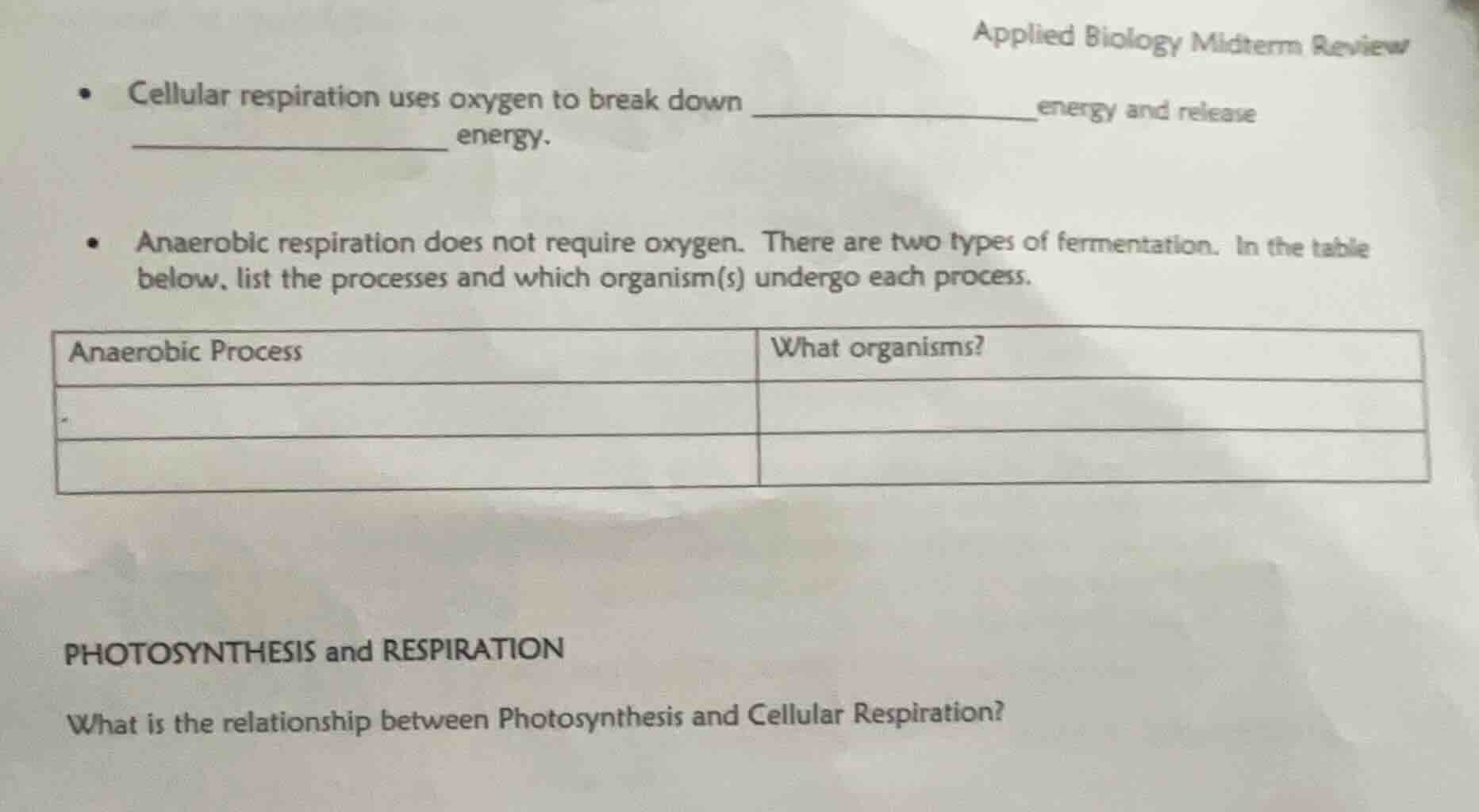
applied biology midterm review - cellular respiration uses oxygen to break down ___________ energy and release ____________ energy. - anaerobic respiration does not require oxygen. there are two types of fermentation. in the table below, list the processes and which organism(s) undergo each process. | anaerobic process | what organisms? | | --- | --- | | | | | | | photosynthesis and respiration what is the relationship between photosynthesis and cellular respiration?
First Fill - in - the - blank:
In cellular respiration, glucose (a form of stored chemical energy) is broken down in the presence of oxygen. The energy in glucose is stored (potential) and when broken down, it is released as usable (chemical or ATP) energy. So the first blank is "stored (or potential, or glucose - stored)" and the second is "usable (or chemical, or ATP)".
There are two main types of anaerobic fermentation: Lactic acid fermentation and Alcoholic fermentation. Lactic acid fermentation occurs in muscle cells (during strenuous exercise) and some bacteria (like Lactobacillus). Alcoholic fermentation occurs in yeast and some bacteria (like Saccharomyces cerevisiae for yeast).
| Anaerobic Process | What organisms? |
|---|---|
| Alcoholic Fermentation | Yeast (Saccharomyces), some bacteria |
Relationship between Photosynthesis and Cellular Respiration:
Photosynthesis (in plants, algae, some bacteria) uses carbon dioxide and water, with light energy, to produce glucose and oxygen. Cellular respiration (in most living cells) uses glucose and oxygen to produce carbon dioxide, water, and ATP (energy). The products of photosynthesis (glucose, oxygen) are the reactants of cellular respiration, and the products of cellular respiration (carbon dioxide, water) are the reactants of photosynthesis. They are complementary processes that cycle matter (carbon, oxygen, hydrogen) and transfer energy (light energy to chemical energy in photosynthesis, chemical energy in glucose to ATP in respiration).

Snap & solve any problem in the app
Get step-by-step solutions on Sovi AI
Photo-based solutions with guided steps
Explore more problems and detailed explanations
First blank: stored (or potential, or glucose - stored); Second blank: usable (or chemical, or ATP)