QUESTION IMAGE
Question
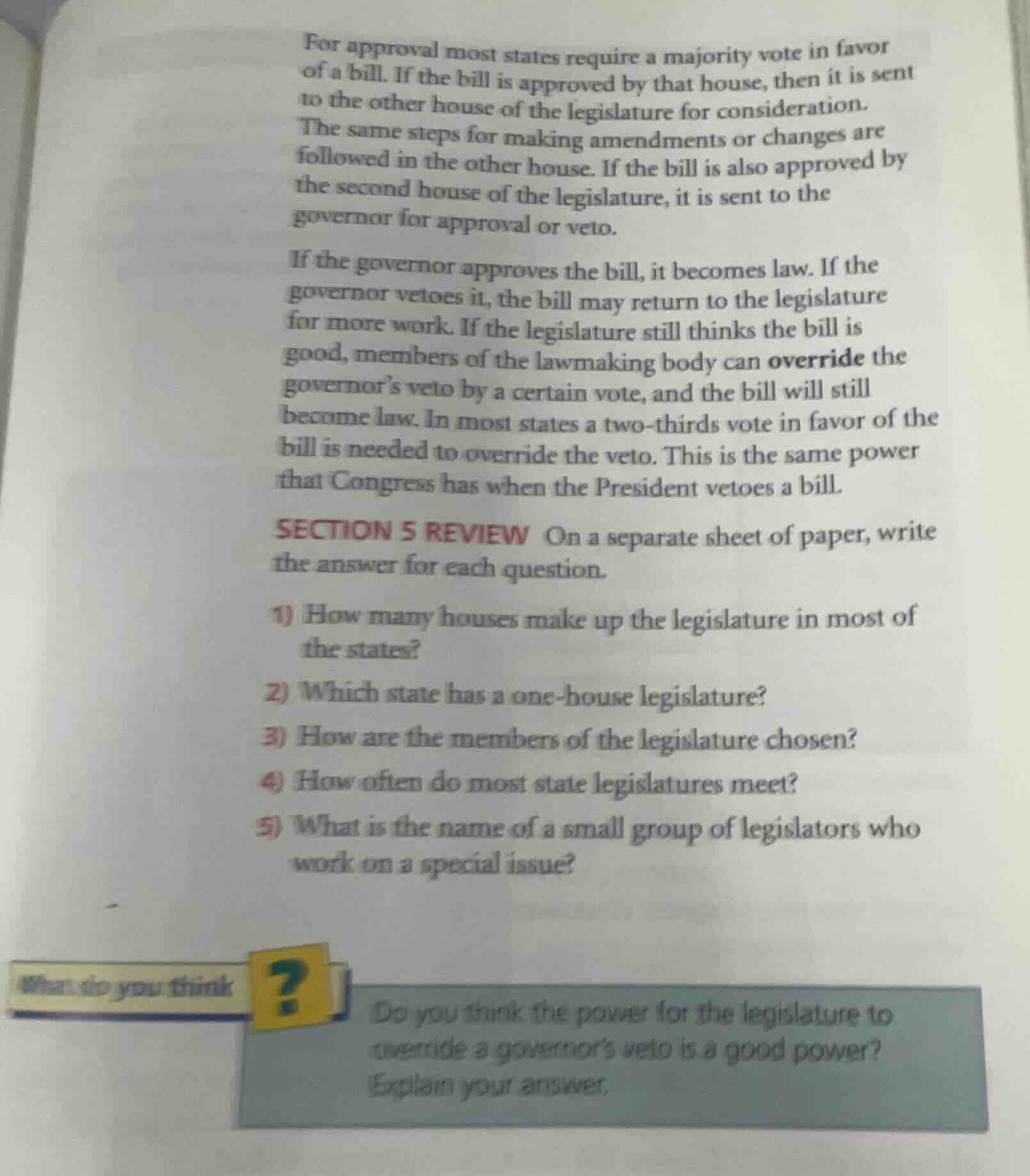
for approval most states require a majority vote in favor of a bill. if the bill is approved by that house, then it is sent to the other house of the legislature for consideration. the same steps for making amendments or changes are followed in the other house. if the bill is also approved by the second house of the legislature, it is sent to the governor for approval or veto. if the governor approves the bill, it becomes law. if the governor vetoes it, the bill may return to the legislature for more work. if the legislature still thinks the bill is good, members of the lawmaking body can override the governor’s veto by a certain vote, and the bill will still become law. in most states a two - thirds vote in favor of the bill is needed to override the veto. this is the same power that congress has when the president vetoes a bill. section 5 review on a separate sheet of paper, write the answer for each question. 1) how many houses make up the legislature in most of the states? 2) which state has a one - house legislature? 3) how are the members of the legislature chosen? 4) how often do most state legislatures meet? 5) what is the name of a small group of legislators who work on a special issue? what do you think? do you think the power for the legislature to override a governor’s veto is a good power? explain your answer.
1)
From the text, it says a bill is sent to one house, then the "other house" of the legislature. So most states' legislatures have two houses.
Nebraska is known to have a unicameral (one - house) legislature. This is a factual knowledge related to US state legislatures.
Legislature members are typically chosen through elections. Voters in their respective districts or areas vote to elect the legislators.

Snap & solve any problem in the app
Get step-by-step solutions on Sovi AI
Photo-based solutions with guided steps
Explore more problems and detailed explanations
Two (most states' legislatures are bicameral, having two houses as indicated by the process of sending a bill to one house then the "other house" for consideration).