QUESTION IMAGE
Question
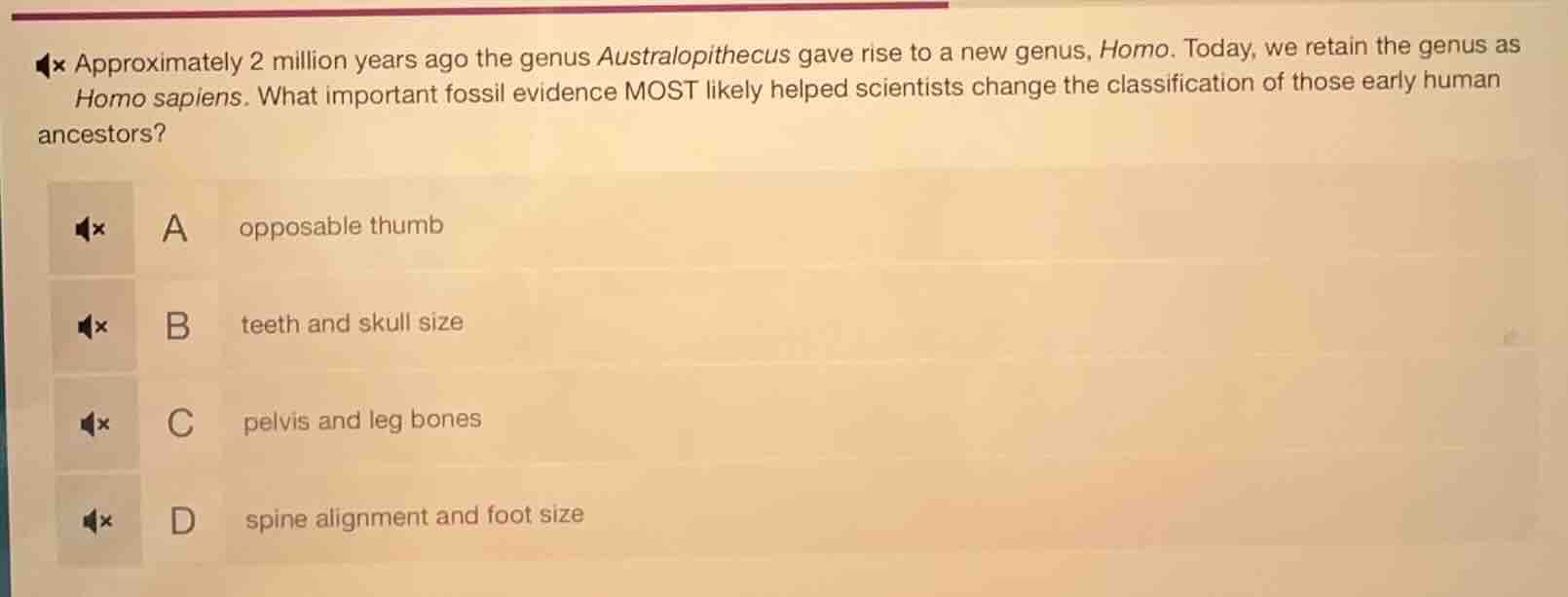
approximately 2 million years ago the genus australopithecus gave rise to a new genus, homo. today, we retain the genus as homo sapiens. what important fossil evidence most likely helped scientists change the classification of those early human ancestors? a opposable thumb b teeth and skull size c pelvis and leg bones d spine alignment and foot size
Brief Explanations
To determine the fossil evidence for reclassifying early human ancestors from Australopithecus to Homo, we analyze each option:
- Option A (opposable thumb): Both Australopithecus and early Homo likely had opposable thumbs, so it is not a key distinguishing feature for reclassification.
- Option B (teeth and skull size): Changes in teeth (e.g., reduced size, less specialized for heavy chewing) and skull size (e.g., increased cranial capacity) are critical anatomical differences between Australopithecus (more ape - like in these aspects) and Homo (more human - like). These features are well - preserved in fossils and would strongly indicate evolutionary changes justifying reclassification.
- Option C (pelvis and leg bones): While related to bipedalism, both genera show bipedal adaptations, so this is not the most distinct feature for reclassification.
- Option D (spine alignment and foot size): Similar to pelvis/leg bones, bipedal - related features are shared, so they are not the primary reclassification evidence.

Snap & solve any problem in the app
Get step-by-step solutions on Sovi AI
Photo-based solutions with guided steps
Explore more problems and detailed explanations
B. teeth and skull size